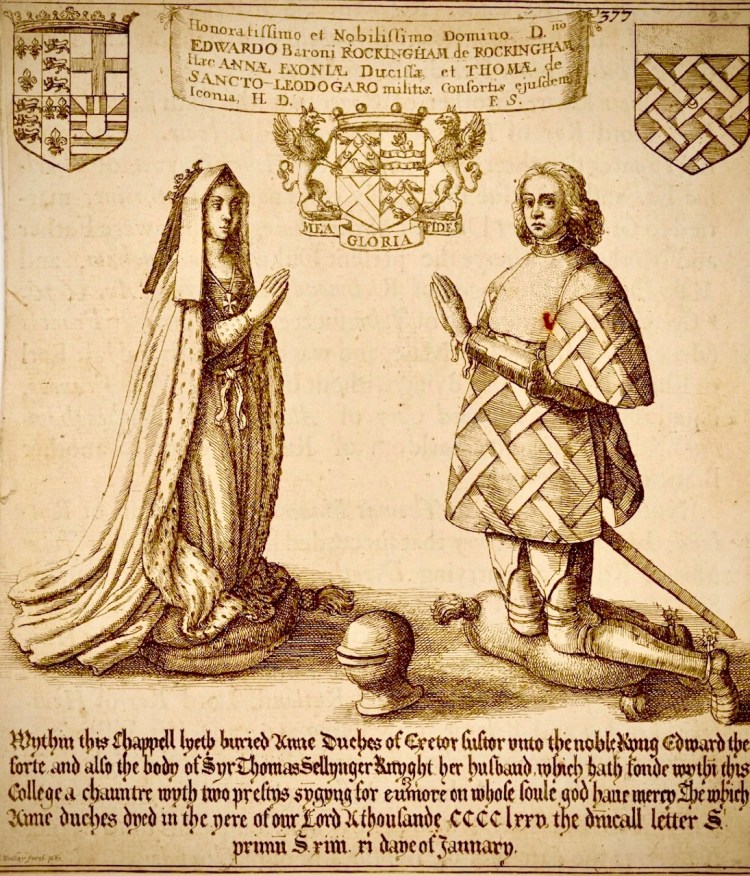
Wythin thys Chappell lyethe beryed Anne Duchess of Exetur suster unto the noble kyng Edward the forte. And also the body of syr Thomas Sellynger knyght her husband which hathe funde within thys College a Chauntre with too prestys sy’gyng for eu’more. On whose soule god haue mercy. The wych Anne duchess dyed in the yere of oure lorde M Thowsande CCCCl xxv.
Anne Duchess of Exeter and Sir Thomas St Ledger. Etching of the memorial brass in the Rutland Chapel, St George’s Chapel. Wenceslaus Holler 1667. National Portrait Gallery.
Anne of York (1439-1476) was born at Fotheringhay Castle on the 10 August 1439, the first born child of her parents, Richard Duke of York and Cicely Neville after what one chronicler described as a ‘tyme of longe bareyness’. (1). However from then on the York family nursery would go on to burgeon and she would eventually have eleven siblings, six of which, plus herself, would make it to adulthood. These siblings would eventually go on to become two kings, one earl, one duke and various duchesses. The various histories of these siblings have been described elsewhere and I won’t go into them here except a mention of Anne’s pivotal role, with other female members of her family, to bring George Duke of Clarence back into the fold after he had rebelled against his brother Edward IV in 1471.
‘By right covert wayes and meanes were goode mediators, and mediatricis, the highe and myghty princis my Lady, theyr mothar; my lady of Exceter, my lady of Southfolke, theyre systars; my Lord Cardinall of Cantorbery; my Lord of Bathe; my Lord of Essex; and moste specially, my Lady of Bourgoigne…’ (2).
The ties that bind were clearly at play here.
But we have come too far here and must backtrack to the 30 January 1446 when Anne then aged six would marry the fifteen year old Henry Holland (1430 -1475) in the Bishop of Ely’s Chapel in Hertfordshire (3). Henry was born in the Tower of London on the 27th June 1430… ah the irony. As was customary the small bride then moved into the household of the groom’s parents. Thus John Holland, Duke of Exeter (1395-1447) became Anne’s guardian. It was probably an indication of the esteem that John Holland was held in that persuaded Richard Duke of York to pay 4500 marks for the marriage although of course Henry’s close connections to the House of Lancaster – a very close relative to Henry VI who was later to dangerously wander in and out of severe mental illness – would also have been another strong motive. Whatever the reasoning Richard coughed up 1500 marks on the wedding day followed by 1000 marks annually thereafter. Henry’s wedding clothes were financed by his father but the rest of the costs of the wedding were covered by the bride’s father. However John Holland was to maintain the couple until Henry’s 20th birthday. These plans went awry upon Exeter’s death the following year whereupon the king granted York ‘the keeping of Henry, son and heir of John, duke of Exeter, from the said John’s death’ (4). It’s therefore fairly safe to assume that both Henry and Anne – now Duke and Duchess of Exeter – from then on lived with her parents or in one of their households until they were both deemed old enough to have their own. This should not lead us to conclude that Henry and his father-in-law would go on to enjoy a warm and convivial relationship. Indeed it is difficult to see how Richard of York could warm to a son-in-law whose own father found untrustworthy. Not only did John Holland have concerns regarding his son’s uncertain temper and conduct but there was also the fear that he might attempt to contravene his will (5). It’s likely that Anne found herself between a rock and a hard place as no doubt she tried, with little success, to play the part of peacemaker between her husband and her father.
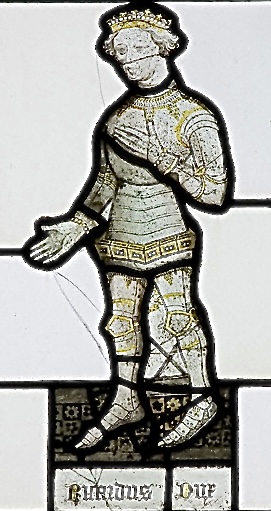
Anne’s father Richard Duke of York. Contemporary image from stained glass window at Trinity College, Cambridge.
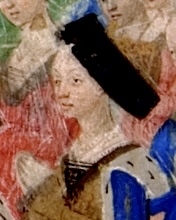
Anne’s mother – Cicely Neville from the Luton Guild Book.
They would have one daughter, Anne Holland (c.1455-1474) who would be contracted to marry George Neville, infant son of John Neville, Earl of Northumberland, and who was male hair to Richard Neville, Earl of Warwick later known as the Kingmaker. However the Duchess was persuaded by Queen Elizabeth Wydeville to renege on that agreement and instead consent to her young daughter marrying Thomas Grey later Marquis of Dorset, the Queen’s son by her first marriage. This marriage ,which would be childless, took place in October 1466 but sadly Anne Holland was dead by February 1474.
Long before the death of their daughter Anne and Henry – their marriage broken down – had been living separately although the date of separation is unknown. Indeed after the Lancastrian defeat at Towton on the 29 March 1461 Henry had exited England and joined Margaret of Anjou first in Scotland and later in France. He was, of course, attainted and Anne, by 1462, was granted her husband’s goods and his ‘whole Exeter inheritance for life, Rochford and lands in Exeter, Hadleigh and Essex with a regrant of August 1467 giving the remainder to their daughter Anne Holland’ (here becomes clear Elizabeth Wydeville’s eagerness to gain the young Anne Holland for her son). Anne initiated divorce proceedings on the 18 January 1471 when her husband was exiled and out of the country. In his thesis on the Holland family Dr Michael Stansfield writes ‘she may well have been fearful of her husband’s imminent return and his repossession of his estates; divorced, he would have no automatic hold over them. She was reafferming her Yorkist loyalties and her abhorrence of the Lancastrian cause her husband so fervently represented. A personal reversion to such an unamiable character as Henry must however also have been a major factor in Anne’s attempts to avoid being reunited with her husband (6).
THE ‘DIVORCE’
As a result of the Canon Laws of the times Medieval divorce was only allowed in very rare circumstances and even then not as we know it today. For example getting a divorce did not allow the divorced couple to make second marriages. So how did Anne manage to divorce her husband – no mean feat in those times? She went down the road of consanguinity which meant the marriage was annulled rather than a divorce taking place. In other words the marriage had never existed. As historian J L Laynesmith explains Anne’s ‘divorce’ from Essex ‘hinged on the absence of adequate papal dispensation as was usually the case in noble divorce suits. Unsurprisingly it was eventually accepted that the dispensation provided at the time only covered her kinship to Henry Holland through her father. The couple were, of course, even more closely related through Cecily, since both were descended from John of Gaunt, and on these grounds Anne’s marriage was deemed never to have been valid (7).
Dr Stansfield describes the process of this annulment in great detail: ‘After the initial appointment of proctors in the duke of Clarence’s London house, little progress was made in the divorce whilst Edward IV regained his kingdom. June 1471 saw the case begin in earnest, with Henry Holland now a prisoner in the Tower. Despite the impotence of his position, the case was to be no formality. Henry was summoned to appear at Lambeth on 19 June, where he found his old associate Hugn Payn amongst those present. The grounds for divorce were consanguinity in the fourth and fifth degrees, which required positive confirmation by several witnesses. Nine,eight men and one woman, were examined on behalf of Anne. Each witness was asked the same set of questions to find out how long they had known the two parties, The examination of Anne’s witnesses had begun in July, with a break for August and September, and was completed in October.
Henry was only allowed to call four witnesses, their examination being completed by 2 August. His witnesses, all men, were asked the same series of questions as Anne’s. Their replies stressed the legality of the papal dispensation and gave valuable details of the marriage ceremony conducted by Caudray, including the actual vows made by Henry and Anne. However, the archbishop of Canterbury pronounced the marriage annulled in November 1471 on the grounds of consanguinity, leaving Anne free to carry Henry’s estates to her new husband SirThomas St.Leger‘ (8).
Perhaps the crux of the matter was that she was basically Yorkist and he Lancastrian which were quite large hurdles to circumnavigate. Casting that aside it must have been extremely difficult to feel warm and fuzzy towards the man who had played a role in the death of your father and younger brother which is indeed what took place at the battle of Wakefield on the 30 December 1460 where Anne’s father Richard of York and brother Edmund, Earl of Rutland, were both slain. Henry has beed described as ‘among those who had most vigorously resisted her rebel family’. He appears to have been a disagreeable character prone to acting with ‘unreasoning impetuosity’, untrusted by his peers and ‘even in such a violent age, his violence was ill-timed and excessive’ and whose actions ‘have left historians barely able to consider him as a serious political figure’. I could go on but you get my drift?….
The reverse can be said of Anne who has been described ‘as having a careful apolitical approach like her mothers which similarly allowed her to weather the immediate storms’ Thus In June 1460 when a group of Lancastrians, including Thomas Lord Scales, took refuge in the Tower of London, where her husband was Constable, she was able to provide a refuge for them from her brother, Edward without any consequences (9).
After the shenanigans of the divorce had died down Henry still remained in the Tower until c. May 1475 when somehow or other we find him serving on Edward IV’s 1475 expedition to France. It has been suggested that he had ‘volunteered’. Unfortunately for him – still considered a major Lancastrian threat – this involved a journey by sea. When you read this you immediately know ’tis not going to end well. It was on the return journey that Henry ‘fell’ overboard and drowned. Perhaps accidentally on purpose as they say. The chronicler Fabyan opined superfluously ‘but how he drowned, the certainty is not known‘ (10). His body was discovered on a beach near Dover or in the sea between Dover and Calais depending on what version of events you are reading. Rumour on the Continent had it that the sailors on board his ship had been given express orders by the king to chuck him into the briny. Well it made a change from the barrel of Malmsey I suppose. The Duchess of Exeter sadly only survived her ex-husband by a year.
Here we again need to backtrack here a little…. Not surprisingly, due to the length of the separation between the warring couple, Anne may have found love and support elsewhere – drumroll – step up Sir Thomas Leger! Possibly the relationship between Anne and Thomas (c.1444-1483) had begun prior to the annulment of her marriage. Thomas seems to have been of a rumbustious nature – or perhaps he was just having a bad day – getting himself into hot water when in 1465 he had a punch-up within the precincts of Westminster Palace. Punching someone’s lights out in the vicinity of the monarch was, obviously, a grave breach of etiquette and seriously frowned upon. John Tiptoft, Constable of England, not a man whose wrong side you wanted to get on having the patience of a bull elephant, sentenced him to having a hand struck off – Yikes! Fortunately the king pardoned his future brother in law. And so, Dear Reader, they were indeed married, at a date unknown to us, but sadly any happiness would be short lived when Anne died on 12 January 1476 at Ulcombe, Kent, a St Leger property, through complications in giving birth to their daughter, Anne St Leger – no doubt named after her mother – who then became the Exeter heir. Thomas never married again and after his wife’s death he would found a beautiful chantry chapel for her then known as the St Leger Chapel but now the Rutland Chapel in St George’s Chapel, Windsor.
The end for Thomas would follow shortly after the death of Edward IV in April 1483. Besides becoming entrenched in Wydville plots – always a bad idea – he planned to marry his daughter, Anne St Leger, to the son of Richard Grey, Elizabeth Wydevilles younger son by Sir John Grey (11). He was captured at Exeter and although ransoms were offered, Richard III was not in a benevolent frame of mind that day, and perhaps particularly miffed by the disloyalty of a troublesome brother in law, saw no reason to issue a pardon on his behalf. Thomas was well and truly hoisted by his own petard and beheaded on or about the 8th November, another victim of the madness of the times later known as the Wars of the Roses. Following on from his execution and attainment and in one of the reversals which so often occurred with the swings and roundabouts of those tumultuous times, his marriage to Anne was denounced in Parliament in 1484. It was said to have been ‘made by sedicious means’ her husband then beyng on lyve’. (12). However both Thomas and Anne were beyond hurt by then and I think it is fitting they should be remembered by their marriage, which although short lived, was probably the happiest of times for both of them. Certainly Thomas did not marry again and in founding a most beautiful Chantry Chapel dedicated to his late wife with ‘too prestys sy’gyng for eu’more ‘ he ensured that she would long remain in peoples remembrance.
THE EXETER INHERITANCE
If you have managed to stay with me up until this point you may be wondering what happened to the Exeter inheritance. Following the deaths of both Anne and her Holland daughter as well as her husband the inheritance was eventually left for Edward IV to dispose off. Of course there was a Wydeville at the receiving end – this goes without saying. Acting in his usual arbitrarily fashion where inheritances were concerned – remember the Mowbray inheritance – Henry Holland’s nearest living relative, Ralph Neville, nephew and heir to the second earl of Westmorland, and Henry’s nephew – was ‘blatantly ignored’. The inheritance was handed to Edward’s younger stepson, Richard Grey and the heir of his elder stepson Thomas Grey. However this injustice was put right when the Greys lost all after their reckless attempt to overthrow Richard III failed miserably and a chunk of the inheritance was given as reward to the Stanleys. After the death of Richard in 1485, Henry VII would give the most of what was left of it to his mother, Margaret Beaufort. And thus ended the once powerful Holland family and inheritance.
Anne and Thomas’ daughter, Anne St Leger would eventually marry George Manners, Lord de Ros of Helmsley. Together they would have a large brood of children…. but that is another story….
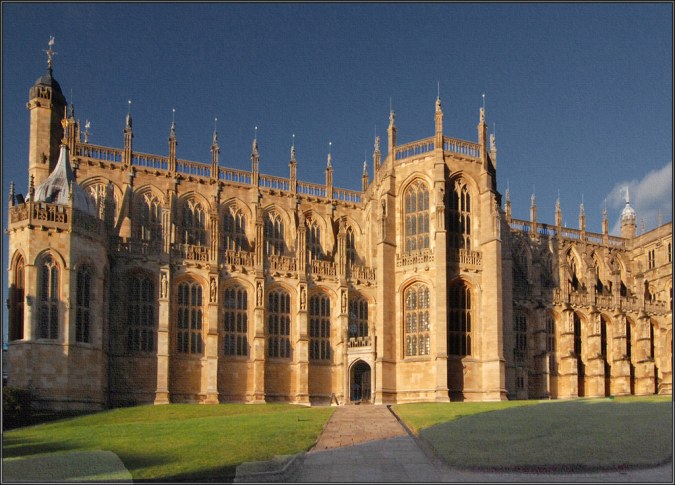
St George’s Chapel, Windsor. Burial place of Edward IV, his sister Anne of York, Duchess of Essex and her husband Sir Thomas St Leger.
1. The Dialogue at the Grave of Dame, Joan of Acre: A poem written by one of the Austin Friars at Clare in Suffolk. With thanks to the late John Ashdown-Hill for this information.
2. The Historie of the Arrival of King Edward IV A.D 1471 p.10. Editor John Bruce. 8 May 1838. 3. Cecily Duchess of York p.49. J L Laynesmith.
4. The Hollands, Dukes of Exeter, Earls of Kent and Huntingdon, 1352-1475 Dr Michael M.N. Stansfield. Corpus Christi College Oxford. Hilary 1987
4. ibid.
5. ibid.
6. ibid.
7. Cecily Duchess of York p.143. J L Laynesmith.
8. The Hollands, Dukes of Exeter, Earls of Kent and Huntingdon, 1352-1475 Dr Michael M.N. Stansfield. Corpus Christi College Oxford. Hilary 1987
9. Cecily Duchess of York p.143. J L Laynesmith
10. Robert Fabyan. The new chronicles of England and France, in two parts, p. 66
11. Richard III p.280. Paul Murray Kendall
13. Memorials of the Wars of the Roses p.18. W E Hampton.
If you enjoyed this post you might also like:
Marriage in Medieval London And Extricating Oneself Only You Couldnt;
THE SIX SISTERS OF WARWICK THE KINGMAKER
CECILIA BONVILLE, MARCHIONESS OF DORSET c.1460-1529; AN INTERESTING LIFE
CICELY PLANTAGENET; NOT SO FORTUNATE AS FAIR.
 A MEDIEVAL POTPOURRI
2 thoughts on “ANNE OF YORK – DUCHESS OF EXETER – SISTER TO EDWARD IV AND RICHARD III”