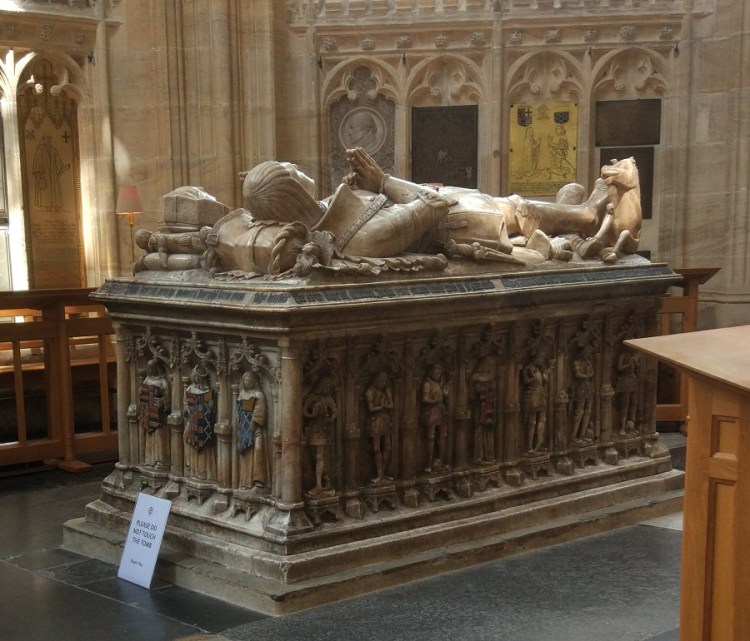
Tomb of Anne St Leger and George Manners, 11th Baron de Ros of Helmsley. Note the brass plaque in the background dedicated to her parents, Anne of York and Sir Thomas St Leger. Photo with thanks to humphreysfamilytree.com
‘Here lyethe buryede George Maners knyght lord roos who decesede/ the xxiii daye of October In the yere of our lorde god Mi Vc xiii and ladye Anne his wyfe dawghter of anne duchesse of exetur Suster unto/ kyng Edward the fourthe and of Thomas Sentlynger knight/ the wyche anne decessed the xxii day of apryll In the yere of our lorde god MiVc xxvi on whose souls god haue mercy amen’
Because there are several Annes – as well as a couple of Thomas’ mentioned in this post, I will in the interests of lucidity refer to them by their surnames throughout.
Anne St Leger (1475-1526) was the daughter of Anne of York (1439-1476) and Sir Thomas Leger (c.1444-1483) thus she was niece to two kings – Edward IV and Richard III. Anne St Leger’s mother died, presumably from complications following childbirth, a few weeks after giving life to her daughter at Ulcombe, Kent, one of the St Leger properties while her father would be executed in 1483 after he had rebelled against her uncle, Richard III. The death of her mother meant that she became the Exeter heiress despite her having not a soupçon of Holland blood running through her veins. The crux of this rather irregular situation was that her mother’s first husband was Henry Holland, Duke of Exeter (1430-1475) – an unhappy ‘marriage’ – not surprising when you consider his atrocious reputation. This ‘marriage’ – following a long separation – was eventually annulled which according to the canon law of the time meant that it had never actually existed. Following upon the separation and annulment, in 1462 and 1465, Anne St Leger’s mother was granted the whole of her ex husband’s Exeter inheritance for life, all his goods as well as a slew of properties (1). This was where it paid dividends to have a king as a brother, particularly Edward IV, who had a rather cavalier attitude towards other peoples inheritances. Think the Mowbray inheritance! In 1475 Henry Holland, quelle surprise, came to a sticky end – or rather a wet one – having ended up in the English Channel after managing to fall – somehow – from a ship returning from France. Perhaps we should not be too surprised at this ‘accident’ when we recall that also present on board was none other than Sir Thomas Leger – who it has been speculated was at the time the lover of Anne of York – by then of course, Henry’s ex ‘wife’. Still far be it from me to cast aspersions and as it has been suggested that it was actually Edward IV who had ordered Henry’s death, instructing the sailors to toss him overboard like a piece of old jetsam, it’s probably only fair that the buck should come to stop with him. Thus, it would later transpire, that both of Anne of York’s brothers would be instrumental in passing the death sentence on both of her husbands. Another one of history’s quirky little coincidences.
Anne of York’s first marriage being annulled (rather than merely divorced) had left her free to marry again. Which she did. In what was without question a love match she and Thomas St Leger were promptly married, unsurprising, when as mentioned above, they are believed to have been lovers prior to her marriage being declared void. Anne and Thomas would become parents to a daughter whom they named Anne and who this story is about. Confusingly this was Anne of York’s second daughter named Anne. Her first daughter, Anne Holland, had been fathered by Henry Holland and had recently died aged about 18. Anne Holland had been married to Thomas Grey, Marquis of Dorset, Queen Elizabeth Wydeville’s elder son by her first marriage. I will return to this point below.
Sadly the marriage of Anne of York and Thomas St Leger was but of short duration when in January 1476 she followed her ex husband, Henry Holland, to the grave just a few months after his rather convenient watery and presumably unlamented death. The infant Anne St Legar, following the death of her mother, became the Exeter heir despite, as mentioned above, completely lacking a blood line to the Dukes of Exeter and riding roughshod over the rights of the true heir, Ralph Neville, later third earl of Westmorland (2). Later Thomas St Leger would plan to marry his young daughter to Queen Elizabeth’s Wydeville’s grandson, the son of the Thomas Grey, Marquis of Dorset, mentioned above, who had been married to her deceased half sister, Anne Holland (3). Please keep up at the back Dear Reader….. Anyway…. in 1483 possibly in preparation for this proposed marriage the Exeter inheritance was divided by an Act of Parliament between Queen Elizabeth Wydeville’s (yes! her again) younger son by her first marriage, Richard Grey, and the rest to Anne St Leger who was, remember, about to become a Wydeville bride – a win win situation for the rapacious queen and her equally voracious family (4).
These plans were rudely interrupted in 1483 by the unexpected and inconvenient death of Edward IV. Thomas Grey after a short stint in sanctuary wisely made a swift exit from England legging it over to Brittany to join Henry Tudor. However Thomas St Leger, clearly made of sterner stuff, stayed put and become embroiled in the Buckingham rebellion. The failure of these two enterprises proved to be the death knell for Thomas St Leger and he was executed after he was captured at Exeter in 1483 when a fed up Richard III refused his brother-in-law a pardon. A large chunk of the Exeter inheritance was then passed to the Stanley family and upon the death of Richard III at Bosworth in 1485 yet a further chunk was given by Henry VII to his mother, Margaret Beaufort. And thus the Holland/Exeter inheritance was lost.
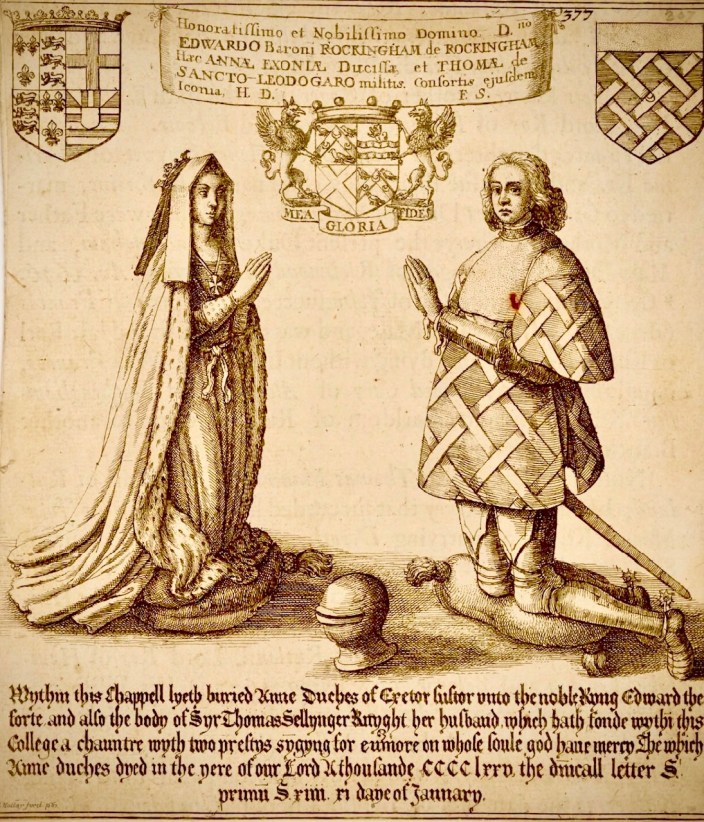
Anne of York and Sir Thomas St Leger. Anne St Leger’s parents. Plaque in the Rutland Chapel, St George’s Chapel, Windsor. This plaque now on a wall would once had been situated on the floor possibly above a burial vault.
However, there was for little Anne St Leger life after lost inheritance, and when she was about 14 she married George Manners 11th Baron de Ros/Roos (c. 1470 – October 1513). George who was born at Etal Castle, Northumberland, came from prestigious stock his parents being Sir Robert Manners and Eleanor de Ros. It’s likely that George and Anne spent the majority of their married life at the magnificent Helmsley Castle in Yorkshire – a property that came to him via his mother’s de Ros holdings. Would it not be gratifying to think that this marriage developed into a happy union after all the machinations of the adults in her life to marry her to suit their various selfish ends? By the time Anne St Leger reached adulthood the turbulence of the period known as the Wars of the Roses had passed. As a result the later adult life of Anne St Leger appears to have not been quite so eventful as that of her mother, perhaps not a bad thing, and little is therefore known about her except she and George would go on to have a large brood of children.
However tempus fugit and George would fight in the French campaign of 1513 with fatal results. Depending on what version of events you read he may have died at Toutney in France either of wounds received at sometime during the siege of Tournai or succumbed to the dysentery that according to Edward Hall’s Chronicle cut a swathe through the English ranks.
According to another version George managed to return to England before he finally succumbed and was buried at Shoreditch – then in Middlesex but now in London. Whichever version is correct George must have certainly been buried in England because in the fullness of time his body would be disinterred and taken to St George’s Chapel, Windsor, where he would be reburied next to Anne following her death in April 1526 His will written on the 26 October 1513 had requested that ‘my body to be buried next unto the place where I shall happen to die, or elsewhere, at the discretion of my executors’ (5).
Today their effigies lie on top of their wonderful alabaster monument in the Rutland Chantry Chapel – formerly known as the St Leger Chapel founded by Sir Thomas St Leger in memory of his wife Anne of York. George’s feet rest on a rather perky looking unicorn, now missing his horn but still, nonetheless, incorrigibly cheerful, peering around at his master whose helm is adorned by a peacock. Either side of Anne’s feet are two pudgy little dogs – signifying faithfulness – their collars are adorned by bells – both who are playfully chewing on their mistress’s mantle (6). Click here to read more about the chapel.
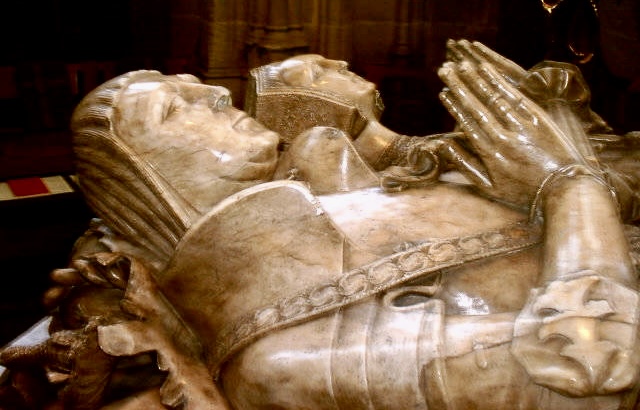
George Manners and Anne St Leger’s effigies atop their monument. English alabaster. The Rutland Chapel, St Georges Chapel, Windsor. Photo Lady Shirley@Flikr.
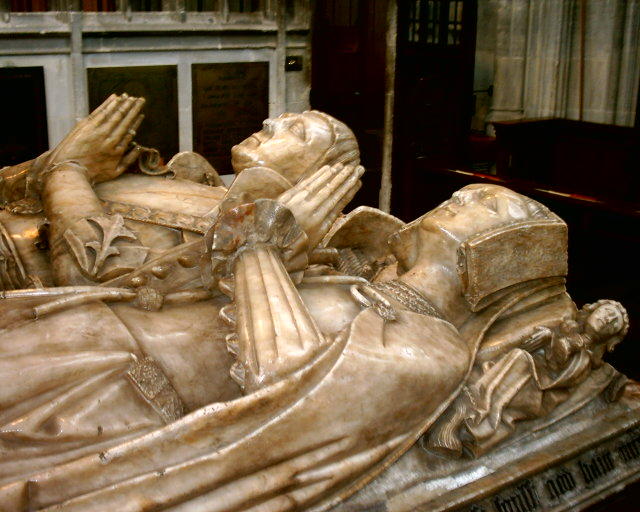
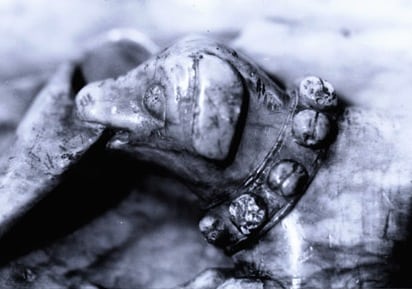
One of the little dogs nestling at Anne’s feet, his collar adorned with bells, chews upon his mistress’s mantle. Photo stgeorges-windsor.

Glorious St Georges Chapel, Windsor. Anne St Ledger, her husband and parents all lie at rest in the Rutland Chapel in the north transcept.
I mentioned at the beginning of this post that Anne St Leger’s later life would appear to have been rather uneventful compared to say that of her mother or aunts. But wait! This is not the end of her story….. It is now thanks to Anne’s descendants, via Catherine, one of her daughters, that the remains of Richard III have been identified.
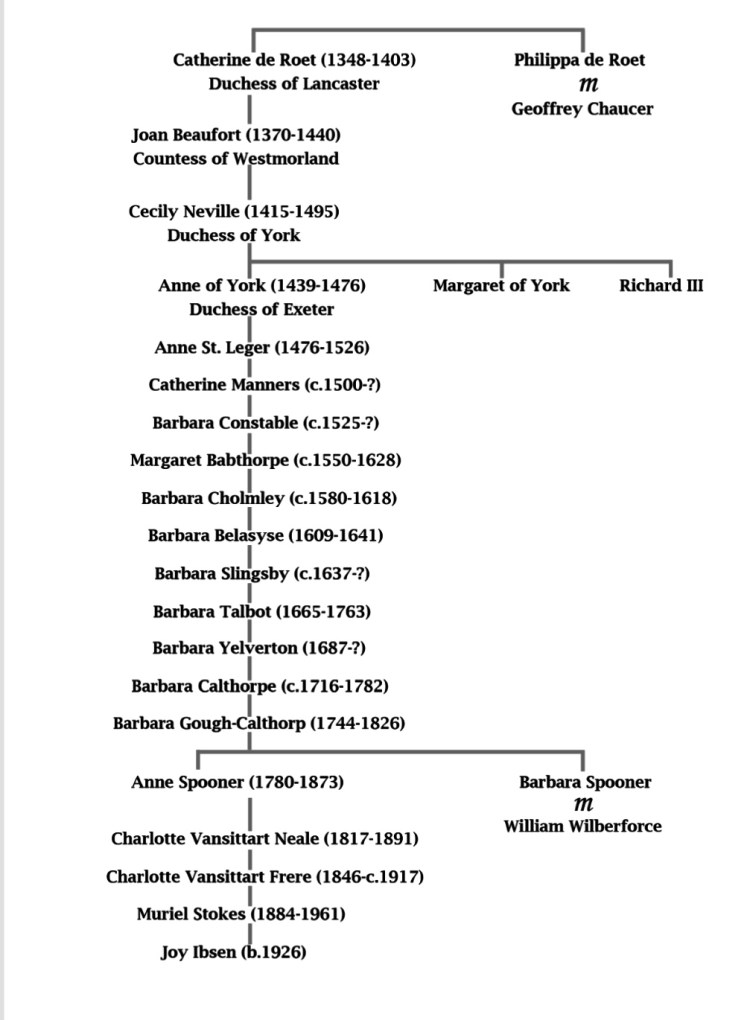
In 2004 the late John Ashdown-Hill painstakingly tracked down Anne’s thirteenth great grand-daughter Joy Ibsen – who was astonished to learn about her illustrious bloodline. The discovery would enable the perfect mitochondrial DNA match to be made between Richard III and Mrs Ibsen and would be vital in identifying the king’s remains found at Leicester in 2012 on the site of the Grey Friars friary. You can read more about the DNA analyses of both the skeletal remains and living relatives of Richard III here.
Anne and George according to what source you are reading had between 8-11 children. Below are the eight listed on peerage.com including last but not least Catherine, the daughter mentioned above, who played such an important role in the tracing of Richard III’s DNA.
Eleanor Manners d. c 13 Sep 1547
Sir Richard Manners d. 1551
Thomas Manners, 1st Earl of Rutland b. b 1492, d. 20 Sep 1543
Hon. Catherine Manners b. 1511, d. a 1547.
- Holland, Henry, second Duke of Esssex, (1430-14750 Michael Hicks. ODNB
- Ibid.
- Ibid.
- The Hollands, Dukes of Exeter, Earls of Kent and Huntingdon, 1352-1475 Michael M.N. Stansfield. Corpus Christi College Oxford Hilary 1987
- Testamenta Vetusta Vol.2. P.528.
- The Roos Monument in The Rutland Chantry Chapel. St George’s Chapel website
If you have enjoyed this post you might
Marriage in Medieval London And Extricating Oneself Only You Couldnt;
THE SIX SISTERS OF WARWICK THE KINGMAKER
CECILIA BONVILLE, MARCHIONESS OF DORSET c.1460-1529; AN INTERESTING LIFE
 A MEDIEVAL POTPOURRI
One thought on “ANNE ST LEGER, BARONESS de ROS – NIECE TO EDWARD IV AND RICHARD III”