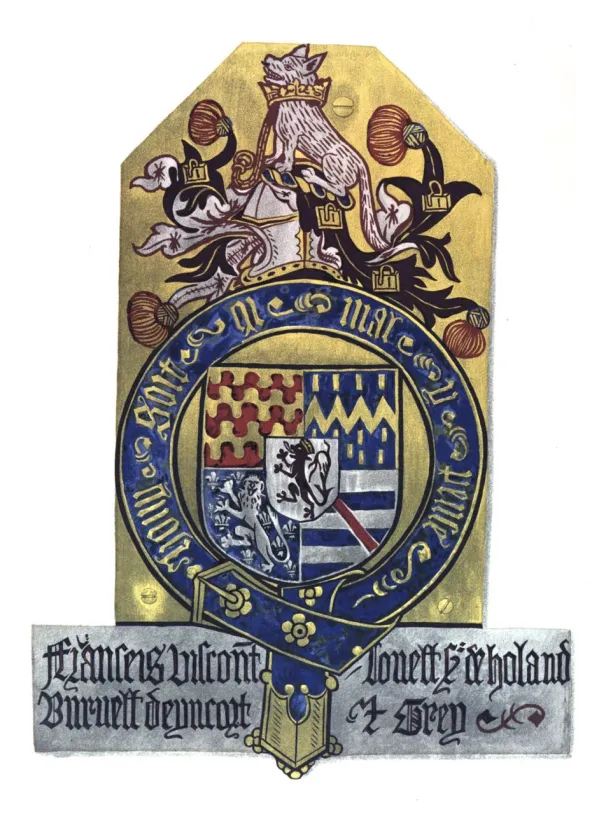
Francis Viscount Lovell’s Stall Plate, St Georges Chapel, Windsor. Image thanks to the Heraldry Society: ‘Francis Viscount Lovell & de holand Burnett deynccort & Grey.’ Note also the silver fox and the mantling strewn with another Lovell badge, padlocks.
Another of the enduring mysteries from the period now known as the Wars of the Roses – the predominant being, of course, the disappearance of the ‘Missing Princes’ – was the fate of Francis Viscount Lovell (b.c.1456 d.after 1488). He appears to have disappeared, literally, into the mists of time last seen – it said – escaping the aftermath of the Battle of Stoke (16 June 1487) swimming away on his horse across the river Trent? Maybe, maybe…. We will return to this later…
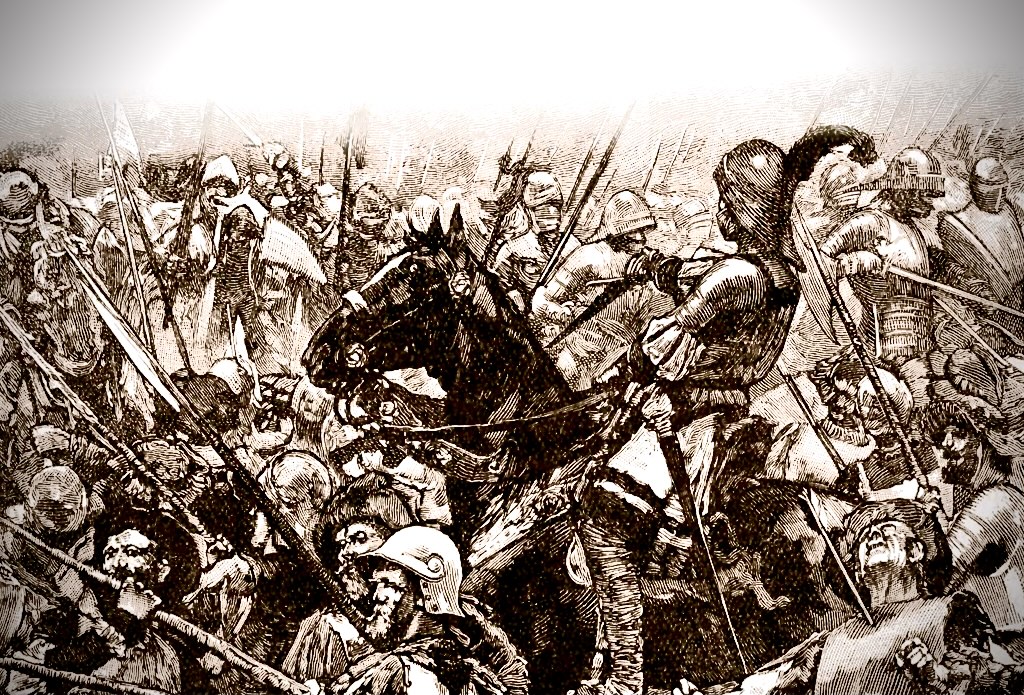
The Last Stand of Martin Schwartz and his German Mercenaries at the Battle of Stoke Field 16th June 1487. Artist Henry Marriot Paget. Cassell’s Century Edition History of England c.1901.
Francis Lovell is credited with being best and most loyal friend to Richard III, a friendship which begun when they were both still children at Middleham Castle, Yorkshire, under the care of Richard Neville, earl of Warwick. Francis, in terms of a 15th century nobleman, has come down to us as a ‘good egg’.
Lovell is beloved amongst Ricardians and a favourite character in Ricardian novels. Who can forget the evocative description left to us by the late Rosemary Hawley Jarman who in her outstanding novel We Speak No Treason painted an emotive picture of Lovell and other followers of Richard’s bidding last farewells to their dead king after Bosworth. Francis is described as wearing a hermit’s robe carelessly donned, with the strength of his mail winking beneath it. They say that the church filled up from porch to rood screen with men who entered like ghosts and wept like babes. There was running feet and a voice that burst through the whispering silence with ‘My lord, my Lord Lovell!’ – crying that they were hanging the prisoners and fugitives in Leicester market and Lovell must fly at once and for answer came only the deep dreadful sound of mens grief. The hasty feet clattered nearer and nearer, and stopped short, the voice said ‘Ah Dickon!’ as a child might wail in the night, then swore like a man in the face of murder and the church was filled with love and hate and vengeance and a heaviness that one could touch with the hand’. Ah! fabulous stuff but back to reality….!
However a contemporary of Francis, William Colynbourne/Collingbourne, was less than respectful, referring to him as ‘Lovell the dogge‘ perhaps with a nod to his loyalty to Richard or even a reference to the silver fox emblem of the Lovell family. The now infamous rhyme, which he audaciously pinned upon a doorway at old St Paul’s Cathedral on the 18 July 1484 read:
The Catte, the Ratte and Lovel our dogge
Ruleth all Englande under a Hogge
Colynbourne had his own personal axe to grind possibly having copped the needle following Richard writing to his mother, Cicely Neville, on the 3 June 1484, requesting that she replace her man Colynbourne, with his man, Lovell: ‘my lord Chamberlaine..be your officer in Wiltshire in such as Colynborne had...’ Colyngbourne, was later to get the chop, or hung drawn and quartered to be precise, under a charge of treason for another matter, although I should imagine the rhyme was well and truly burnt into everyones memories present at his trial. But I have galloped too far forward here….
FAMILY
Francis descended from a wealthy high status family traceable back to Robert d’Ivry, Lord of Breheval/Breherval/Bréval and Yvery/Ivry-la-Bataille, Normandy. One account records Robert as having accompanied William the Conqueror to England in 1066 and he is indeed listed on the Roll of Battle Abbey. Whether he arrived in 1066 or later he was rewarded by the Conqueror with the lordships of Kary/Cary and Herpetreu/Harptree in Somerset but returned to Normandy where overtaken by ill health he retired to the Abbey of Bec and became a monk (1).
One of Robert’s sons, Ascelin Goël, acquired the nickname of ‘Lupus’ – latin for wolf – because of his violent temper while his son went by the epithet of ‘Lupulus’ – wolf cub – which in time morphed to Lupel and then to ‘Lovell’. Indeed the Lovell family emblem is a silver wolf with a nod to their tetchy ancestor. Here is a link to more information about Francis Lovell’s Norman ancestry also an interesting book detailing the genealogy of the Lovell family
Moving on to 1252, Robert’s descendant, John Lovell, succeeded to the family estates in Norfolk, Suffolk, Oxfordshire and Wiltshire. John married a wealthy heiress, Maude de Sydenham, heiress of Sir William de Sydenham, gaining himself the Lordship of Titchmarsh, Northamptonshire, in the process. John’s successor was another John who served Edward I in Wales in 1277. This John was summoned to Parliament and became the first Lord Lovell. His son, yet another John, 2nd Baron Lovell (d.1314), married Maude Burnell, sister and heiress of Edward Lord Burnell. Both John and Edward fought at Bannockburn which John did not survive. Maude’s father was Sir Philip Burnell of Acton and her mother was Maude sister of Richard Fitzalan earl of Arundel.
John, 3rd Baron Lovell – I hope you are keeping up at the back dear reader – having never been summoned to Parliament was never technically a lord. Still, he was a close friend and companion of Edward III, fighting at Crécy and the siege of Calais. Dying in somewhat mysterious circumstances in 1347 it has been suggested that he may have been murdered (2). He was succeeded by John Lovell, 4th Baron of Titchmarsh, who died a minor c.1361
The fifth baron, yet another John (d.1408)) married yet another Maude (d.1423) who was yet another heiress being the daughter of Robert de Holand/Holland. In 1391 this John Lovell would be found taking proceedings ‘against evil doers who had prevented him from reaching his house at Minsterlovell’ (3).
In 1408 the inheritance passed to the eldest son, another John (obviously) the 6th lord Baron (d.1414) who married Alianore/Eleanor la Zouch (1367-1429) the daughter of William la Zouch. This John was succeeded by his son William, 7th Baron (d.1455) who married Alice Deincourt (b.c.1403-d.c.1473) widow of Ralph Butler/Boteler of Sudeley. Interestingly Ralph Butler was the father-in-law of Eleanor Butler née Talbot, who would prove to be the rock that the House of York would later founder upon. It is to William that we owe the building of the beautiful second Minster Lovell Hall upon the site of the earlier ruinous one. I now need a lie down in a darkened room.
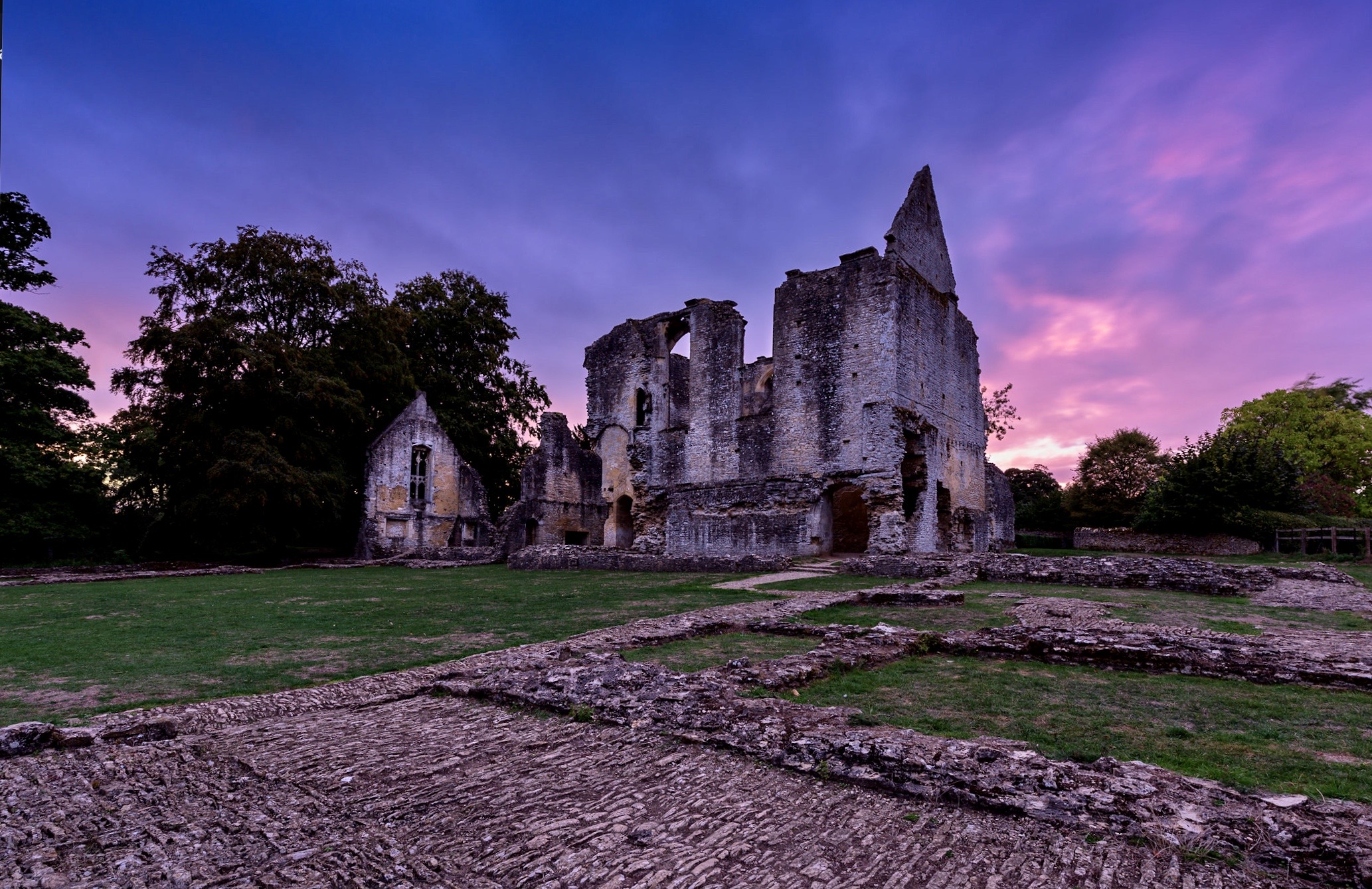
The enchanting and enigmatic ruins of Minster Lovell, Oxfordshire standing on the banks of the River Windrush. Rebuilt by Francis’s grandfather William Lovell and later home to Francis and his wife Anne. King Richard III stayed here during his Royal Progress in 1483. Photo with thanks to Colin Whitaker.
William’s son, John 8th Baron (1432-1465) married Joan Beaumont and it was they who would go on to become the parents of Francis. Joan’s parents were John Beaumont Ist Viscount Beaumont 1409-1460 – who died fighting for Lancaster at the Battle of Northampton on the 10th July 1460 – and his first wife, Elizabeth Phelip (d.before 1441) daughter of William Phelip, Baron Bardolph. Following Elizabeth’s death, John Beaumont had married Katherine Neville (c.1397-d.1483) – dowager duchess of Norfolk and aunt to Richard Neville earl of Warwick ‘The Kingmaker’ and two kings, Edward IV and Richard III.
Following John Lovell’s death in January 1465 Joan, moving swiftly on, married none other than Sir William Stanley in November of the same year, dying herself on the 5 August 1466 possibly, judging by the timeframe, in childbirth. It would later transpire at the Battle of Bosworth in 1485 that Stanley’s betrayal would play a pivotal role in the defeat and death of Richard III to whom Francis was such a close friend.
CHILDHOOD
As with his death date his date of birth is also unknown but it has been suggested he could have been aged anywhere between seven to nine years old at the time of his father’s death in the Autumn of 1465. Rosemary Horrox believes the younger age more likely given the date he received livery of his lands (4).
Francis joined Warwick’s household around 1465 which probably coincided with the arrival of Richard duke of Gloucester, who was about two years older than him. Following the death of his mother in August 1466 Francis became an extremely valuable orphan.
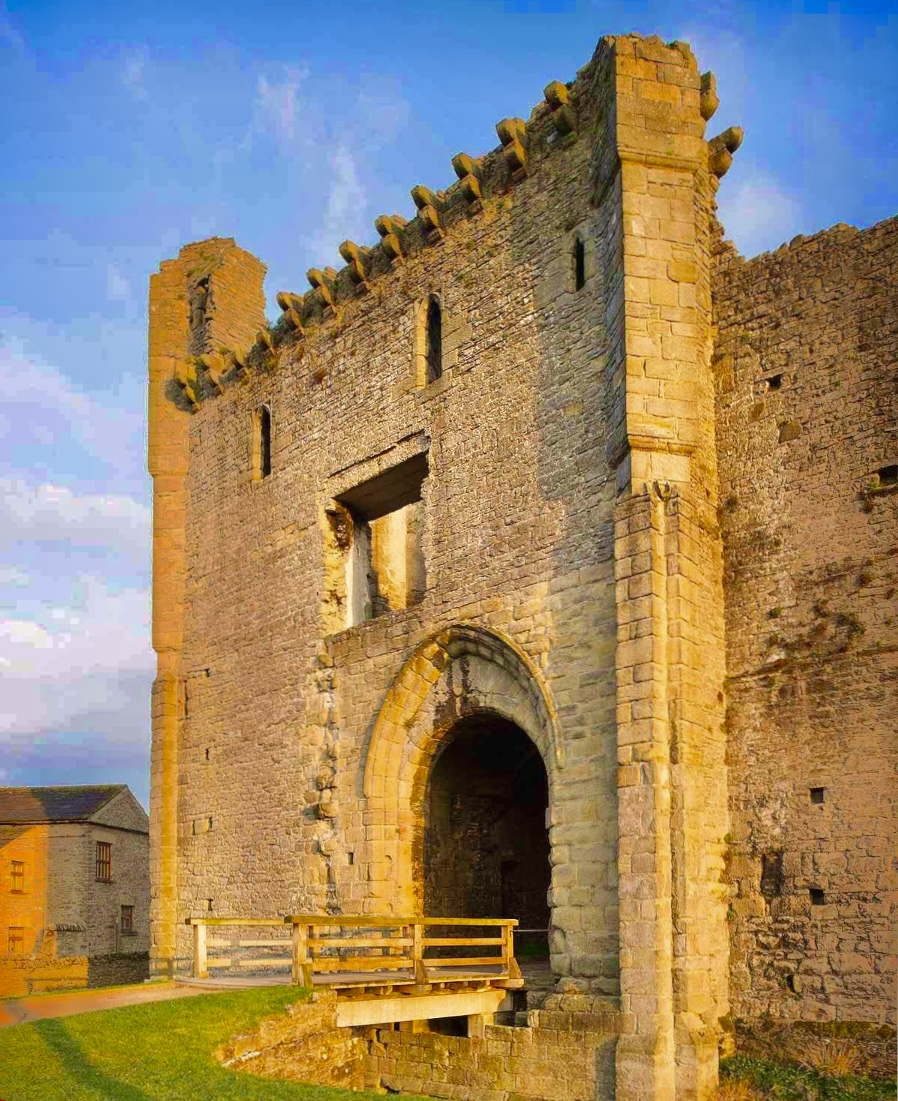
The gatehouse of Middleham Castle, north east tower. Created c.1400. Photo thanks to english-heritage.org.uk
By the time his wardship and lands were granted to Richard Neville, earl of Warwick – later known as the Kingmaker – on the 13 November 1467, Francis had already been married for about a year to Warwick’s niece, Anne Fitzhugh, the daughter of Henry, Lord Fitzhugh (1429-1472) of Ravensworth and Alice, daughter of Richard Neville, earl of Salisbury (1400-1460) and Alice Montague (c.1406–1462).
Francis’ maternal grandfather, John, Viscount Beaumont, had fallen at the battle of Northampton fought on the 10 July 1460. It’s likely that his widow, the formidable Katherine Neville, dowager Duchess of Norfolk and Viscountess Beaumont, thus stepmother to his daughter, Joan, Francis’ mother, was influential in getting the small boy placed in Warwick’s household. Katherine was one of the wealthiest and influential women in England with close familial links to the two most powerful men in the realm, aunt to both Warwick and Edward IV, and it’s reasonable to surmise that she would have felt responsible for the wellbeing of both her stepdaughter and step-grandson. The placing together of Francis and the slightly older Richard duke of Gloucester led to a burgeoning friendship that was to endure throughout their lives.
Young Francis was both royal ward and convenient source of income until he reached his majority. During his sojourn in the Warwick household this income from the massive Lovell estates was utilised to cover Richard’s heavy expenses in Warwick’s household via a grant of £1000 per annum. By the bestowal of this enormous grant to Warwick Edward IV was able ‘to ensure that his brother was lavishly maintained as behoved his status while transferring the cost of this to somebody else – in this case the young Francis Lovell. The grant also enabled Warwick to enjoy the reflective glory of bringing up his royal cousin as well as discharging a chivalric obligation to both his king and a kinsman at no expense to himself. Needless to say neither the young Francis nor his mother Joan appeared to have had say in the matter’ . Furthermore ‘for Edward this had the advantage of solving the problem of his brother’s upbringing and education at a suitably prestigious household with no financial burden for him to shoulder. This would certainly appear to be in keeping with what we know about Edward IV’s character in his predilection for finding the easiest option and for playing fast and loose legally with vulnerable inheritances’ (5).
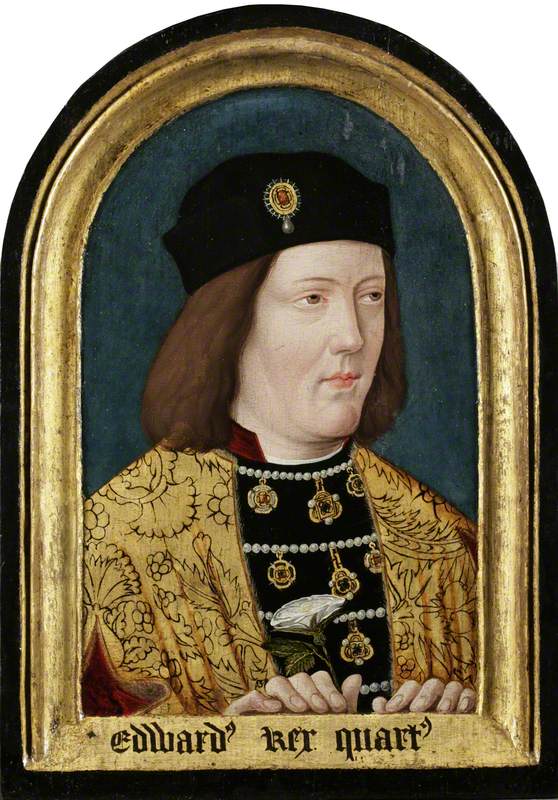
Although Warwick was in receipt of the £1,000 per annum from the rental income of the Lovell estates for the upkeep of Richard of Gloucester he was not given the wardship of Francis and his estates until 1467. This arrangement would continue until the relationship between Edward and Warwick faltered – through a combination of factors – and then broke down irretrievably in 1469-70 with Richard, then aged 16, having been removed by early 1469. This situation after various twists and turns which – are well documented elsewhere – culminated in Warwick’s death at Barnet on the 14th April 1471. In one of history’s twists Richard of Gloucester, then aged 18, was present that day. It is not known what his thoughts were on seeing the corpse of the man who had played such an influential role in his life but he did go on to marry Warwick’s daughter, Anne, who had also shared part of her childhood with both Gloucester and Lovell. But I’ve wandered off onto a tangent here…
Following Warwick’s death at Barnet, Francis’ wardship was granted on 11 July 1471 to the king’s brother-in-law John de la Pole, duke of Suffolk. This would have been where he made the acquaintance of Suffolk’s son, John later earl of Lincoln, yet another friendship that was to endure down the years until disaster and tragedy overtook them all.
MARRIAGE
By the time the wardship and custody of Francis and control of his lands were granted on 13 November 1467 to Richard Neville, earl of Warwick, he had been already been married to Warwick’s niece, Anne Fitzhugh , aged about five, the daughter of Henry, Lord Fitzhugh of Ravensworth, North Yorkshire, and Warwick’s sister Alice, since 1466. Henry Fitzhugh, was a long standing Neville ally – having supported the Earl of Salisbury in the 1450s – and Warwick’s deputy on the West March in 1466. He followed Warwick into rebellion in 1469–70 later being pardoned as were Francis and Anne Lovell by Edward IV in 10 September 1471. Henry died on the 8 June 1472 (6).
Just prior to Warwick’s death at Barnet in 1471 Francis may have been living with Anne’s family at Ravensworth Castle, Yorkshire as he and the Fitzhugh family were all jointly included in the September 1471 pardon. As was the custom of the times, Francis and Anne would have begun living together as a married couple when she attained the age of about 16, perhaps even a little earlier. We do know that they were certainly living together by early 1477 because a letter written by Dame Elizabeth Stonor to her husband, Sir William Stonor on the 6 March of that year mentions that she had sent tokens, i.e. gifts, to both Francis and Anne as Sir William had instructed her to do:
And Syr, I have sent my lorde Lovell a tokyn and my ladys, as ye comaunde me to do, schache as schalle plese them…. (7). Unsurprisingly not a lot is known about their marriage but later events would lead to the conclusion that their union would develop into a love match. We will return to this later…
BECOMING LORD LOVELL
On the II July 1471 the wardship of Francis and his estates were granted jointly to the king’s brother-in-law, John de la Pole, duke of Suffolk and his wife Elizabeth, sister to Edward IV, to be held during his minority although the king, bearing in mind the future death of the ageing Alice Deincourt, Francis’ aunt, exempted any lands which might come to Francis in the future – which is precisely what happened with the death of the said Alice in 1474.
Finally on the 6 November 1477 ‘Francis became Lord Lovell, possessor of the largest estate below that of an earl in England, one of the twelve richest peers in England and possessor of a wide inheritance stretching from Oxfordshire to Yorkshire and from Essex to Shropshire. Lovell now received a summons to Parliament indicating that his minority was over and he now had become a man of estate and, as such, able to play a role in the affairs of state’ (8).
Once again Francis joined the orbit of Richard duke of Gloucester, being knighted by the duke at Berwick on the 22 August 1481 during the Scottish campaign which was upgraded to Viscount in January 1483. No doubt they were bonded by joint memories of childhood years spent together. Their childhoods had borne some similarity in parts, a mix of extraordinary privilege, the loss of one or both parents at a young age and times that must have been both confusing and stressful witnessing how great men could also fall as well as rise.
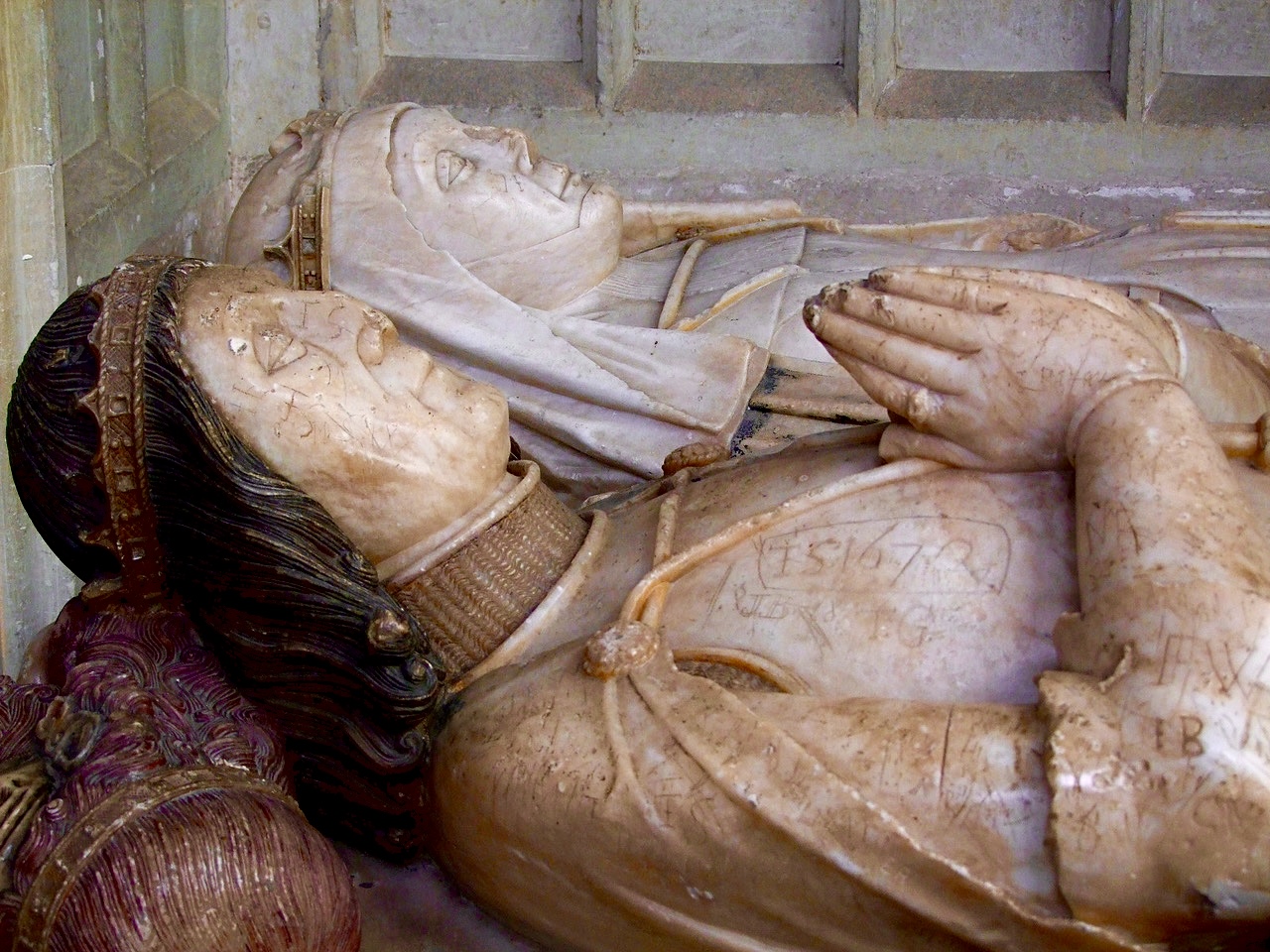
The alabaster effigies of John de la Pole and his wife, Elizabeth Plantagenet, parents of John de la Pole, earl of Lincoln. Wingfield Church, Suffolk. Elizabeth was sister to Edward IV and Richard III.
LIFE AS THE KING’S FRIEND
When Richard of Gloucester became King Richard III on the 6th July 1483 things took another upward turn for Francis. Both he and his wife would play important roles at Richard’s coronation, with Francis carrying the Sword of Justice to the Temporality which was carried unsheathed and pointing upwards during the coronation procession. Prior to this, possibly in his capacity as Chamberlaine of the King’s household, he had been charged with the task of finding a suitable riche rynge for Anne Neville, Richard’s wife and soon to be queen, which after being blessed by an archbishop would be placed upon the fourth finger of her right hand at the moment of her crowning. We know this because in the margin of the Little Device for the coronation of Richard III a note was made: Remembre A Ryng that Lovell shall ordeyne for (9). Anne was of course the daughter of Richard Neville earl of Warwick and all three would have shared memories of their childhood days at Middleham and the great Kingmaker.
Anne lady Lovell also had a significant role to play in the crowning of her cousin, Queen Anne, being allocated viij yerdes scarlet for a coronation robe as well as two gowns, one a longe gowne maade of vj yerdes of blue velvet purfiled (i.e. bordered) with v yerdes and quarter of crymysyn satyn and the other a long gowne maade of vij yerdes of crymysyn velvet and purfiled with v yerdes and j quarter of white damask…(10).
It must have seemed the perfect day for the couple with Francis’ life now even more on the up and up, concluding with a magnificent banquet. The banquet lasted longer into the summer evening than it should have, breaking up by torch light,. Apparently the third course was never served because Richard talked so much. It was the end of an unforgettable day and as the guests departed ‘wher yt lyked them best‘ they would have noticed the conduit in Westminster Yard had been filled with a tun of red wine.
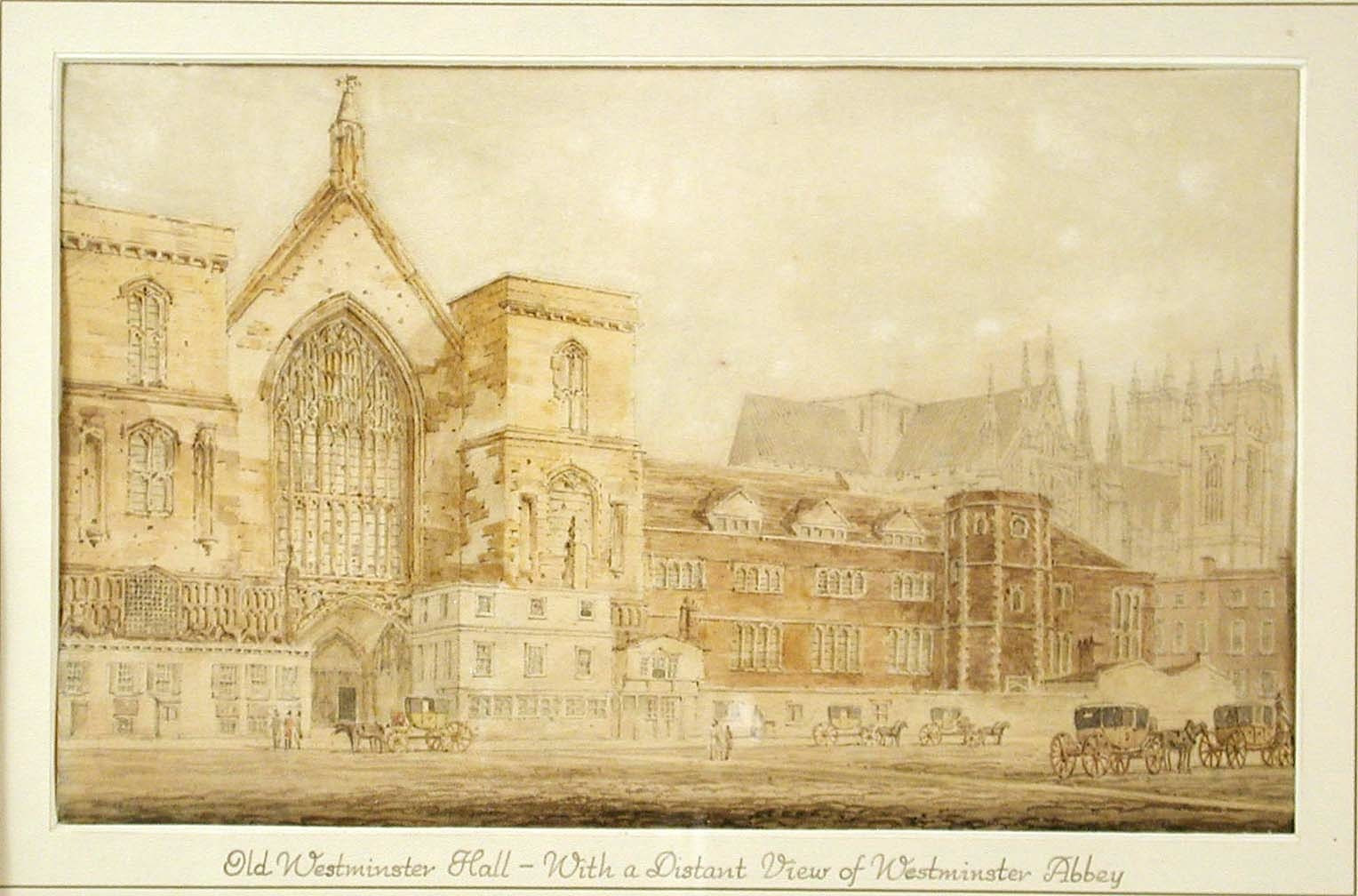
Old print of Westminster Hall venue of the King Richard III and Queen Anne Neville’s Coronation Feast
This seems a good place to leave Francis and Anne on what must have been the most memorable days of their lives.
If you would like to read Part Two of this post you can read it here.
- A Biographical Genealogy of the Lovell Family p.p.17-18. May Lovell Rhodes and T D Rhodes. c.1924.
- Last Champion of York, Francis Lovell. Richard III’s truest Friend. p.15. Stephen David.
- Minster Lovell Hall. p.19. English Heritage. A J Taylor CBE, MA, D Litt formerly Chief Inspector of Ancient Monuments.
- Lovell, Francis, Viscount Lovell Oxford Dictionery of National Biographies 23 September 2004. Rosemary Horrox.
-
Last Champion of York. Francis Lovell, Richard III’s Truest Friend p.p.18-19. Stephen David.
- The Kingmaker’s Sisters p p.77-78. David Baldwin.
-
Kingsford’s Stonor Letter and Papers 1290-1483 p.297. Edited by Christine Carpenter.
- Last Champion of York p.45 Stephen David.
- The Coronation of Richard III The Extant Documents p.41 & 224. Edited by Anne F Sutton and P W Hammond.
- Ibid. p.169.
.
 A MEDIEVAL POTPOURRI
One thought on “A SUMMARY OF THE LIFE OF FRANCIS VISCOUNT LOVELL AND HIS MYSTERIOUS DISAPPEARANCE – PART ONE.”