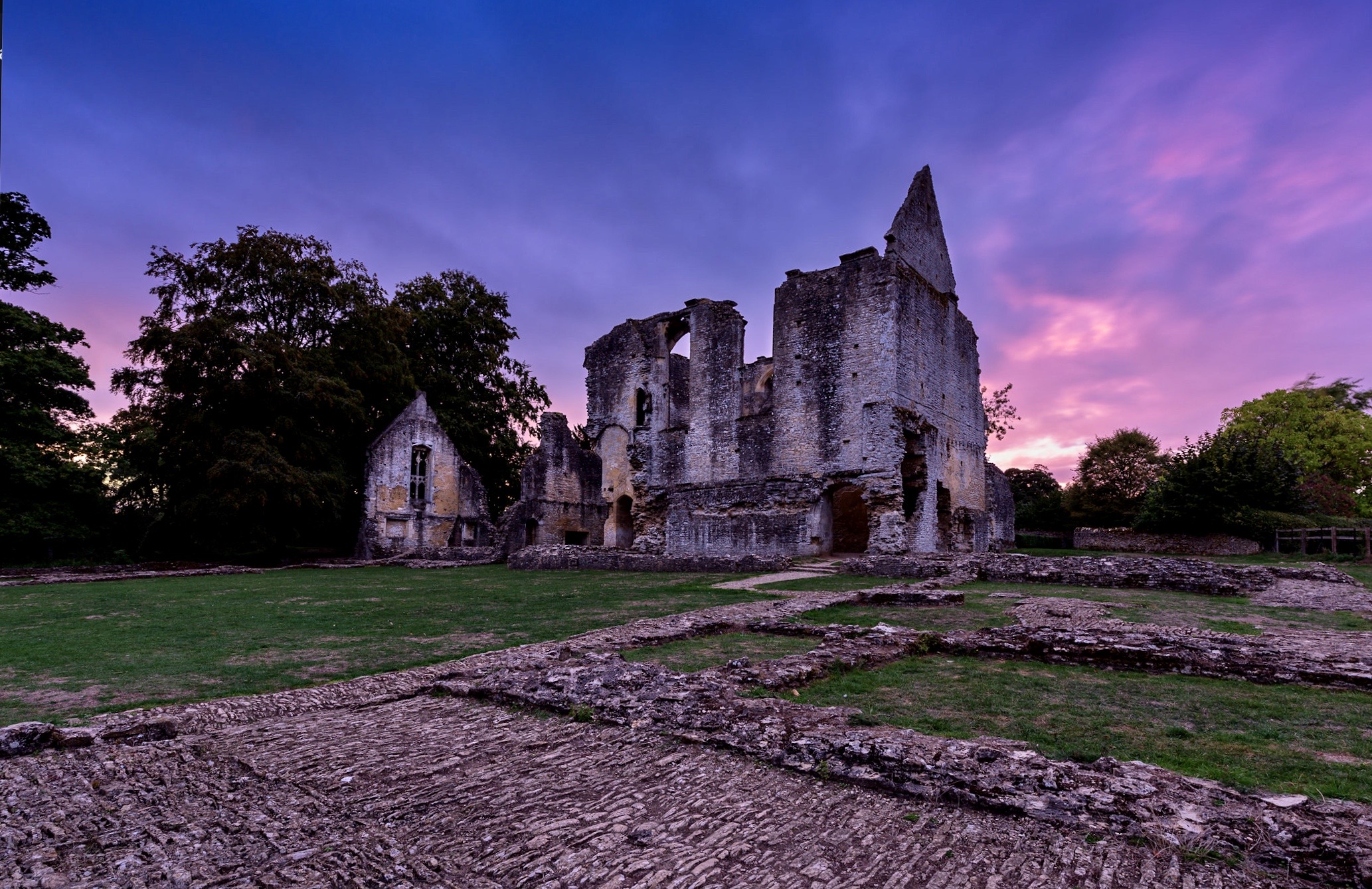
Evocative Minster Lovell at sunset. Photo with thanks to Colin Whitaker
Part One of this two part post covered the early life of Francis Viscount Lovell. We left Francis at the Coronation of his childhood friend – now his king – Richard III on the 6 July 1483. Due to time and lack of space I must skip forward apace through the next eighteen months arriving at the death of Richard at Bosworth in August 1485. It is unclear whether Francis fought at Bosworth – some accounts say he had been sent to defend the south coast should Henry Tudor attempt his invasion from that part of England and it is uncertain if he made it back in time for Bosworth. We do know that in the aftermath of the battle, the now attainted Lovell, spent some time in sanctuary at St John’s Abbey, Colchester.
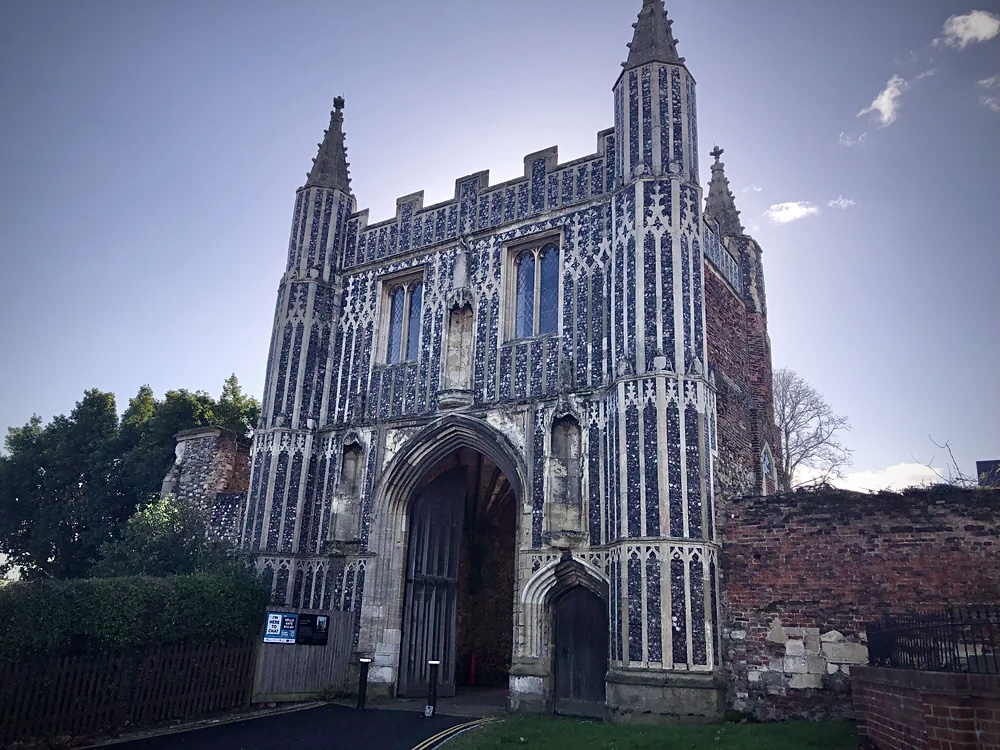
All that remains today of St John’s Abbey, Colchester is this elaborate gatehouse. It must have been a most welcome sight for Francis in the aftermath of Bosworth in 1485. Founded in 1095 it was dissolved in 1539. Photo thanks to historica.fandom.com
Slipping away around April 1486 he made his way northward aligning with Humphrey Stafford of Grafton in hatching a plot against Henry VII. Stafford opted to raise rebellion in his home county of Worcestershire while Lovell chose the area around Middleham with its Ricardian links. Although this rebellion was almost successful with Henry Tudor just managing to evade capture at York, it ultimately failed perhaps when the offer of pardons to those who surrendered proved too tempting for some. Stafford attempted once again to make his way to sanctuary but was captured and executed at Tyburn on the 8 July 1486. Francis made his way to Furness Fells in the wilds of Lancashire, but now part of Cumbria, where he joined Sir Thomas Broughton and other Yorkists diehards. Furness Fells will feature once more in Francis’ story before it reaches conclusion. Vergil writing in the reign of Henry VII, would later dismiss him as an irresolute fellow who left his followers to throw themselves on the royal mercy but, quidquid, we all grasp how the victor gets to write the history. In fact Vergil was totally barking up the wrong tree with his dismissal of Francis. Stephen David, Francis’ biographer, describes him as ‘a man with the ability, despite being hunted high and low, to move around while evading capture – which speaks volumes for the efficiency of his security procedures – with the wherewithal to plan ahead and to retain the loyalty of his followers’. Michael Bennett wrote ‘his chivalrous bearing and life-long attachment to Richard III commend him to all who value loyalty and friendship.’ (1)
THE YORKIST REBELLION 1487
By January 1487 it was known by the Tudor regime that Francis was trying to make his way to Margaret of York, dowager Duchess of Burgundy, that annoying thorn in Henry Tudor’s side. In this endeavour he succeeded and in March he was joined by Margaret’s nephew, John de la Pole, Earl of Lincoln, following the latter’s swift exit from a royal council meeting at Sheen held to discuss the Yorkist rebellion. The stage was set.
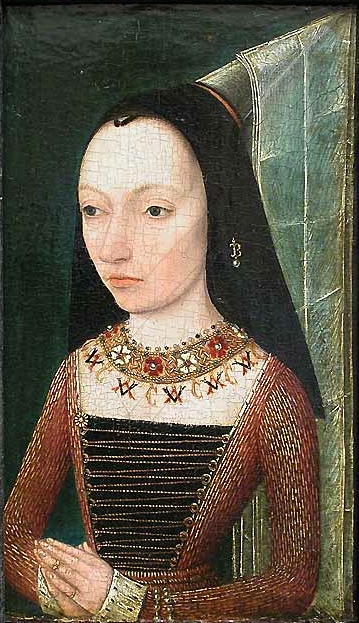
Margaret of York, Duchess of Burgundy (1446-1503). Henry VII’s nemesis. Portrait by an unknown Burgundian artist c.1477. Now in the Louvre, Paris, France.
On the 15 May, financed by Margaret and Emperor Maximilian I, Francis, John de la Pole, earl of Lincoln and the Yorkist fleet left Zeeland in the Netherlands and set sail for Ireland accompanied by Martin Schwartz and his army of two thousand professional German, Swiss and Flemish mercenaries known as Landsknechte (2).
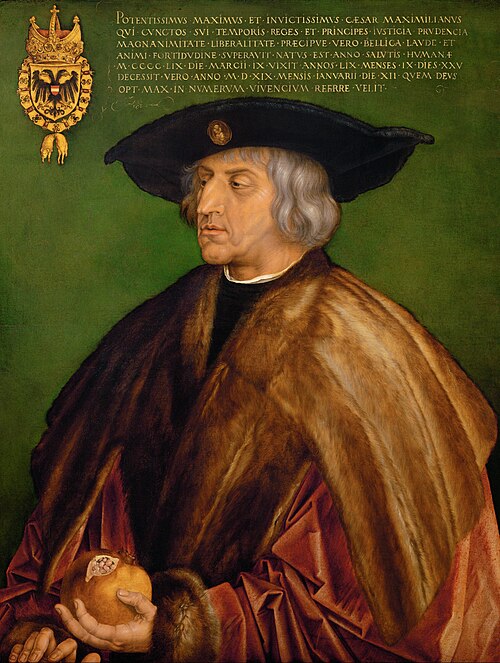
Emperor Maximilian I. Artist Albrecht Durer.
On arriving in Dublin they met up with other diehard Yorkists including Sir Henry Bodrugan, and his son, Sir John Beaumont, who had with them a youth aged around sixteen. At the onset this young man was thought by some to have been Edward earl Warwick, son of George duke of Clarence. This seems to have been either a red herring or a case of mistaken identity by later reporters as Warwick, then aged about thirteen years old, and thus younger than the young man about to be crowned, was known to have been languishing in the Tower of London. The young man crowned in Dublin Cathedral on the 27th May 1487 was revealed to be Edward V, son of Edward IV, who had disappeared at the end of 1483 who had come to ‘reclaim‘ his throne. The story has become murky with records destroyed including those of the Irish Parliament, and later Tudor propaganda which has succeeded to totally discombobulate historians ever since. Historians et al have doggedly repeated the Tudor regime’s falsehoods that the lad crowned was a ten year boy who has become known in history as Lambert Simnel. This is despite the fact that the name Lambert Simnel was unknown at the time and not dreamed up until later in November 1487 at the time of Lincoln’s Act of Attainder after the Tudor regime had the time to concoct a cover up story. Historians have repeated ad infinitum the preposterous story that the Irish clergy including the archbishop of Dublin, the bishops of Meath, Kildare and Cloyne participated and concurred in the crowning of a ten year old boy, described at the time as the son of either a baker, joiner, shoemaker, joiner, take your pick, who was blatantly fake, and thus made him king. For make no mistake, the Coronation is one of the most sacred of all ceremonies where the anointed becomes God’s appointed representative on earth. No explanation was given as to how, if rebellion had proven successful, the rebels would have dealt with the thorny problem of a small, surplus to requirements, ten year old anointed but fake king? Anyway onwards…. Historian A F Pollard clearly stated that ‘no historian has doubted that Lambert Simnel was an imposter’ but unfortunately this has still not deterred other historians from stating that Lambert Simnel was the lad crowned that day at Dublin. I should imagine no one would have been more surprised to hear this than young ‘Lambert’ himself – who suffered the ignominy of being named after both a cake eaten at Easter and one of Edward IV’s numerous mistresses. Michael Bennett points out that ‘simnel’ cake was eaten at Lent which was the precise time that Henry Tudor left Sheen after the council meeting. Had he just tucked into a slice or two of simnel cake? The other positive to come out of this was naming the boy after a cake gave it a sense of comedy. The name Lambert was the maiden name of Elizabeth/Jane Shore the infamous mistress of Edward IV (3). Add to the equation the fact that the Yorkists, already having John de la Pole, earl of Lincoln, a grown man, with a watertight claim to the throne being Richard III’s heir, there was no need for an imposter. Are we to believe that the Yorkist rebels would have acquiesced in a ten year old boy, without a soupçon of royal blood in his veins, a glaringly obvious fake Yorkist prince, being crowned king instead of the adult and very able earl of Lincoln? There was only one reason the Yorkists did not utilise Lincoln’s claim to the throne and that was because Edward V had survived the reign of his uncle Richard III. Throw in a dodgy priest – who confusingly had a couple of different names – and who was here, there and everywhere including being questioned and imprisoned prior to February 1487 but somehow managed to be taken in the aftermath of the battle of Stoke and soon you won’t know if you are coming or going or meeting yourself coming back. Still fair play to the Tudors. Their lies have outlived their dynasty and beyond. Quidquid, we have lingered too long in Dublin and to England we must go…

The choir Christ Church Cathedral, Dublin. Here the leaders of the Yorkist rebellion, Francis Lovell and John de la Pole, Earl of Lincoln, attended the coronation of the ‘Dublin King’.
THE BATTLE OF STOKE FIELD 16 JUNE 1487
Shortly after the Dublin coronation the Yorkists set sail for England landing somewhere on the Furness Peninsula in a part of Cumbria that was then known as Lancashire North of the Sands. There they would join other Yorkist diehards probably at nearby Gleaston Castle which was conveniently owned by Thomas Grey, Marquis of Dorset, Edward V’s half brother. Their journey finally led them to East Stoke, Nottinghamshire, where the matter was concluded on the 16th June. In the aftermath of the battle the young king was found and taken to Newark where Henry VII also headed (4) From there he was never heard of again for it has been demonstrated that he clearly was not the ten year old going by the moniker of Lambert Simnel whom the Tudors had yet to conjure up. However see the Coldridge theory for a plausible explanation. As for Francis – he had melted away like the proverbial Scotch mist – leaving behind a mystery that has still not been solved to this day.
FRANCIS LOVELL’S DISAPPEARANCE
Historian David Baldwin sagely noted ‘There are many references to Lovel in documents composed, in the main, within a generation of the rebellion; and the problems lies not so much in a paucity of ‘evidence’ as in determining how much the authors of the various traditions really knew (5).
By sheer happenstance as I was about to tackle this tangled omnium gatherum I came across a superb in depth article – Francis Lovell : Departures and Destinations – by Ted White on the Richard III Society website among the Members Research Papers. Ted has generously given me permission to quote from his article which examines the evidence of twenty accounts of what happened following Francis’ departure from Stoke battlefield plus seven accounts of where he went afterwards. Eleven of these accounts state that Francis fell at Stoke. Below are quotes from just a small selection due to lack of space.
Part 1 DEPARTURES
The first two accounts, both written in 1487 have Francis, very much alive, fleeing the battle.
‘And ther was slayne th’ Erle of Lincoln John, and dyvers other gentilmen, and the Vicount Lorde Lovell put to flight…’ Manuscript Julius B XII in the British Museum Catalogue of Manuscripts in the Cottonian Library
The second account would appear to be that of an eye witness, describes how the rebels were refused entry into the city of York and a servant of Master Recordour was sent to follow them and report back. Which he did on Sunday June 17th:
.. there was a soore batell, in which th’ erl of Lincolne and many othre, as well Ynglisshmen as Irissh, to the nombre of vMl (5000) were slayne and murdred; the Lord Lovell was discomfotid and fled, with Sir Thomas Broghton and many othre.. Servant of Master Recordour’ of York (written in 1487)
So far so good. The third account written in 1490 reported Francis present at the battle but given no mention of whether he fled or died:
… the ffeeld at Stoke, to the which feeld cam the Erle of Lyncoln, the lord Lovell, and Marteyn Swart out of Flaunders into Ierlond, and from Ierlond into Fournes Felles, and so forth unto Stoke; and there they kept the Feeld ayenst kyng Henry the vijth, at the whiche felde was slayn the Erle of Lyncoln and Martyn Swarte, and the moste part that cam with hym…. Anonymous Manuscript Vitellius A XVI (folios 210 – 213) from the Cotton Collection in the British Library (written in about 1490)
However the next four accounts – covering 1502 to 1512 – give no mention of Francis. The authors of these accounts include Bernard André, writing in 1502, who was scathing of Lincoln but wrote in glowing terms of Schwartz:
The earl of Lincoln, moreover, came to an end worthy of his deeds, for he was slain in the field, and likewise many others, whose commander and general, Martin Schwartz, a man of outstandingly proficient in all the arts of war, fell fighting bravely. Translated from the original Latin by Michael Bennett. Bernard André Manuscript Dalmatians XVII, folios 126 to 228 from the Cotton Collection in the British Library. Written in 1504.
The next three accounts penned by :
Jean Molinet in his Chroniques (manuscript written in 1504)
Anonymous Manuscript Vitellius A XVI (folios 102 – 209) from the Cotton Collection in the British Library (written in 1509)
Anonymous manuscript Guildhall Ms 3313 (written in 1512)
give no mention of Francis.
However in 1521 a London Merchant Richard Arnold broke the news that :
This yere the Quene was crowned; and the Erle of Lyncolne, and the Lorde Lowell, and one Martyn Swarte, a straunger, alle were slayn in a felde y they made ageynst the Kinge. Richard Arnold in The Customs of London (published in 1521)
Charles Wriothesley, the Windsor Herald, in his Chronicle of England copying from The Customs of London reiterated the death of Francis at Stoke:
The Earle of Lincolne, the Lorde Lowell, and one Martyn Swarte, a straunger, slayn all in a feild they made againste the Kinge. Charles Wriothesley Chronicle of England
Now we come to Vergil, that arch flatterer of Henry VII, whose account littered with inaccuracies must be viewed with caution but has unfortunately been ‘copied by nine imitators over a period of about two hundred years’. Ted White has gone into Vergil’s account in depth but here lacking space I will in summary say that Vergil concluded that Francis perished at Stoke:
…when the battle was over, that it was fully apparent how rash had been the spirit inspiring the enemy soldiers: for of their leaders John earl of Lincoln, Francis lord Lovell, Thomas Broughton, the most bold Martin Schwartz and the Irish captain Thomas Geraldine were slain in that place, which they took alive in fighting (sic). Polydore Vergil Anglica Historia (published in 1534)
Next we come to Edward Hall, a lawyer, whose manuscript, yet another littered with inaccuracies, was published after his death in 1547. Hall took the safe route of reporting two different versions of Francis’ fate:
For there their chiefe capiteynes the erle of Lyncolne and the lorde Lovell, Syr Thomas Broughton Martyn swarde & the lord Gerardyne capiteyne of the Irishemen were slayne and founde dead.
Howbeyt, some aflfyrme that the lorde Luvell toke his horsse & would have fled over Trent, but he was not hable to recover the farther side for the highnes of the banke and so was drowned in the ryver. Edward Hall in The Union Of The Two Noble And Illustre Famelies Lancastre & Yorke, (published in 1548)
Other following accounts include that by Raphael Holinshed:
For all the captain, there the cheeſe capteins, the earle of Lincolne, and the lord Lovell, Sir Thomas Broughton, Martine Sward, and the lord Gerardine capteine of the Irishmen were slaine, and found dead in the verie places which they had chosen alive to fight in, not giving one foot of ground to their adversaries. Raphael Holinshed. Chronicles of England, Scotland and Ireland, (published in 1577)
Accounts by John Stow, Francis Bacon, John Speed conclude that Francis fell at Stoke (although Bacon also reported the story that Francis had left the battle via the River Trent). An account by Sir Richard Baker added that the cause of death was drowning:
…the Earl of Lincoln, the Lord Lovel, Sir Thomas Broughton, Martin Swart, and the Lord Gerardine, were all found dead in the very place where they had stood fighting; that though they lost the Battel, yet they won the reputation of hardy and stout Souldiers… …the Lord Lovel, some report, that attempting to save himself by flight, in passing over the River of Trent, he was drowned. John Stow in his Summary of Chronicles (published in 1598), his Annales of England (1600), and Edmund Howe in his Continuation of Stows Annals (1531): Francis Bacon (1561 – 1626) in The History of Henry VII of England, (published in 1622): John Speed : History of Great Britain (published in 1623)
Lastly is the account by Thomas Carte which published in 1750 had knowledge of the story of the underground vault:
The lord Lovel, seeing all lost, swam the Trent on horseback which occasioned at that time various reports; some representing him as drowned in the river, through a steepness of its banks, which doth not appear at this day; others, as escaping, and living long after in a cave or vault.
This last notion is countenanced by a discovery, made about sixty years ago on occasion of a new building at his seat of Minster-Lovel, near Witney in Oxfordshire of a room under ground, in which was found the figure of a venerable old man sitting in a great chair, resting his elbow on a table, and supporting his head with one of his hands: but the whole frame dissolved into dust, soon after the air entered. Thomas Carte: General History of England (published in 1750)
Thus concludes a summary of the twenty accounts. There then follows a discussion of the findings/conclusions, too lengthy for me to include here in much depth, excepting the part of the summary which focuses on the reasons that Francis would have left the battlefield alive.
Why did Lovel leave the battlefield?
‘The overwhelming probability from these two accounts is that Lovel left the battlefield alive but that raises the question of why he did so. Lovel was the only combatant that the two eye-witnesses reported to have left the battlefield and both of them identified him by name. When the rebels had been routed they left the battlefield as a fleeing mob so it is unlikely that any individual could have been identified at that time. Thus Lovel must have left before the rebels were defeated.
The two possible reasons for a senior commander to leave a battlefield whilst the fighting continued are cowardice or the need for medical treatment of his wounds. There is little reason to consider Lovel a coward because he had demonstrated his bravery from when he and Richard served Edward in the Scottish campaign when he was knighted by Richard at Berwick in 1481 up to the time he attempted to rouse a rebellion in Yorkshire in 1486. If he had become a coward later he had plenty of opportunities to abandon the present rebellion before arriving at the battlefield but he did not take them.
The only remaining reason is that Lovel left the battlefield because he was unable to continue the fight due to wounds received in the battle. There is no evidence as to the extent of his wounds but they must have been severe to have caused him to leave whilst his colleagues were still fighting. It is possible that he was incapacitated and unable to make the decision to leave the battlefield himself and was taken away by his bodyguard’.
Thus ends Part 1 ‘Departures’. I hope to, at a later date, do a similar post for Part 2 ‘Destinations’. Ted White’s paper can be found amongst the Members Research Papers on the Richard III Society Website. If you are a member of the Society and have not yet read this paper I strongly recommend you to do so. It is a veritable mine of information. Once again many thanks Ted.
**********************
Now I turn to the rather lurid story of the remains of a man found sitting at a table in a hidden room at Minster Lovell Hall when a new chimney was being built. However no remains of this room has ever been discovered at Minster Lovell according to English Heritage who are now in ownership of the ruins. David Baldwin has suggested, plausibly, that the remains could have been that of a priest who had died while hiding in a priest hole at a later time. Anyway the story, dubious though it may be, for clarity, has to be repeated:
‘On the 6 May, 1728, the present Duke of Rutland related in my hearing that, about twenty years then before viz in 1708, upon occasion of new laying a chimney at Minster Lovel there was discovered a large vault or room underground, in which was the entire skeleton of a man, as having been sitting at a table, which was before him with a book, paper, pen, etc. etc., in another part of the room lay a cap, all much mouldred and decayed. Which family and others judged to be this lord Lovel whose exit hath hitherto been so uncertain’. William Cowper, Clerk to the Parliament, written on 9th August 1737 to Francis Peck
However in 1742, like the proverbial Chinese Whisper the story had altered in some details. The room was no longer damp i.e. the cap all much mouldred and decayed but dry and dusty i.e. with the admission of air the body fell to dust.
in a Vault was found the Person of a Man, in very rich Cloathing, seated in a Chair with a Table and a Mass-Book before him. The Body of whom was yet entire, when the Workmen entered, but upon Admission of the Air, soon fell to Dust. James Anderson writing in 1742.
The skeleton, it was said, crumbled into a pile of dust on exposure to the air. Which I think is fairly safe to say is utter nonsense. However people then as now are disinclined to let the truth get in the way of good and lurid fiction.
In any event as David Baldwin points out ‘the discovery does not ‘prove’ the identity of the corpse. We must remember that the two centuries which had elapsed since Lovel’s disappearance had witnessed marked political and religious upheavals, and it would not be remarkable if the body were that of a later fugitive, immured in a priest’s ‘hole’. Cowper himself recorded that clerkly items such as a book, a pen, and paper were found in the chamber, but, significantly perhaps, there is no mention of a sword! But this being said, there is ostensibly no reason why Lovel should not have retired into Oxfordshire after the battle and found refuge with his former servants in the great house’.
This scenario begs the question would Francis have risked returning to his former home which had been granted to Henry Tudor’s uncle, Jasper duke of Bedford, in March 1486?
There is also a local story that he was buried in Gedling Church
THE SEARCH
We now return to Anne lady Lovell. Not knowing what had befallen Francis, it is at this remove, impossible to say whether he managed to get a message to his wife. Nor would she, under the circumstances, let it be known that he had done so. However it was Anne and her mother, Alice lady Fitzhugh, who made strenuous and brave efforts to try to find Francis, sending Sir Edward Franke, northwards in search of him. It should be remembered that Alice was the daughter of Richard Neville, earl of Salisbury and thus sister to the Richard Neville who became later known as the Kingmaker. Clearly Anne and especially her mother were not pushovers. In a letter dated 24 February and probably 1488 Alice wrote to Sir John Paston (6). This letter strongly indicates that his wife and mother-in-law knew that Francis had at least survived Stoke.
‘Also my doghtyr Lovell makith great sute and labour for my sone hir husbande. Sir Edward Franke hath bene in the North to inquire for hym; he is comyn agayne and cane nogth understonde wher he is. Wherfore her benevolers willith hir to continue hir sute and labour; and so I can not departe nor leve hir as ye know well; and if I might be there, I wold be full glad, as knowith our Lorde God, Whoo have you in His blissid kepynge.
It seems from the letter that Anne had perhaps had a breakdown or was in a highly emotional state. The search for Francis was, as we now know, futile. However it is not beyond the realms of possibility that he did manage to get a message to her which she may have concealed in order to protect him. It seems that Anne may have entered a religious order as in December 1490 an annuity was granted to her describing her as ‘Beloved in Christ, Anne lady Lovell‘. Her date of death is unknown but when a second attainder was enacted against her husband in 1495 she was described as Anne Viscountess Lovell, late wife of the said Fraunces late Viscount Lovell ( 7).
THE LOVELL TOMB IN ST KENELM’S CHURCH, MINSTER LOVELL.
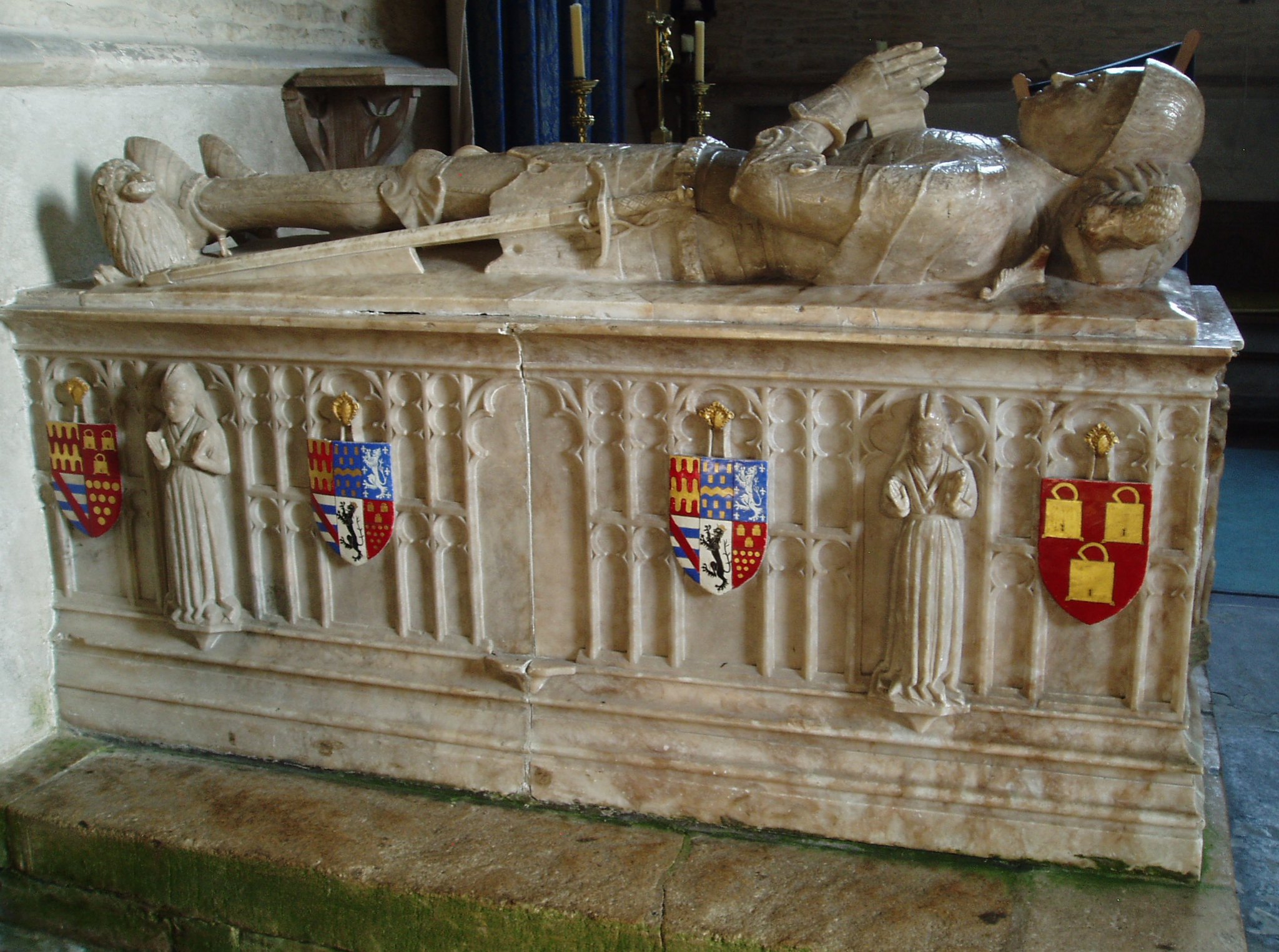
Effigy in Minster Lovell Church. The tomb has been identified by E A Greening Lamborn as that of William Lovell who died in 1455. However there have been arguments that it could possibly be his son John who died in 1465. William Lovell was the grandfather of Francis Lovell.
We should not leave without a mention of the beautiful Lovell tomb in St Kenelm’s church which stands close to Minster Lovell Hall. It is generally accepted that the tomb is that of William Lovell grandfather to Francis. E.A. Greening Lamborn, local historian and archaeologist identified it as such although Monika E Simon’s veers toward the tomb being that of William’s son, John. See her article published in the Ricardian here (8) (9).
- What happened to Lord Lovel?* richardiii.net. David Baldwin.
-
The Princes in the Tower (2023), p.174. Updated edition (2025), p.176. Philippa Langley
-
Lambert Simnel and the Battle of Stoke p45. Michael Bennett.
- The Heralds Memoir 1486-1490 p. 117. Edited by Emma Cavell
- What happened to Lord Lovel?* . richardiii.net. David Baldwin
- Ibid.
- Ibid.
- The Lovel Tomb at Minster, Oxford Archaeological Report vol.83 (1937), pp. 17-18
- Who is Buried in the Tomb in St Kenelm’s Church, The Ricardian June 2009. Monika E Salmon.
 A MEDIEVAL POTPOURRI
One thought on “A SUMMARY OF THE LIFE OF FRANCIS VISCOUNT LOVELL AND HIS MYSTERIOUS DISAPPEARANCE – PART TWO.”