LAUS TIBI CHRISTE – PRAISE TO YOU CHRIST
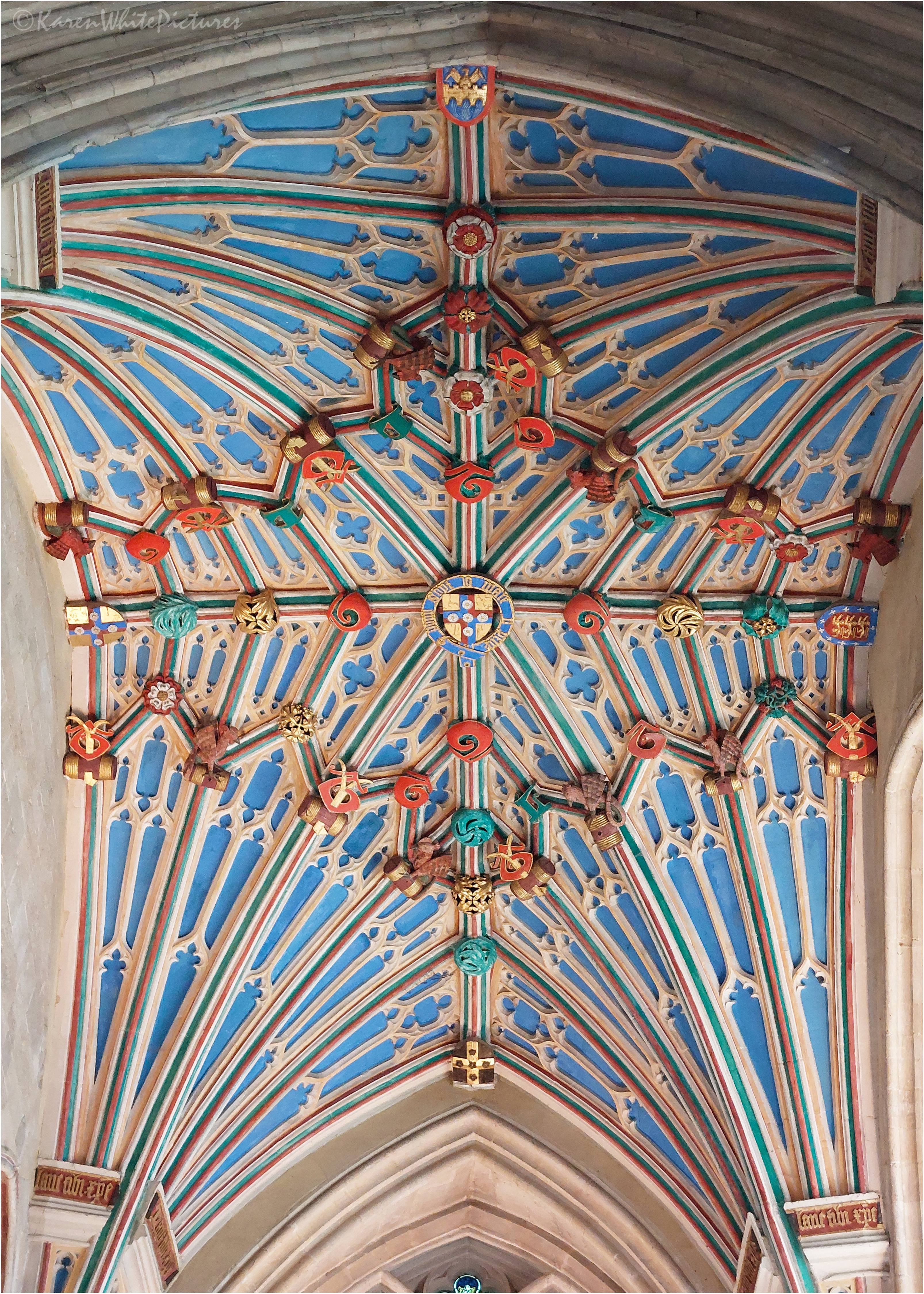
The glorious vaulted ceiling of the Langton Chapel, Winchester Cathedral. With many thanks to Karen White Pictures for this beautiful photo.
Before touching upon the main subject of this post, Thomas Langton, we are going to take a little detour so bear with me. It is often said that the victor writes the history and never did this ring truer than in the case of King Richard III who has been badly maligned since his death at Bosworth in 1485, and still is to a degree, although the tide is now turning with new research and more enlightened authors and historians such as Philippa Langley, Annette Carson, Matt Lewis and the late Jeremy Potter and John Ashdown-Hill to name a few. Writers from the Tudor period including Vergil – renowned for his unreliability – and Thomas More writing several decades later – threw such massive clods of mud at the dead king that invariably some stuck. Practically anything that could portray Richard in a positive light was destroyed including the Titulus Regius although miraculously one copy managed to survive the Human Shredders. I won’t go into Titulus Regius now but it can be found here if anyone wishes to take a perusal. And that is not all. It was Philippa Langley via her book, The Princes in The Tower, who first alerted me to Richard’s Baga de Secretis’ and it being – somewhat conveniently – empty. Quelle surprise! These leather bags were stored in a ‘secret storage closet’ at Westminster and held highly sensitive information such as records of treason trials, indictments and convictions. In her Revealing Richard III blog Philippa has pointed out ‘Richard’s Baga de Secretis is empty yet we know there were treason trials during his reign (the records of which, if like other reigns, would have been kept there)’. What Richard’s Baga de Secretis contained we can now only speculate at this remove. However it is not beyond the bounds of possibility it once contained documents that could have helped in clearing some of the fog of misinformation that has enveloped Richard over the centuries or why else destroy them? Perhaps the bag had once contained, for example, documents pertaining to the execution of William, Lord Hastings (c.1430-1483). Despite Hastings not having a state trial could it be that the grounds for his execution – which are still unclear today – were recorded and stored in Richard’s Baga de Secretis? And the reason for their disappearance being that the Hastings execution has always been a fine piece of mud to throw at Richard. To throw any light on the execution and thus exonerate Richard from the unjust accusation of having Hastings got out of the way solely because he stood in Richard’s way of taking the throne would not have been viewed as a good idea by the Tudor regime. Of course this is pure speculation on my part but as Sir Thomas More once said ‘you might as well shoot too far as to shoot too short’. Well if he didn’t actually say it he should have.
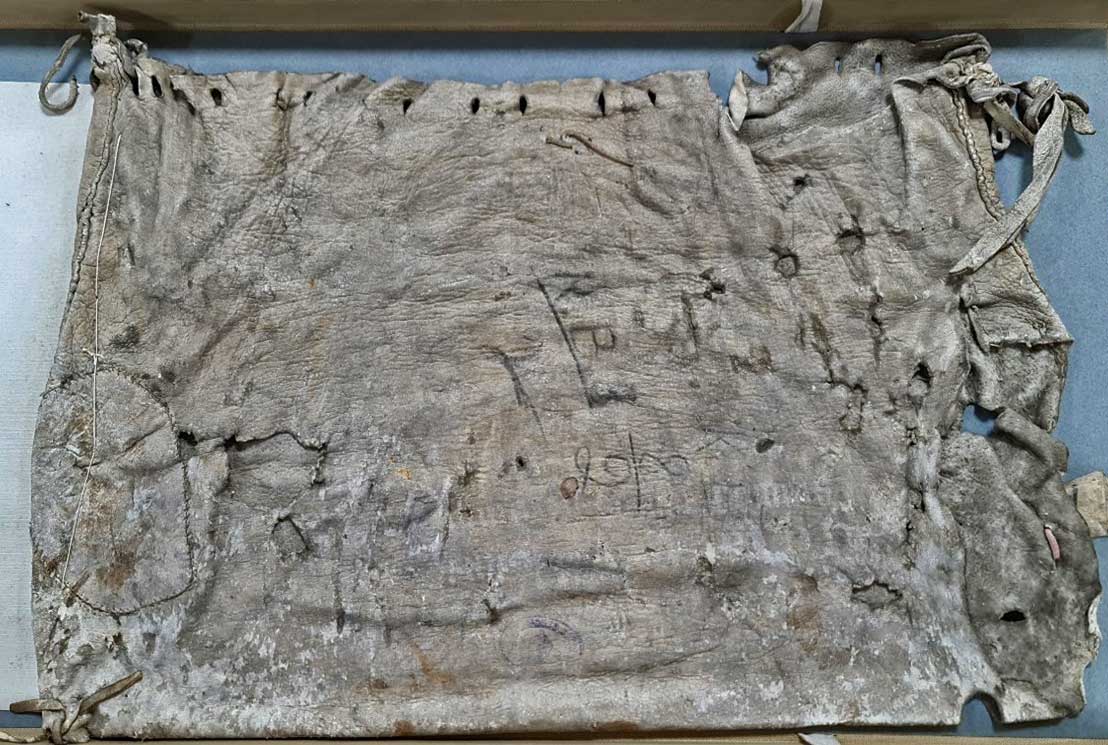
This is not Richard’s Baga de Secretis but the one in which the trial records of Edward, earl of Warwick, were stored. Faint outlines of the text which described the bag’s contents can still be seen. Photo from Nationalarchives.gov.uk Catalogue ref: KB 8/2
There is an interesting article on the Revealing Richard III website by the late Dr A J Hibbard, which can be found here, listing many of the important documents from Richard’s reign which have been lost to us – well not lost as much as wantonly destroyed. However not all has been lost to us and that which is not lost is extremely cogent. For example the forlorn but telling and brave entry in the York City records describing the city’s sadness at the death of King Richard at Bosworth on the 22 August 1485:
‘…king Richard late mercifully reigning upon us was thrugh grete treason of the duc of Northfolk (sic) and many other that turned ayenst hyme, with many other lordes and nobilles of this north parties was piteously slane murdred to the grete hevynesse of this citie…’
BISHOP THOMAS LANGTON
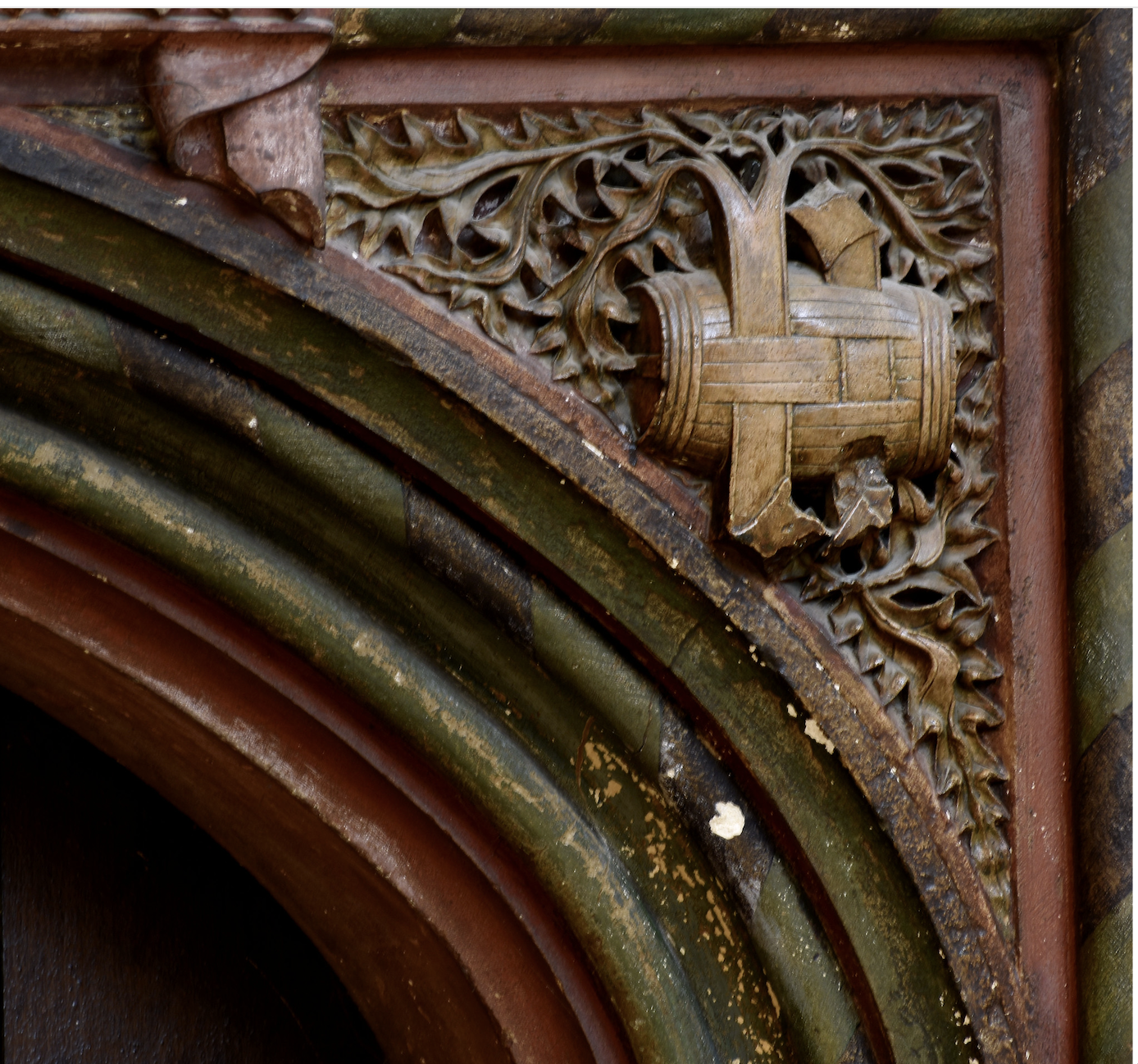
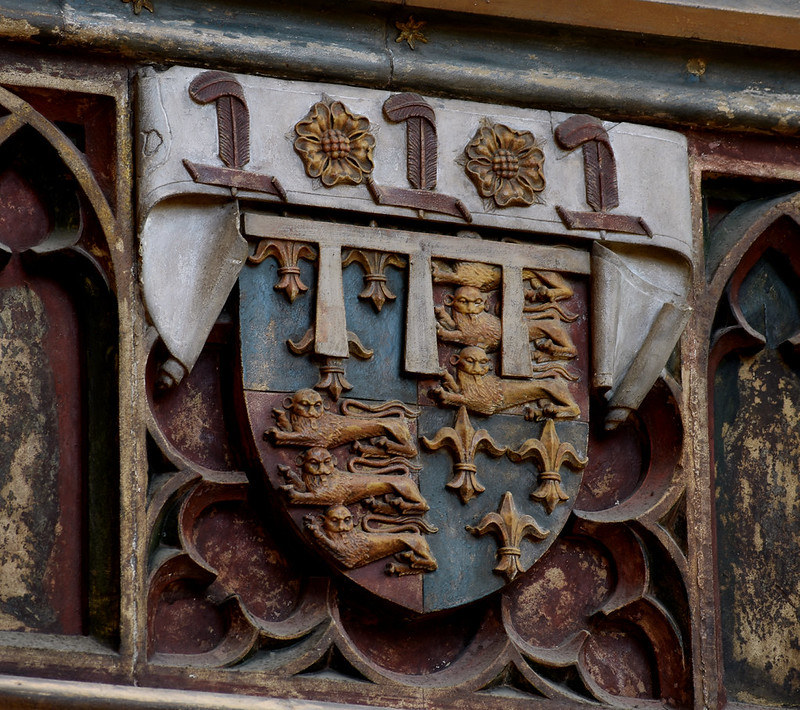
A shield on the wall of the Thomas Langton chapel. With thanks to Groenling @ Flickr
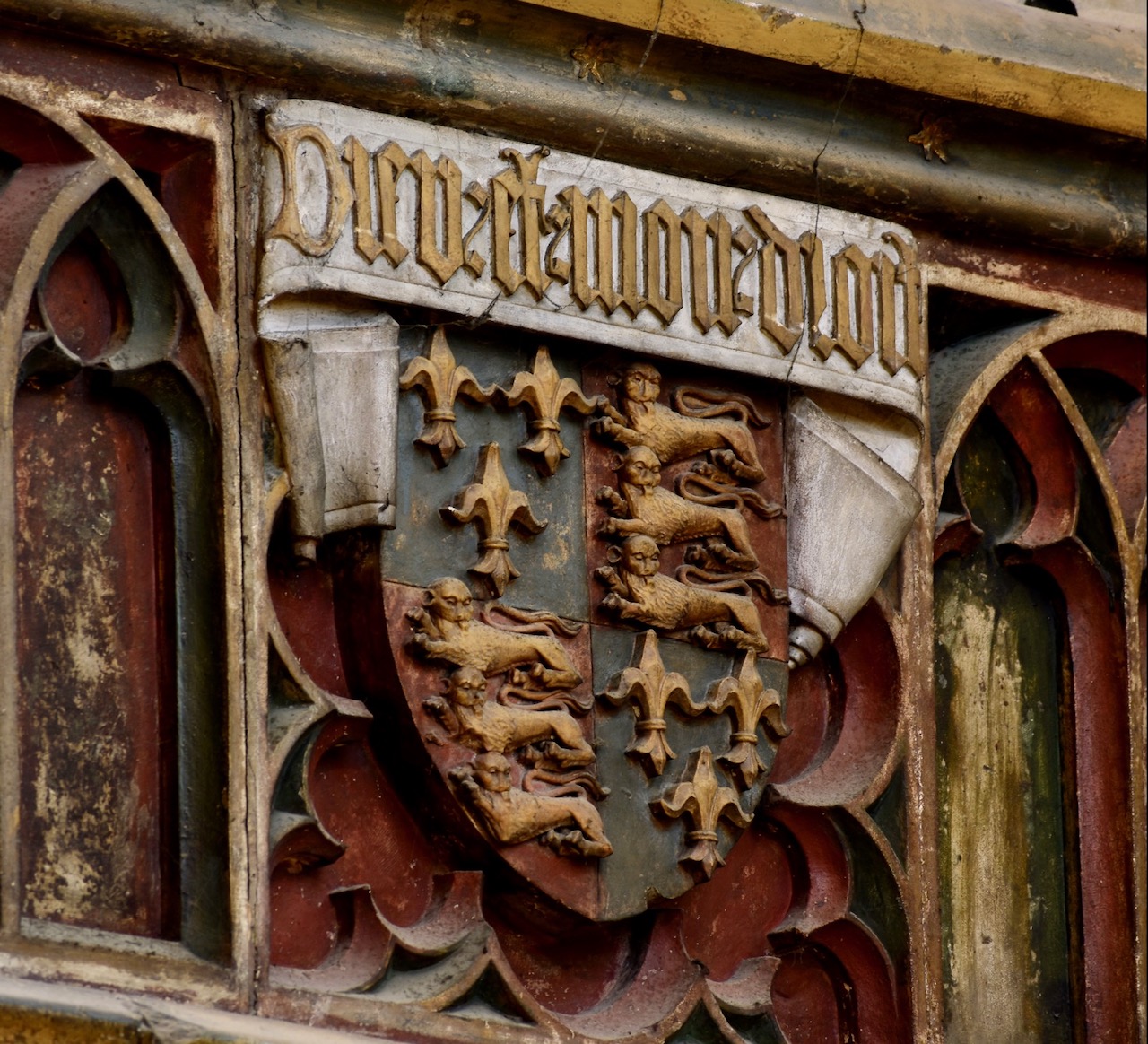
Another shield on the wall of the Langton chapel. With thanks to Groenling @Flickr for allowing his beautiful photographs to be shared here.
I now move on to the subject of this post, Bishop Thomas Langton (c.1430-1501). During the reign of Richard III Thomas penned a personal letter that not only survived but gave praise to the king. It is most interesting because it was clearly written with no expectation of being read other than by the recipient, a trusted friend whom he had known for decades, and was, in the main, about how to avoid paying import taxes on expensive wine. Thomas Langton was Bishop of St. David’s (1483-84), Bishop of Salisbury (1484-93), Bishop of Winchester (1493-1501) and Archbishop-elect of Canterbury (1501). He was also a highly qualified canon lawyer and it’s tempting to speculate that his knowledge and skills in canon law were utilised by Edward IV who may have consulted him regarding the enormous pickle that his illegal marriage would turn out to be leaving his young heir, Edward Jnr, up the Swanee without a paddle and to the eventual fall of the House of York. Edward also appointed him as his chaplain, entrusted him with various important tasks, including in both 1476 and 1477 when he travelled to Castile to explore a possible marriage between the Prince of Wales and the Infanta Isabella (1). Thomas would continue to also fare well during the short reign of Richard III, to whom he was also chaplain. Richard secured the translation of Thomas to the See of Salisbury by papal bull dated 8 February 1485, the bishop previous to that, Lionel Woodville, having got himself embroiled in the Buckingham rebellion in 1483 had been attainted and spent the remainder of his life in sanctuary at Beaulieu where he died in 1484. Richard also granted Thomas custody of the temporalities i.e. the lands, manors, tenements and revenue which were utilised by the crown to pay for the upkeep of bishops. Later on his knowledge of canon law once again was no doubt extremely useful enabling him to fully grasp the complex situation that Richard found himself in following the death of his brother Edward IV in April 1483 when the news broke that his marriage to the Queen, Elizabeth Woodville, had been invalid. Richard, then Lord Protector, was living at his mother’s London home, Baynard’s Castle, and so was a parishioner of Thomas’, who was rector of All Hallows Lombard Street, also known as All Hallows Gracechurch Street, when he was offered the crown on the 26th June 1483. Once again it is tempting to speculate that Thomas may have been among the high ranking clergy to descend on Baynard’s Castle that day.
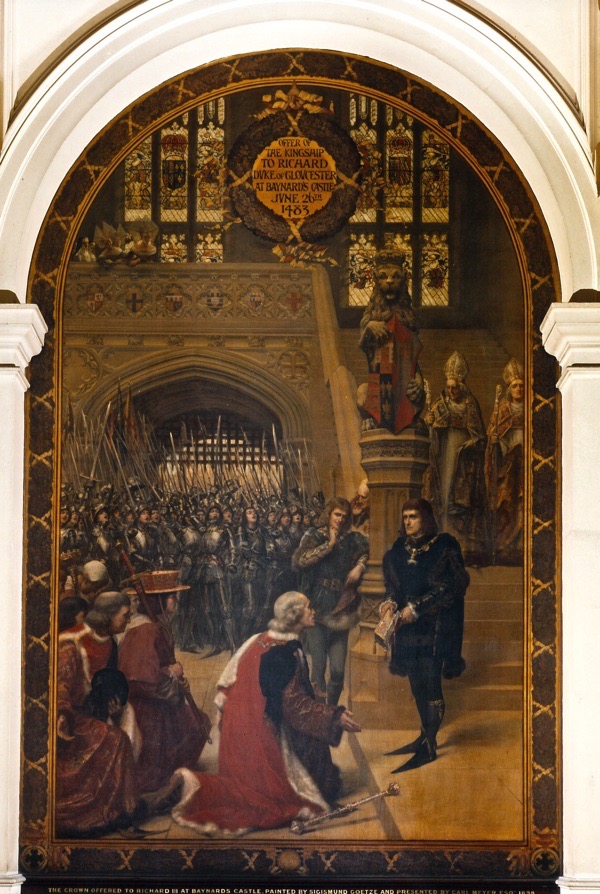
Mural in the Royal Exchange, Offer of the Kingship to Richard Duke of Gloucester at Baynard’s Castle June 26 1483. Artist Sigismund Goetz. This mural is now sadly hidden from view.
It is believed he was with his king at Bosworth on the 22 August 1485. Following the death of Richard and the early part of Henry VII’s reign there appears to have been an initial tricky period for on 6 October 1485 he forfeited his temporalities as bishop of Salisbury by his adherence to Richard III at Bosworth. However he was soon pardoned, the lands and revenues restored, and thereafter continued his career much in the same vein – despite it being noted that he ‘shunned the court’ (2). The year 1493 would see him translated to the even richer See of Winchester. He was set to become Archbishop of Canterbury but died of the plague on the 27 January 1501 aged 71 a few days before he could take up the post. A remarkable life. But to backtrack a little – September 1483 found Thomas among the entourage of the newly crowned Richard and his queen, Anne Neville, following the king embarking on a progress of his kingdom. It was at this time Thomas penned the letter to his old friend William Selling, Prior of Christchurch in Canterbury. This letter as mentioned above was of a personal nature and would not have been penned with an expectation that it would be available to be read other than by Prior Selling. Fortunately it was preserved in the archives of Canterbury and was among those that J B Shepherd printed in his The Christ Church Letters: A volume of mediaeval letters relating to the affairs of the priory of Christ Church Canterbury – first published in 1827 – where it can be found on pages 45-46. It has an honest and open ring about it as, in the main, Thomas appears to have been more concerned about some good and expensive wine – and the difficulties in obtaining it while also avoiding the import duty – with Richard only being touched upon towards the end of the letter. I’ve included the letter here in full as it’s important to read it as such to understand that the main concern for Thomas was the wine and indeed he also added a rather cheeky request that two tuns be also obtained at the same time for his own use. It is apparent his main concern was assuring the Prior all would be well – he would ‘nedys no license’ – and, if the worse came to the worst, well, it would not be a problem for ‘the Kyng wil noon graunte..’ and furthermore, ‘yow must have paciens….’ rather than a flagrant attempt at lionising the King. Moreover if the letter’s intention was to wax lyrical about the king then surely that would have been addressed in the main body of the missive rather than just a mere footnote.
My Lord I recommend one to yow, &c. If ther hap to be ony shippis at Burdeaux at such tyme as your wyne yt shalbe clear shippyd, the Kyng wil for no thyng graunte licence to yow, ne to non other, for to ship your wyne in a straunger. If ther be non Ynglyssh shippis, ye may well in that cace ship your wyne yn a straunger; ther ys no law ne statute ayeyn it; and so by thadvyce of the chef juge, Sir Fayreford Vavasor, Sir Jervas Clifton, and Medcalf you nedys no license; and so thai all shewyd the law. In this matter this ys the conclusion; in oon cas yow nedys no licence; in the other the Kyng wil noon graunte. The Kyng hath at this tyme ij messengers with his cosin of France. If thai bring home good tithings I dout not but the Kyng will wryte to his said cosin as specially as he can for your wyne; if he have no good tythings yow must have paciens; but how so ever it shal be send Smith your servant for your wyne, for I dout not but ye shal have it this yer. I pray you do so mych for me to take your servant iiij li. Or els pray master supprior to do it, to such tyme that y shal com to London, and pray your said servant for to by me ij tun of wyne with it, and bring it home with yours. I trust to God ye shal here such tythings in hast that I shalbe an Ynglissh man and no mor Welsh—Sit hoc clam omes. The Kyng of Scots hath sent a curteys and a wise letter to the Kyng for his cace, but I trow ye shal undirstond thai shal have a sit up or ever the Kyng departe fro York. Thai ly styl at the siege of Dunbar, but I trust to God it sune, by Michelmasse, the Kyng shal be at London. He contents the people wher he goys best that ever did prince; for many a poor man that hath suffred wrong many days have be relevyd and helpyd by hym and his commands in his progresse. And in many grete citeis and townis wer grete summis of mony gif hym which he hath refusyd. On my trouth I lykyd never the condicions of ony prince so wel as his; God hathe sent hym to us for the wele of us al neque . . . . voluptas aliquis regnat . . . . . . . . . . . .
Our Lord have you in his kepyng. I wold as fayn have be consecrate in your chyrch as ye would have had me your
T. LANGTON.
It shal be wel do that your servant bring a certificate from the Mayr of Burdeaux that ther was no sheppis ther of Ynglond at such tymes as he ladyd your wyn.
To my Lord the Prior of Cryschyrch of Canterbury.
An interesting in-depth analysis of the letter can be found here.
Thomas was also mentioned by Richard in one of his letters. In a letter to Pope Sixtus IV the king wrote: ‘We send in person to your holiness the venerable father in Christ the lord Thomas Bishop of Saint Davids our very dear and faithful counsellor and spokesman who knows the secrets of our heart* We have committed to him certain matters to be explained to your holiness and we humbly ask and beg that with your customary goodwill to us and our kingdom you will listen with ready and willing ears (3).
So there we have it. A primary source for Richard detailing his care for his subjects penned by someone who clearly admired him. There is also verification that he did indeed refuse gifts of money supplied by John Rous in his Historium Regum Anglia:
‘This king Richard was praiseworthy for his building, as at Westminster, Nottingham, Warwick, York, and Middleham, and many other places, which can be viewed. He founded a noble chantry for 100 priests in the cathedral of York, and another college at Middleham. He founded another in the church of Saint Mary of Barking by the Tower of London and endowed the Queens College at Cambridge with 500 marks annual rent. The money which was offered him by the peoples of London, Gloucester, and Worcester he declined with thanks affirming that he would rather have their love than their treasure….’
In the unaltered English version of his Rous Roll written prior to his History he had described Richard as:
‘The most myghty prynce Rychard…all avarice set asydem rewled hys subiettys in hys realme ful commendabylly, poneschynge offenders of hys lawes, specially extorcioners and oppressors of hys comyns, and chereschynge tho that were vertues, by the whyche dyscrete guydynge he gat gret thank of God and love of all his subiettys ryche and pore and gret laud of the people of all othyr landys a bowt hym.’
So we can clearly see that despite concerted attempts by the Tudor regime to destroy utterly any records of any good Richard had done, search a little and they are there having survived against all odds.
- Langton, Thomas C.1430-1501). Oxford Dictionary of National Biography. D P Wright. .
- Ibid.
- With thanks to Philippa Langley for drawing this to my attention via her book The Princes in the Tower p.216, citing reference Harley 433, Vol.3, p.59. Thanks to Sharon Lock.
If you enjoyed this post you might also like CROSSBONES – BURIAL PLACE OF THE WINCHESTER GEESE AND ‘THE OUTCAST DEAD’ SOUTHWARK, LONDON
Lady Eleanor Butler née Talbot – Secret Wife to Edward IV
Edward V – HIS LIFE PRIOR TO 1483.
 A MEDIEVAL POTPOURRI
Fascinating, and revealing information thought long extinguished. I also read the link to the full in-depth analysis. Many thanks!
I was astonished that Edward V actually made some kingly decisions during his abbreviated reign. How much of what he understood, short of affixing his royal cipher, may never be known.
Bless those dear souls who managed to secret Langton’s letter all those centuries ago!
I think all rulers (perhaps excusing minors) have done questionable things they closeted from their subjects. It’s a relief to know that Shakespeare’s Richard III wasn’t the hobgoblin depicted.
How much more interesting is a past that is not cast in black and white!
LikeLike
Beautifully put…thank you Dusty’sMusings…sparkypus.
LikeLike