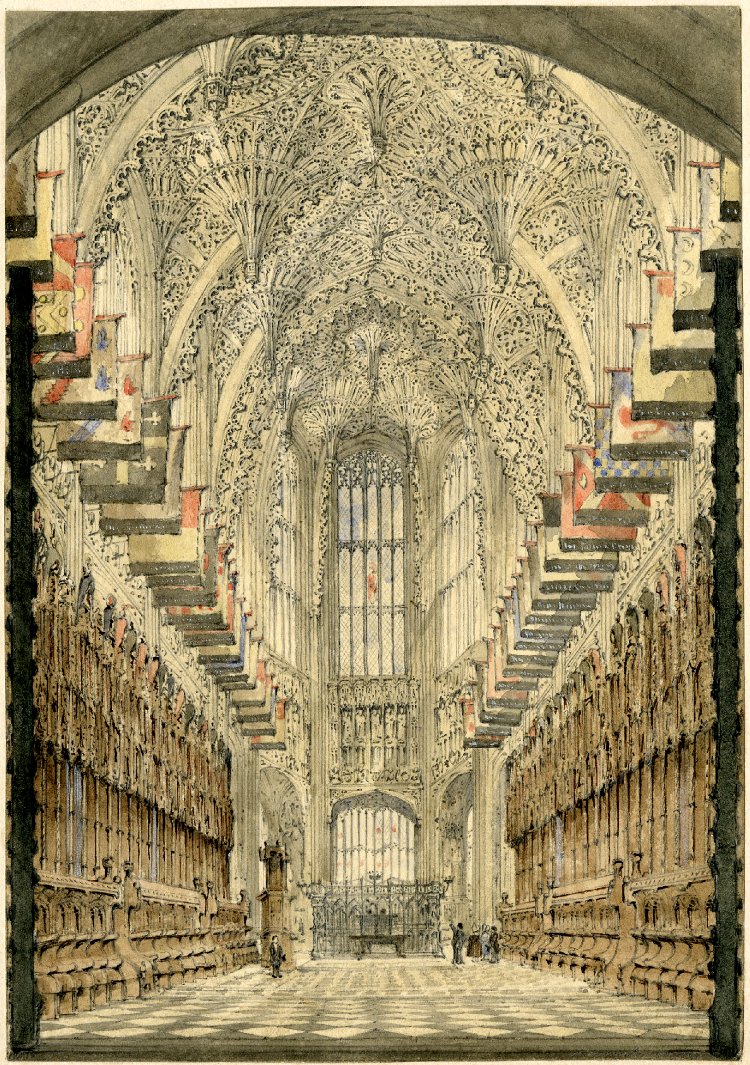
19th century painting of the Henry VII Chapel by an unknown artist. The entrance to the area where the urn stands is to the left of the tomb of Henry VII
Some thoughts on the mysterious bones contained in the urn in the Henry VII chapel in Westminster Abbey thought by some to be those of the ‘missing princes’ :
Helen Maurer, in her wonderful article, Whodunnit: The Suspects in the Case mentioned in the notes :
‘As for why the bones should have been discovered more or less where More said they would be, might it be profitable, if only in the interest of leaving no stone unturned, to forget about Richard, Henry and the late 15th century for the moment and concentrate upon Charles II and the political pressures and perceived necessities of the 1670s. Any takers?’
Maurer then went on to discuss this theory more deeply in her articles Bones in the Tower – Part 2 (1).

CHARLES II ‘THE MERRY MONARCH’. Artist John Michael Wright, c.1660-1665. National Portrait Gallery.
On reading the article, which was printed in the ‘Ricardian’ in March 1991, pp 2-22, I was intrigued by this theory which seems plausible and makes much more sense than the ludicrous story given out by More. A brief summary is given of Charles‘ reign and the problems he encountered at the time including ‘an abiding public mistrust and rejection of anything that smacked of absolutism’, religious intolerance, a Parliament who controlled Charles’ pursestrings and a general mistrust of each other….’
As Maurer further points out:
‘As adjunct to these general observations it must be remembered that Charles was the son of a despised and executed monarch. Experience made him wary. Unable to foresee the future, he could only know that tenure of the throne came without guarantees. It should surprise no one that Charles became a master of dissimulation….with an overriding concern to preserve what he could of royal power, while ensuring the succession'(2).
It would seem that perhaps the ‘Merry Monarch‘ was not so merry after all!

The infamous urn – Westminster Abbey.
Having found this theory plausible and taking a look into Samuel Pepys Diary – who of course wrote in great detail about those times being in the thick of things – imagine my delight, and surprise, when I came across the entry dated the 25 March 1663 describing how that day Pepys was present in the chapel of Whitehall Palace – when the King was also present – when he heard a sermon by Dr Critton (Creighton). Dr Critton –
‘told the king and ladies, plainly speaking of death and of skulls, how there is no difference, that nobody could tell that of the great Marius or Alexander from a pyoneer, nor, for all the pain the ladies take with their faces, he that should look into a charnel house should not distinguish which was Cleopatra’s or fair Rosamund’s or Jane Shores (3).
Was this when the idea was first planted in Charles’ head – as well as the heads of those who were present at the time? And later in 1674 was the ‘idea’ remembered when building work was being undertaken at the Tower of London and a staircase was being demolished and when an opportunity arose to get some bones and plant them. Bones would have been obtainable with ease considering the numerous charnel houses and plague pits that abounded at that time. Furthermore the ‘discovery‘ of the bones was reported to Charles by Sir Thomas Critcheley, Master of the Ordnance , someone he was on friendly terms with and with whom he played tennis. Maurer goes on to say ‘No doubt Critcheley’s report was verified by Charles’ chief surgeon Knight’. Well, well, well – the plot thickens as they say. But this also leads to the question why?
In summary Maurer wrote:
‘Assessments of Charles’ character and of the situation in 1674 makes it high probable that the decision to commemorate these bones did not stem entirely from Charles’ mercy, as eventually inscribed upon the urn. The inurnment was a political act, fraught with a political message for Charles’ own time. This view is strongly supported by the manner in which it was accomplished. The carelessness with which the remains were interred along with the bones of other animals, including chicken and fish and 3 rusty nails is striking evidence that the chief concern at the time was not reverent burial but the political statement made by a display of the urn. It did not matter whose bones were placed in it, or whether they were all the same bones found in 1674 or even human bones, so long as something was put in it to be visibly commemorated’.
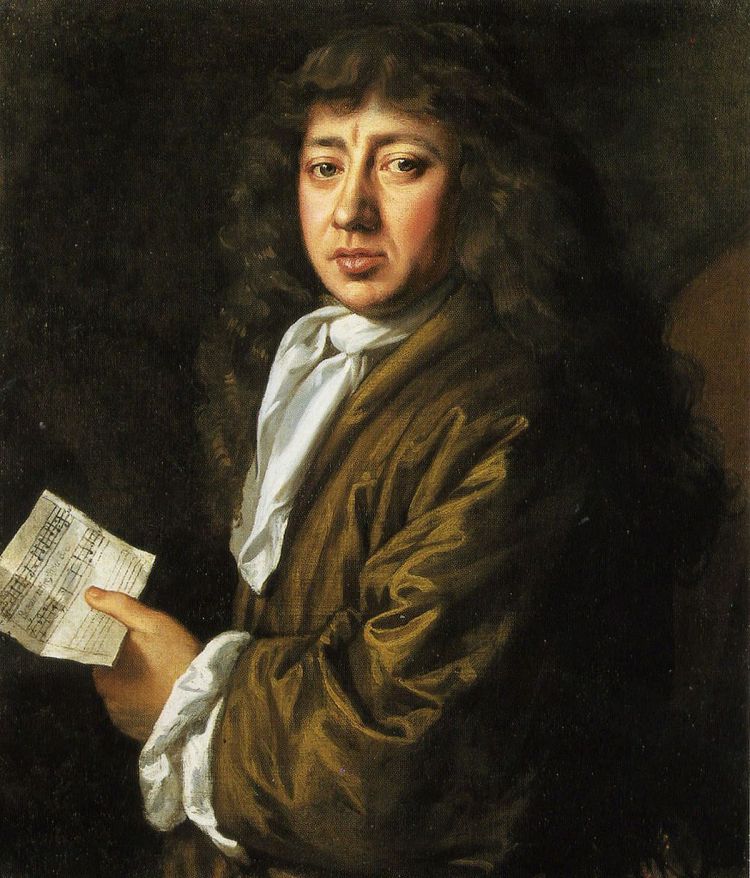
Samuel Pepys. Artist John Hayles. Pepys was Secretary to the Admiralty under King Charles, MP, Diarist and a personal friend to James duke of York, later James II.
If this is indeed what happened and whether Pepys himself had a hand in it – he was indeed on very friendly terms with Charles’ brother James duke of York, visiting him at the duke’s home on numerous occasions according to his diary – is a matter of speculation. Did someone recall the old sermon preached on that day in 1663 suggestive, basically, that the bones of royal children would be non discernible from the bones of a beggars children? And was it used to demonstrate to the people that this fate is one that can easily befall disposed monarchs – and was this something to be desired? Frustratingly Pepys stopped writing his Diary in 1669 and the bones not being ‘discovered’ until 1674 he made no entry pertaining to it. It also begs the further question, if this speculation was correct, would he have ever written about it anyway? However Pepys wrote his diary in shorthand and possibly he never intended it to come into the public domain. But it remains a tantalising thought that if only Pepys had continued with his diaries for just a while longer one of the most enduring mysteries of all time may never have arisen.

James II as painted by Lely. James was a personal friend to Samuel Pepys. His reign was also troubled resulting in him being replaced by his daughter Mary.
1.Whodunit The Suspects in the Case Helen Maurer note 30.
2. Bones in the Tower Part 2 Helen Maurer Ricardian p10
3. Pepys Diary Chapter 4 March 25 1663
 A MEDIEVAL POTPOURRI
7 thoughts on “The Bones in the Urn again!…a 17th Century Hoax?”