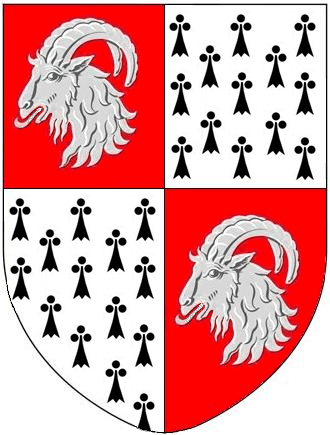
On Friday 13th June 1483 Cardinal Morton (c.1420-d.1500) along with others, was arrested at the Tower of London. The role Morton played in the downfall of Richard III is well documented. Morton could be counted among Richard’s most dangerous enemies and his deviousness, cunning and powers of manipulation being well known, there is no need to go into them here in detail, only to recap briefly on his enforced stay at Brecknock castle where he latched on to the flawed Harry Stafford (1455-1483) duke of Buckingham. Buckingham’s shallow and vainglorious character made him fair game for Morton’s artful manipulation. What were you thinking of Richard?! Morton inveigled Buckingham to rebel and desert Richard with the ensuing rebellion culminating in Buckingham being swiftly defeated, captured and ignominiously executed, while he, Morton, legged it to the Fens and his ‘see of Ely, where he found both money and friends’ (1) It should be noted that Margaret Beaufort’s estate at Collyweston was but a short distance of forty miles from Ely. Morton then ‘sailed into Flanders, where he remained, doing good service to the the Earl of Richmond until the scheme at Brecknock had been realised and the Earl had become king of England‘ (2 ). As Bishop of Ely Morton would have been very conscious of the sanctity of the Coronation ceremony but this did in no way deter him from playing a prominent role in the betrayal of King Richard. How he came to terms with his treachery is difficult to understand, and is of course something we will never know, but manage it he did somehow and the rest is history.

His achievements are likewise well known and numerous, including Henry Tudor promoting him to the see of Canterbury and Lord Chancellor in 1487, eventually prevailing on the Pope to make him a cardinal, the conceiving of the infamous Morton’s Fork – although to be fair some attribute this to Bishop Fox – and his patronage of the young Thomas More who served in his household as a page (3). Morton was without doubt an enormously malign influence in poisoning the young More against Richard. More later went on to write his ‘History’ which has proven to be extremely damaging to Richard’s memory as it is oft quoted by ‘historians’ who should know better. It is believed by some that it was in fact Morton who was the original author including the late Professor A F Pollard who opined Morton wrote a latin version which More translated later into English (4).

It is easy to imagine, as he lay dying, after achieving what was an extremely good age in those harsh times, that Morton felt rather pleased with himself for had he not been instrumental in achieving practically the impossible – the slaughter of a rightful king and replacing him with someone with very tenuous claims to the throne? He had already made elaborate plans for where he wanted to be buried.in the Chapel of our Lady in the crypt of Canterbury Cathedral beneath the pavement of the western bay.
‘He had chosen the spot himself as a quiet and retired one, “non in tumultu sed in secreto subterraneoque loco in criptis nuncupato, lapide duntaxat coopertus marmoreo coran Imagine Beatissime Virgin Marie, quam ex intimo diligebat sepulture locum elegit ubi ipsius corpus felicissimum jam quiescit” ‘ (5)
Which translates as he had chosen for his burial ‘not an ostentatious place but rather a secret one with a simple marble cover before an image of the most blessed Virgin Mary., whom he held in very high esteem and where his most fortunate body might rest in peace’

A splendid altar tomb – now a cenotaph – was built which incorporated Morton’s rebus of a bird (a mort) and a barrel (a tun), and the Tudor badges of portcullis and rose. And here he was laid to rest.

Morton’s rebus, a bird (a mort) and a barrel (a tun)

Morton’s cenotaph in the western bay of the Chapel of our Lady. Crypt Canterbury Cathedral.

Alabaster effigy of Morton on his tomb. Canterbury Cathedral.
However, this is where his plans finally went awry. The crypt became a ‘repository for scaffolding poles and building material, and rendered unfit for sacred purposes‘ (6)

Turner’s painting of the Crypt, Canterbury Cathedral showing Morton’s tomb amid building rubble. 18th Century.
The slab covering the tomb was eventually broken and smashed and the remains in their cere cloth revealed Over a period of time these were gradually stolen until none were left except his skull which a Ralph Sheldon rescued in 1670 leaving it to his niece on his death. Eventually the head found a final resting place at Stonyhurst College, where it still is to this very day. It is both ironic and just that the king that Morton callously betrayed, and whose remains were given a cut-price burial in Leicester, has now been reburied with the honour that he deserved, while all that remains of Morton is his head in a box in a cupboard. As they say man makes plans and the Gods laugh…
As a footnote to this story in my delving around I think I may have come across a ‘secret’ portrait of Morton in the wonderful medieval windows of St Mary’s Church, Fairford, Gloucestershire. These windows have survived it is believed because they show hidden portraits of the Tudor royal family and important members of Henry VII’s court. One portrait is described as being that of Wolsey – but I believe this is erroneous – why would an elderly Wolsey’s portrait being included with those of Henry VII and his family including Henry VIII as a child? I have since compared it with that of the wooden bosses thought to represent Morton at Bere Regis Church. I show them here for comparison. Any thoughts?

The portrait in the nave of St Mary’s Church said to be of Wolsey…But could it possibly be Morton?

One of the bosses on the roof of Bere Regis Church thought to represent Morton for comparison.

(1) R L Woodhouse The Life of John Morton Archbishop of Canterbury p.75
(2) Ibid
(3) W E Hampton Memorials of the Wars of the Roses p96.
( 4) A F Pollard Luminarium Encyclopedia. On line article.
(5) C Eveleigh Woodruff.M.A. The Chapel of our Lady in the Crypt of Canterbury Cathedral p. 158.
(6) Ibid
(7) I am most grateful for this information kindly given to me by Mr J Reed, Assistant Curator of the College Collections and Museum by the Association, Stonyhurst College.
 A MEDIEVAL POTPOURRI