
Since my earlier post on Old London Bridge – A Medieval Wonder! I am happy to say that the wonderful book Old London Bridge and Its Houses with its wealth of information by Dorian Gerhold has been reprinted. Being born and raised in London I always had a deep, deep interest in old London and its history but perhaps of anywhere that I have read about (or visited if it still stood) none has piqued my interest more than the old medieval bridge with its long and chequered history. Building work commenced in 1176 led by Peter de Colechurch, a priest, chaplain and architect, who would later be interred in the chapel that stood on the bridge. It’s quite frustrating that the many views of the bridge created by artists over the centuries, although charming, have only captured the backs of the houses. What would it have looked like in its heyday when it was crowded with medieval shops each with its own sign swinging outside? What would the medieval shopper seen? It would have been the medieval equivalent of Harrods or even Hatton Garden and a trading area for prestigious trades to which people would travel long distances to buy the superior goods that were available. Street traders were not allowed and no one went there for a hot pie or a loaf of bread. Indeed a Humfrey Searel was imprisoned for selling apples in 1617. Shops selling food and drink in the period spanning the middle ages – of which I find the most interesting and am concentrating on here – were unknown. The few grocers that were trading on the bridge in the 14th and 15th centuries sold more specialist items such as spices and even dyes.
 A view of Old London Bridge by an unknown artist. The area just to the south of the Stone Gate was known as Bridge Foot. Getty Images.
In the time span which I am focussing on here, the 14th and 15th centuries, five trades dominated the bridge – haberdashers, glovers, bowyers, fletchers, cutlers with a few pursers and stringers. The haberdashers sold an enormous range of items including ‘thread of various sorts, dress accessories such as combs, purses, girdles, bracelets, spectacles, looking glasses, undergarments, hats, writing materials such as parchment and paper, rosaries, garment fasteners such as laces, points, pins, buttons and miscellaneous small items such as thimbles and money boxes’. When from 1285 ‘every freeholder in England with land worth between 40s and 100s a year was expected to keep in his house, a sword, a knife and bows and arrows and from 1363 all able-bodied men were expected to practice archery’ it can be seen that the bowyers, fletchers and stringers would be kept busy. Interestingly after 1371 it was no longer allowed to make both bows and arrows. You had to choose one trade or another. Of course naturally some people ‘resisted’, as you do, and a gentleman living on the bridge, Robert Verne, found himself in hot water when it was discovered in September 1375 he was making both. He thereupon promised to stick to being a fletcher only. By October he had broken his promise and the Mayor fined him and ordered him to be a bowyer.
The author has included charts covering how many of each type of merchant were trading in any one period. So we can see that from 1404 onwards haberdashers increased dramatically from 14 to approx 28, which remained a constant figure up to the 18th century. Bowyers maintained a steady trade from 1381 onwards until a rapid decline in 1577-1606 when they became non existent. Spurriers too became non existent around 1545 but it was good news for miscellaneous durables covering such items as makers of bottles, combs, clocks, trunks and spectacles etc., The last armourer left in 1478.
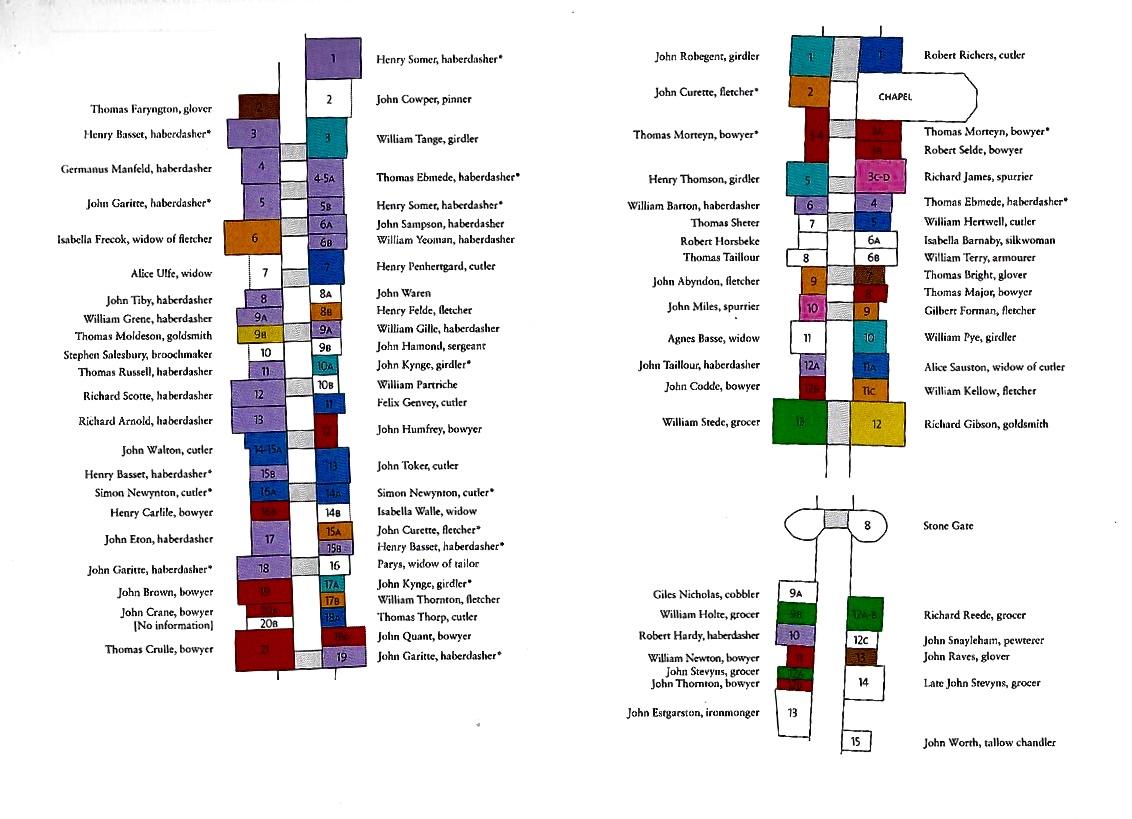
This chart shows and names the tenants on the bridge in the year 1478. Stone Gate is shown at the bottom of the chart on the right hand side with the chapel at the top. The rest of the bridge is shown on the chart to the left. The most prestigious trades were located to the north of the bridge.
For me the most intriguing part of the history of the bridge is that touching upon the houses and the people who lived and worked in them. What were their names, what did they sell, what were the interiors of their homes like? Happily for me and anyone interested in the minutiae of the history of the bridge the extensive records of Bridge House which maintained the bridge and owned the buildings on it have survived recording these very facts including the rental incomes as far back as 1358 and 1404 to 1421. The author has studied these records indepth and the result has been this amazing book. By happy chance the leases of the houses from the early 17th century thoughtfully begun to list the number of rooms in each house, plus the dimensions. These leases are especially plentiful in 1650s when all the houses were relet and a new source of information has been uncovered by the author – a table of measurements which was drawn up in 1683. This has enabled the author to write a book that is jam packed with information about how the houses and their rooms would have been utilised. There are some informative and delightful cutaway depictions which gives an intriguing peep inside as to how these houses would have appeared.
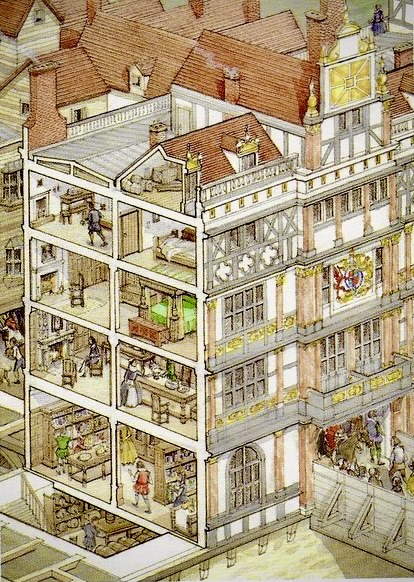
Cutaway of the eastern section of Nonsuch House c.1590. Artist Stephen Conlin.
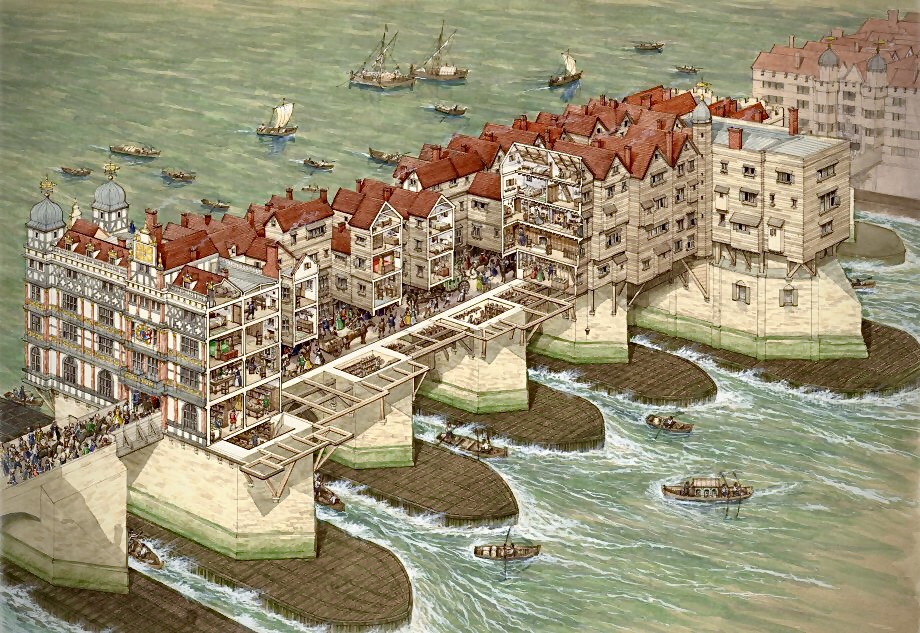
Reconstruction drawing of the bridge c.1590. Artist Stephen Conlin.
Foreigners enthused about the bridge so let us leave the last word with a French man L Grenade wrote in 1578 :
“A great and powerful bridge, the most magnificent that exists in the whole of Europe. It is completely covered with houses which are all like big castles. And the shops are great storehouses full of all sorts of very opulent merchandise. And there is nowhere in London which is more commercial than this bridge … I reiterate that there is no bridge in the whole of Europe which is on a great river like the Thames and as formidable, as spectacular and as bustling with trade as this bridge in London.”
I have been absolutely entranced by this book and if anyone reading this who shares my love of the history of old London should feel tempted to purchase it I would say go ahead, treat yourself, you will not be disappointed.
If you have liked this post you may also be interest in :
The Orange and Lemon Churches of Old London
The Abbey of the Minoresses of St Clare without Aldgate and the Ladies of the Minories
THE GRAFFITI OF THE TOWER OF LONDON
THE ANCIENT GATES OF OLD LONDON
LONDON’S LOST AND FORGOTTEN RIVERS
OLD LONDON BRIDGE – A MEDIEVAL WONDER!
 A MEDIEVAL POTPOURRI
6 thoughts on “Old London Bridge and Its Houses by Dorian Gerhold – a review.”