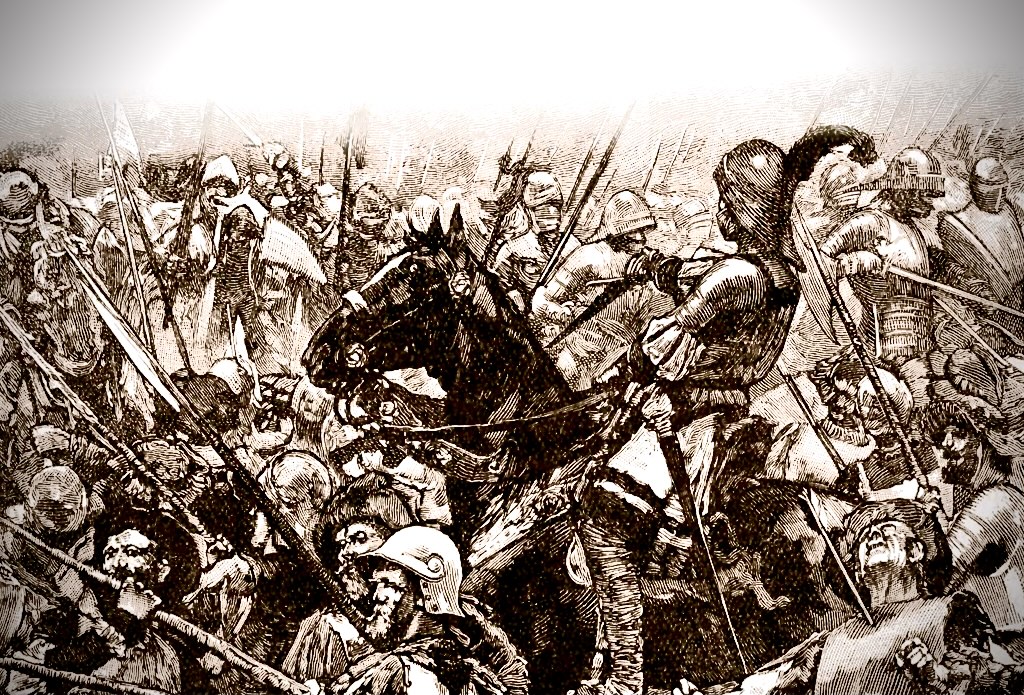
The Last Stand of Martin Schwartz and his German Mercenaries at the Battle of Stoke Field 16th June 1487. Artist Henry Marriot Paget. Cassell’s Century Edition History of England c.1901.
Dublin, Ireland, Ascension day, 24th May, 1487 (1). A young lad is crowned King of England and France and Lord of Ireland in Christ Church Cathedral, Dublin, by the last remaining diehard Yorkist rebels and leading Irish nobles. As the coronation regalia was out of reach at Westminster, London, they enterprisingly utilised a crown from a statue of the Virgin Mary. From the very get go there is confusion as to whether he was crowned Edward V or Edward VI but the consensus of opinions lean towards the latter. Who this young lad was has baffled historians ever since – was it Richard of Shrewsbury or Edward Earl of Warwick? Or perhaps neither of these? Let’s take a look at them one by one:
Richard of Shrewsbury, younger son of Edward IV
Edward, Earl of Warwick, George Duke of Clarence’s son
Edward elder son of the late Edward IV, who had been for a short time Edward V.
Lambert Simnel the young boy whom the rebellion was erroneously named after.

The choir Christ Church Cathedral, Dublin scene of the ‘Dublin King’s’ Coronation..Photo with thanks to Diliff – own work.
RICHARD OF SHREWSBURY, DUKE OF YORK
Clearly Richard can be safely ruled out as the rebels and the Herald – helpfully – all called the young lad crowned in Dublin ‘King Edward’. However Richard, born 17 August 1473, was and still is sometimes speculated as being new king. He was of course the younger of Edward IV’s sons and had disappeared in 1483 with his brother, Edward V, from the Tower of London. Their story has been told many times and is so well known I won’t go into it here. The notion of Richard being the new king was speedily abandoned and Warwick named in his stead. Can we rule out for sure that Richard was not the newly crowned king? Almost certainly but nothing is entirely certain in this foggy story much of it written in the early reign of the first Tudor king. It is more probable that Richard had made his way to Burgundy to the safe haven that was the court of his aunt, the indomitable Margaret of Burgundy? Did he then go on to morph into Perkin Warbeck to try yet again to gain the throne that had been lost to the Tudors?
Edward, Earl of Clarence.
Edward (b.25 February 1475 – executed 28 November 1499) swiftly replaced Richard as being identified as the new king. In the aftermath of the death of his mother, Isobel Neville, daughter of Richard Neville, Earl of Warwick, on the 22 December 1476, his father George, Duke of Clarence, may have taken off to Ireland for several weeks (2). He had put the death of his wife and their baby son squarely down to their both having been poisoned. He was later accused, in the Act of Attainder against him, of instructing friends and allies namely Abbot John Strensham of Tewkesbury, one of his son’s Godfathers, John Tapton and Roger Harewell to aid him in getting his two year old son out of England and to safety, Ireland being one of the very places thought of as a possible haven. This was to be achieved by the three men bringing a small boy to Warwick Castle to take the place of the true son of Clarence. Meanwhile another man, John Taylour was instructed to collect the real Edward in preparation of getting him out of England. Tapton and Harewell under interrogation, whatever form that took, would deny that they had handed the child over. Well they would wouldn’t they and their denials in the circumstances really don’t amount to much. It is not known whether Taylour too denied whether he had carried out his part of the plan and indeed may have even been out of the country and not available for questioning (3). Whether the plan was a success or a failure, on the execution of Clarence, the small boy, genuine article or not, was firstly given into the guardianship his father’s enemy Thomas Grey, Marquess of Dorset and later on for a short time to his aunt, Queen Anne Neville. How the thought of him being in Dorset’s ‘care’ makes my blood run cold… He would eventually be placed with other royal children at Sheriff Hutton Castle, Yorkshire, where following the deaths of both his aunt in March 1485 and his uncle King Richard III at Bosworth in August 1485 he would be given for a short while into the care of Margaret Beaufort, Henry Tudor’s mother, at her London home of Coldharbour before being housed in the Tower of London until he was finally executed on the 28th November 1499. It should be noted that none of his above guardians would have probably seen hide or hair of him prior to their guardianship of him so it would be very possible indeed they would not have spotted a changeling boy had been brought to them. It is rather disturbing to think that if this indeed happened a completely innocent young man would have been executed, although, of course, the true Earl was an innocent too.
Interestingly a Burgundian chronicler, Jean de Molinet, writing in about 1504 and free from the restraints of writing under a Tudor regime wrote that ‘One little branch, engendered by a Royal tree, had been nurtured amongst the fruitful and lordly shrubs of Ireland…. this very noble branch is Edward, son of the Duke of Clarence…’ As John Ashdown-Hill pointed out, Molinet’s Burgundian background ‘makes him a very interesting source’ one of the ‘key supporters of the Dublin King’ being Margaret of York, Duchess of Burgundy. Margaret was of course aunt to Edward of Warwick as she was to both the sons of Edward IV.
LAMBERT SIMNEL
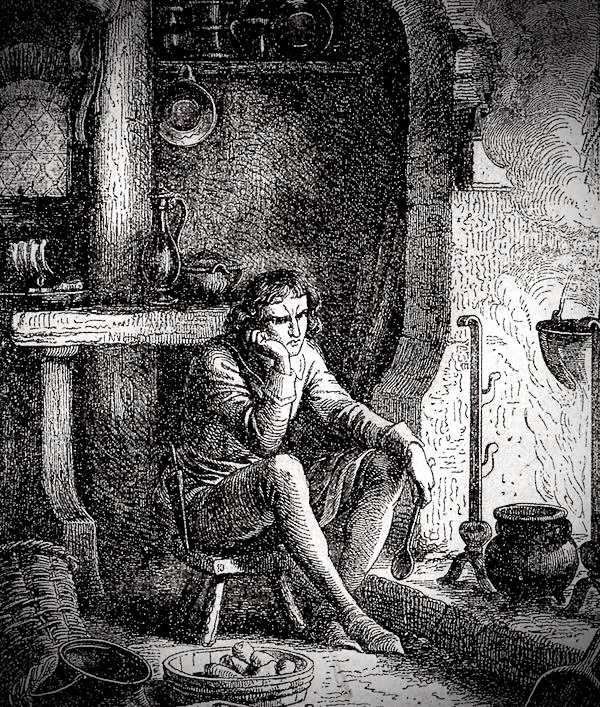
Lambert Simnel as a scullion in the kitchen of Henry VII. Artist unknown. Getty images.
Lambert born c. 1476/7 was a fake. A Tudor red herring dreamed up sometime between the Battle of Stoke and John Earl of Lincoln’s Attainder in November 1487. Why on earth would they have crowned and annointed an imposter? It makes no sense at all and frankly is ludicrous. It begs the question who was Lambert? Described by Virgil as a comely youth, and well favoured, not without some extraordinary dignity and grace of aspect’ his story is suspiciously odd from the beginning with a name that screams ‘made up’ and those not well read in history can be forgiven for confusing him with a character from panto or even a cake that you eat at Easter but in fact early documentation states his father’s name was Thomas Simnel who had connections to Oxford. After he was produced following his introduction in Lincoln’s Attainder, Henry had him placed to work in the kitchens as a scullion. What else could Henry do with the young innocent young boy said to be about 10 years old. He perhaps didn’t come off so bad as he would later achieve the giddy heights of a falconer. However Simons was imprisoned for life.
At one point, Henry, who could be really mischievous at times, bless, had invited several Irish nobles who should have known Simnel by sight- if he had actually ever been in Ireland – including the Earl of Kildare to dine. The hapless Lambert was charged with pouring them their wine – ‘new King Lambarte Symenell brought them wine to drink…’ The Irish nobles failed to recognise the ‘servant’ attending on them. Henry gave them a nudge – ‘Ah‘ said Henry ‘here is the lad you lot crowned at Dublin – you’ll be crowning monkeys next‘ or words to that effect (4). Little is known about Lambert’s later life. Let’s hope it was a good one.
THE DUBLIN CORONATION
On Saturday 5 May 1487 John Earl of Lincoln, Francis Viscount Lovell and Martin Swartz, a highly experienced general, arrived in Dublin along with 2000 veteran German troops supplied by the staunch Yorkist, Margaret of Burgundy. Margaret ‘ abhorred the mingling of the blood of York and Tudor and yearned to see it thrown down from the throne of England and that of York, pure and undivided, set up in its place’ besides which she liked nothing more than to wind Henry Tudor up. Lincoln led the call for the young lad, who had arrived in Ireland earlier, possibly accompanied by Sir Henry Bodrugan, to be crowned. Which he was – the Bishop of Meath performing the ceremony. After the crowning he was ‘carried from the church to the castle by a chieftain of the name of Darcy’, said to be man of great height (5). Swiftly following on from this, King Edward, Lincoln, Lovell and the Irish lords, Thomas and Maurice Fitzgerald along with Swartz crossed the sea from Ireland to Cumbria arriving around the 4th June and from there onto their final destination, Stoke Field in Nottinghamshire, the battle taking place on the 16th June. Upon their arrival in Cumbria they had been joined by Sir Thomas Broughton and his followers, their numbers now swollen to around 8,000. Although Kildare had also recruited 4000 Gaelic kerne to augment their numbers they were still hopelessly outnumbered – it has been suggested Tudor’s army amounted to as many as 36,000 – and expecting no mercy if they were taken the rebels fought bravely until they were almost exterminated to a man (6). Amongst those that fell that terrible day were Lincoln, the Fitzgeralds and the brave Swartz. Lovell may have escaped and there is a story that he was given refuge in Scotland. The rather lurid story that he escaped to his ancestral home of Minster Lovell and was there found, a skeleton, walled up in a hidden room in the 18th century can be discounted as the manor and lands were at the time of Stoke owned by Henry’s uncle Jasper Tudor, Duke of Bedford who held them until his death in 1495.
Edward V
After the battle the Herald recorded that the young King Edward was taken, only his real name was ‘John’ ‘And there was taken the lade that his rebelles called King Edwarde whoos name was in dede John – by a vaylent and a gentil esquire of the kings howse called Robert Bellingham’ (7). Edward/John was then taken to Newark Castle which was the same place Henry Tudor headed.
The inclusion of the name ‘John’ has been described by Gordon Smith as perhaps a ‘spontaneous invention recorded shortly afterwards‘. Only wait! It is perhaps more than a coincidence that there are reasons to believe that Edward V had been living since 1484 incognito under the name of John Evans (EVans…get it!) at Coldridge in Devon one of the properties owned by his half brother, Thomas Grey, Marquess of Dorset. After Stoke, if this theory is correct he would return there to live out the remainder of his life perhaps after being grieviously wounded during the battle. To read more about this theory please read, if you have not already done so A Portrait of Edward V and Perhaps Even a Resting Place? and A PORTRAIT OF EDWARD V AND THE MYSTERY OF COLDRIDGE CHURCH…Part II.
And so the last terrible battle of the Wars of the Roses was over. I’ll not linger upon it. It is well recorded elsewhere. But in very brief summary the Yorkist leaders, Thomas Fitzgerald and Martin Swartz lay among the slain but the majority were unnamed and would be buried in mass graves far from their homes. It is said only 200 of King Edward’s army survived. The English and Irish who were captured after were executed while the foreign ones were dismissed.
AFTERMATH
One of the most surprising victims of the rebellion was Edward V’s mother and mother-in- law to Henry VII, Elizabeth Wydeville. Only having recently regained some of the status she had lost during the reign of Richard III she was now the dowager Queen Mother and it came as a bolt out of the blue when after a council meeting at Sheen in February 1487, held to discuss the revolt, her recently acquired gains were removed from her forthwith and she was sent to reside in Bermondsey Abbey while her son Thomas Grey Marquess Dorset, despite his protestations of innocence, was sent to the Tower. She lived out the last years of her life at Bermondsey and her will demonstrates that she was living, if not in penury, in much straitened circumstances. Yes, Elizabeth had been caught at it again. She was involved in the Yorkist rebellion of 1487 later erroneously known as the ‘Simnel’ Rebellion. This was quite extraordinary as, if the rebellion had succeeded, her own daughter Elizabeth of York would have been ejected from the throne, her little grandson Arthur disinherited. No doubt her son-in-law would have got the chop too but every cloud has a silver lining as they say. Why would she do this? Certainly not for the son of Clarence, a man she had hated, to take the throne. Let’s not beat about the bush. Elizabeth knew that at least one of her sons survived but that is another story for another day.
Recommended reading- Lambert Simnel and the King from Dublin GORDON SMITH
- The date of 24th May has been accepted by some historians as this was the date given in the Earl of Lincoln’s attainder passed by the English Parliament in November 1487. However historian Randolph Jones believes that the Coronation was actually held 3 days later on the 27th May, which was a Sunday and the usual day that Coronations were held. See his article A Revised date for the Dublin Coronation of Edward VI. Ricardian Bulletin June 2009 pp.42-44.2.
- John Ashdown-Hill The Third Plantagenet p.133.
- The Dublin King p.71 John Ashdown-Hill.
4.See the notes to Gordon Smith’s article ‘Lambert Simnel and King from Dublin, Ricardian: Book of Howth p.190; Mackie p.74; Potter p.90. There is no firm date for the Irish visit with its jokes about apes and Lambert Simnel’s banquet, but it may be as early as February 1489, when Henry VII reaffIrmed the titles of the Irish lords at Greenwich, CP, vol.1, p.458. The banquet story has been charmingly told by Mackie, based on the Book of Howth.
5. John Cassell Cassell’s Illustrated History of England p.83 1857.
6. Lambert Simnel and the Battle of Stoke p.131. Michael Bennett. Chronicles of Jean Molinet.
7. Heralds Report. c.1488-90. Author: A herald or pursuivant at the court of Henry VII. British Library, Cotton MS.
If you have enjoyed this post you might also like:
EDWARD, EARL OF WARWICK – HIS LIFE AND DEATH.
A Portrait of Edward V and Perhaps Even a Resting Place?- St Matthew’s Church Coldridge
A PORTRAIT OF EDWARD V AND THE MYSTERY OF COLDRIDGE CHURCH…Part II A Guest Post by John Dike.
SIR JAMES TYRELL – CHILD KILLER OR PROVIDER OF A SAFE HOUSE ?
 A MEDIEVAL POTPOURRI
17 thoughts on “THE MYSTERIOUS DUBLIN KING AND THE BATTLE OF STOKE”