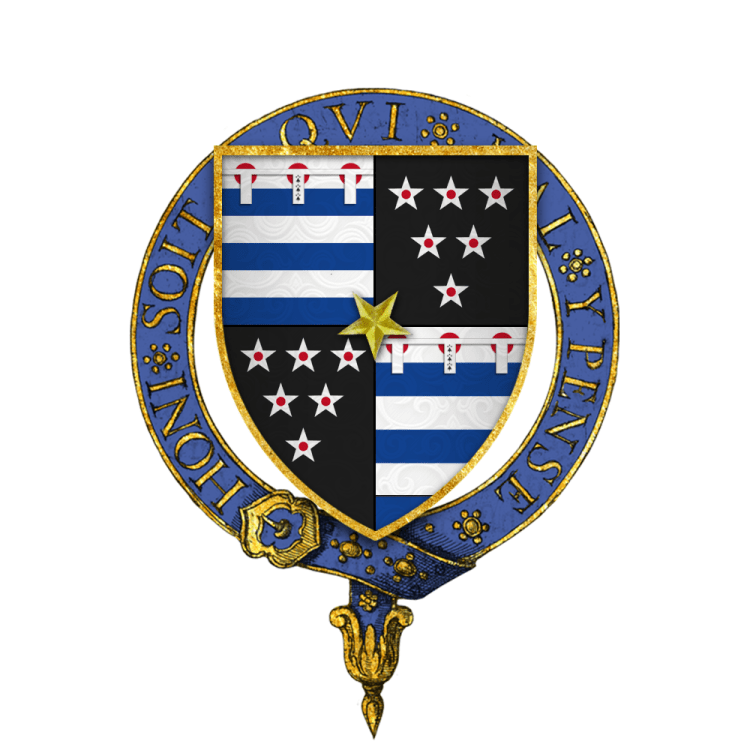
Arms of Thomas Grey, Marquess of Dorset (c.1455-1501). Wikipdia.
Well, well, well. What can I say about Thomas Grey Marquess of Dorset (c. 1455–1501)? A member of the voracious Wydeville/Woodville family he lived through the tumult of the Wars of the Roses, at one time ending up in a bit of a pickle after managing to irk a suspicious Henry VII and for which he spent some time in Tower of London but with remarkably good luck managing to die in his bed in 1501. Husband to the extremely wealthy Cecilia Bonville, (c.1460-1529) suo jure Baroness Bonville and Harrington, with whom he had a massive brood of children. I will return to this marriage below. My favourite portrayal of him was in the mavellous 1972 BBC broadcast ‘Shadow of the Tower ‘in which he was portrayed as a peevish, whinging and truculent medieval Billy Bunter. But what was he really like? Has he been dealt with unkindly by history while actually possessing a capacity for bravery or was he just basically inept? And was the family motto a ma puissance (according to my power) appropriate in his case or perhaps a tad ambitious? Or was he merely multifaceted as so many people were and still are?
He was the elder of the two sons that Elizabeth Wydeville (c.1437-1492) had with her first husband Sir John Grey (c.1432-1461). Sir John would die fighting for Lancaster at the second battle of St Albans on 17 February 1461. With his mother’s amazingly fortuitous second marriage to Edward IV, Thomas and his brother Richard would eventually gain a large brood of half brothers and sisters the most famous of which were, of course, Edward V and Elizabeth of York. His grandmother Jacquetta of Luxembourg (b.1415-1472) was from high status noble stock – being the daughter of Pierre, Comte de St. Pol She had been married at 16 to the much older, extremely rich and powerful John of Lancaster, Duke of Bedford, a brother to Henry V. Her husband dying quite soon after their childless marriage she promptly married Richard Wydeville, clearly a love match with him being a mere knight and way below her social status. The couple married without permission from Henry VI, for which they would later be issued with a massive fine. Some sources say this fine was later rescinded but presumably if it was ever paid it would have been done so by Jacquetta as she was the one with the dosh. Richard, with his new wife, returned to England to live – probably at Grafton – ancestral home of the Wydevilles. There they raised their children including the daughter who had the luck of turning the head of a young testosterone loaded Edward IV who would please himself as to whom he would marry , unwisely as it transpired, for the marriage turned out to to be the rock that the House of York foundered upon. But back to Thomas…..
PERSONAL LIFE

Astley Castle, Warwickshire. Marital home to Sir John Grey and Elizabeth Wydeville later Queen of England, parents to Thomas Grey. It’s unclear whether Thomas Grey was born at Astley but he would most certainly have spent much of his childhood there. Photo Astley Parish Council.
Thomas’ place of birth is unknown. John Ashdown-Hill suggested it was somewhere in London although it also seems likely it may have at Astley Castle, Warwickshire – think more fortified manor house than ragged castle – ancestral home to the Grey family. He has been described by the historian T B Hugh as a man of ‘mediocre abilities as well as ‘shifty‘ who managed to attain his position solely through his mother marrying a king rather than via pluck or ability although it is true he had a vague connection to Edward I (1). It should however in all fairness be remembered that Vergil, writing c.1513, described him as vir bonus et prudens (good and foreseeing) although it should also be remembered that Vergil was prone to sometimes speaking a load of old cobblers – well quite frequently to be honest (2) . Now while I have no wish to cast aspersions on the integrity of Polydore Vergil it would serve us well to remember that history is written/dictated by the victors – in this case Henry VII’s fan club i.e. Morton, Foxe, Bray and Urswick and thus Vergil’s account should be viewed with some caution. For those who wish to read more about Vergil’s reliability click here. and here.
Once Elizabeth Wydville had become queen she sought to make advantageous marriages for her children and for her eldest man cub she succeeded in doing so in 1466 when Thomas married Anne Holland (c.1455-c.1474), the daughter and heiress of Henry Holland, duke of Exeter and whose mother was Edward IV’s sister, Anne of York (1439-1476 ). It has been said that this marriage, which took place in October 1466, exacerbated the already simmering fury of Richard Neville, later known as ‘The Kingmaker’, after a proposed marriage between his then infant nephew and male heir, George Neville (I465-83) and Anne Holland was scuppered in order for her to marry Thomas (3).
Shortly prior to this Richard Neville had already been outraged over the clandestine marriage of the king and Elizabeth Wydeville, the ensuing secrecy of which had left him looking foolish as he had, oblivious to the true situation, carried on in his negotiations for a French bride of suitable rank for Edward. Warwick would get his revenge in 1469 when he managed to execute a couple of Wydevilles, Thomas’ grandfather and uncle, Richard and John Wydeville.
Sadly Anne was to die aged 18 and childless. Nothing daunted another marriage and another great heiress soon loomed on the horizon and in 1474 Thomas, aged 19 married 13 year old Cecilia Bonville.whose stepfather was none other than William Hastings, first Baron Hastings (c. 1430–1483).
It was through Cecilia that Thomas would gain the vast estates that had come to her via her grandfather William, Lord Bonville (c.1392-1461) as well as the Harrington barony. Didn’t he do well? And no doubt stepfather – Edward IV – breathed a massive sigh of relief as his stepson became self sufficient. However the Bonville marriage would bring Thomas head on in collision with Cecilia’s stepfather, the formidable William Hastings, first Baron Hastings (c.1430-1483) who had risen to dazzling heights because of his close friendship with Edward IV. Possibly this caused a few headaches for Cecilia who may have felt as if she was stuck between a rock and a hard place. Nevertheless Cecilia’s and Thomas’ marriage would prove to endure successfully if the number of children the couple produced is anything to go by. Casting that aside though it has to be said that Thomas was far from a faithful husband and it’s recorded that one of the reasons he fell out with Hastings was over a mistress/mistresses, which I will return to later.
There is also some reason to believe that he had an affair with Lady Anne Stonor nee Neville, wife to Sir John Stonor and daughter of John Neville, Marquess of Montague – brother to Richard Neville, Earl of Warwick. Perhaps fortunately for him both Neville brothers were dead at this time haven fallen at Barnet in 1471. The newly wed Anne Stonor’s behaviour does seem rather strange when she hastened to Thomas’ home, Taunton Castle, immediately after her marriage in late 1481 to Stoner, where she remained for several months, presenting her husband with a son nine months later (4). Furthermore it would seem that Thomas had taken a shine to yet another of Montague’s daughters because there is also the intriguing bequest made in the will of his daughter Elizabeth, Lady Scrope of Masham (d.c.1518) when she bequeathed a bed to an illegitimate daughter of Thomas: ‘Mary, daughter in base unto Thomas Grey Marquess of Dorset my bed that my Lord Marquess was wont to lie in….’ (5). Now far be it for me – as I’ve said before – to cast aspersions – but it does indeed sound a tad dodgy. Anyway onwards….
Besides rumours of possible liaisons with Montague’s daughters there are also statements by the chroniclers of the times that both Thomas and his stepfather-in-law, Hastings, shared the same mistress i.e. Elizabeth/Jane Shore née Lambert. Following the coronation of Richard III in 1483 the Great Chronicle of London recorded that ‘Shortly afftyr (Richard’s coronation) was a woman namyd Shoore that before days, after common fame, the Lord Chambyrlayn (Hastings) held, contrary to his honour, called to a reconnyng ffor part of his goodys & othyr thyngys…and she lastly as a common harlot put to opyn penaunce’. Following on from this on the 23 October 1483, in a public proclamation issued by Richard III, Thomas was denounced in the following words: ‘Thomas Grey, late Marquess of Dorset, not fearing God, nor regarding the peril of his soul, hath devoured, and deflowered many maidens, widows and wives, and holding the unshameful and mischievous woman Shore’s wife in adultery. ‘ (6).
POLITICAL AND MARTIAL LIFE
Thomas fought – for York obviously – at the battle of Tewkesbury in May 1471 where it has been suggested by some sources he was in suspiciously close proximity to Prince Edward of Lancaster when he met his demise. He was soon after ‘created earl of Huntingdon on 14 August 1471, a dignity which he subsequently resigned before he became a marquess’ (7). He was also present on Edward IV’s French expedition in the autumn of 1475. He would also later benefit from the death/judical murder of George, duke of Clarence in 1478 and it has been said that he treated George’s son, the young tragic Edward Earl of Warwick, with undue harshness during the period he was his ward.
Nowhere did the differences between Thomas and Hasting become more apparent than in the aftermath of Edward IV’s unexpected death in April 1483. These differences according to Mancini had arisen on account of the mistresses they had abducted or seduced from each other besides of which, in any case, Hastings loathed the entire (Wydeville) family on account of the marquess (8). Whether this is the entire crux of the matter or just part of it is now lost to us. According to Mancini the dying king had sought to reconcile the pair of them, both of whom were dear to him. It’s easy to imagine the rising panic the king may have felt as he realised his death was imminent and he was leaving his kingdom to a young and extremely vulnerable heir, the 13 year old Edward, who would need all the support he could get – not two snarling egotistical nobles at each others throats.
Immediately following Edward’s death the Wydevilles, galvanised into action, sought to gain control of the person of the new king, Edward jnr, who was living at Ludlow Castle, then in the Welsh Marches but now in Shropshire. As mentioned above according to Mancini, Hastings already detested the Wydevilles and it has been suggested that it was he, now thoroughly alarmed at the direction things were heading, and in an attempt to put a brake on their schemes, who wrote to Richard, duke of Gloucester, to warn him of their shenanigans. Perhaps he even repeated the utterance of Thomas, his dangerously deluded son-in-law, who perhaps lacking the ability to read a room, announced to a probably stunned Council that they – the Wydevilles – were ‘so important that even without the king’s uncle, we can make and force these decisions..’ (9). Oh dear. …. Unfortunately for Thomas and his mother, Gloucester deftly managed the situation and after arresting Anthony Wydeville, earl Rivers, now the male head of the Wydeville family and his nephew, Richard Grey, at Stony Stratford, proceeded to London with the young king under his care. When news of Gloucester’s impending arrival reached London, Thomas, abandoned the Tower of London, of which he held the control of, but not before secretly removing ‘great quantities of the (late) king’s treasure out of it‘ (10). He joined his mother, her youngest son Richard of Shrewsbury and several daughters when they scurried out of Westminster Palace and over the road into sanctuary at Cheyneygates, the Abbot’s house in the precincts of Westminster Abbey. Cheyneygates far from being the hell on earth described by Virgil, as per usual over egging the pudding, as an ‘asylum‘ and ‘this earth’s sole refuge for the poor, for bankrupts, and for rascals‘ would have actually been the height of luxury. If we look into the future we will see that in 1487 Elizabeth would take a 40 year lease on Cheyneygates something she would have hardly have done if it was the awful dump as described by Virgil.
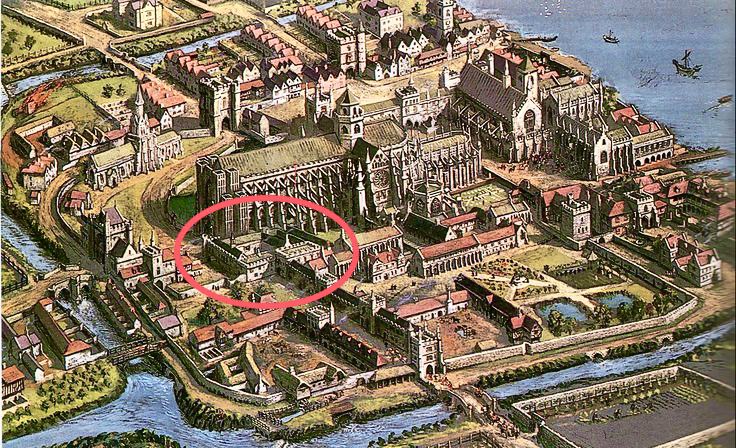
Artist’s impression of the Abbot’s house known as Cheneygates, in the precincts of Westminster Abbey. It was here that Thomas Grey joined his mother and half siblings in sanctuary.
But I’ve gone off on a tangent here and back to the story…. Once more Elizabeth Wydeville found herself in sanctuary and this time through her own ill thought out plots. We will never know how different things would have turned out if she had but remained openly at Westminster to greet her son Edward V and his uncle Richard Duke of Gloucester upon their arrival. What had she to fear? Richard is well known for his kind treatment of women, including the wives of traitors such as Katherine, Lady Hastings as well as Henry Tudor’s mother, Margaret Beaufort, whose plotting was a major contributing factor to his later downfall and death in 1485. Unfortunately for many of the participants in this story the Wydeville family, described by Thomas More as the proud and haughty kindred of the Queen chose the warlike route which led to ruination and death for so many including Thomas’ nemesis, William Lord Hastings and a bloody and dreadful day at Stoke where the York dynasty was extinguished forever.

Elizabeth Wydeville whose first husband was Sir John Grey, father to Thomas and his brother Richard Grey. Spent her last years in Bermondsey Abbey after one plot too many…..’Royal Window’ North Transcept, Canterbury Cathedral.
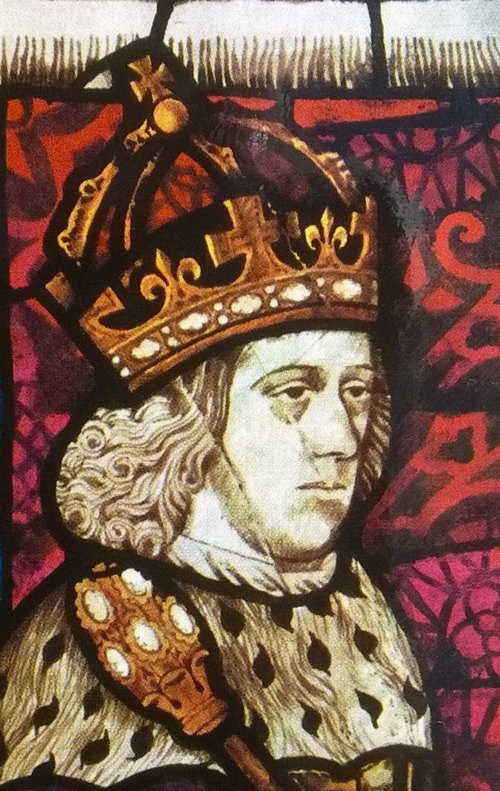
Edward IV. Indulgent stepfather to Thomas Grey. In a deadly complication, Thomas and Edward’s closest friend, William Hastings, stepfather in law to Thomas would fall badly fall out with fatal results. ‘Royal Window’ North Transcept, Canterbury Cathedral.
Thomas did not remain for long in sanctuary and it has to be one of the high points in his life – where he most certainly earned a couple of kudos – when he managed to make his escape after thwarting the guards set up around the precincts of the Abbey. Mancini describes the search made on the orders of Gloucester when it was discovered Thomas had made his escape: ‘On the supposition he was hiding in the near vicinity, he (Gloucester) set armed men with dogs to surround the mature crops, as well as the newly planted and woodland areas, seeking him out by the most closely hemmed in encirclement in the manner of huntsman, but nowhere was he discovered (II). A letter written by Simon Stallworth describes how the goods of Thomas were taken wherever they were found: Wher so evyr kanne be founde any godyse of my lorde Markues it is tayne (12). Dangerous times for Thomas who then recklessly joined the Buckingham rebellion.
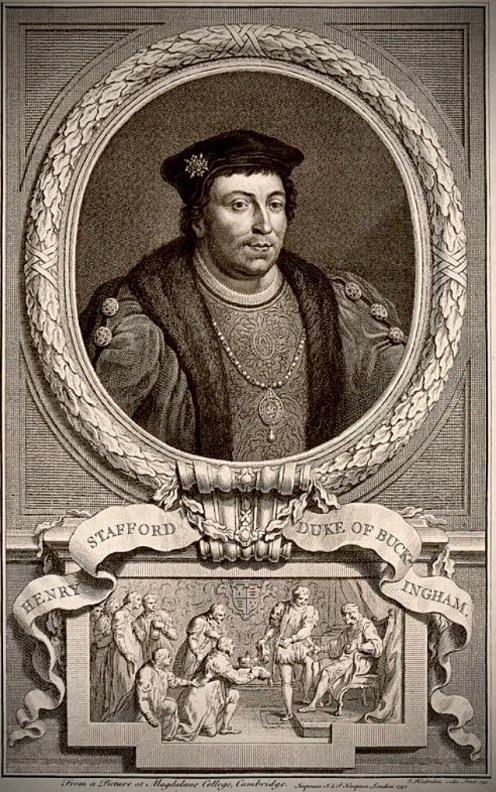
Henry Stafford duke of Buckingham. For reasons unclear rebelled against Richard III with fatal results – for himself. Thomas Grey unwisely joined Buckingham’s rebellion although he escaped and survived. Buckingham – quelle surprise – got the chop. A rather ridiculous creature – whom Richard III shocked at his duplicity named him the ‘most untrue creature living’. An 18th century etching. Possibly from a lost original?
Following the collapse of the rebellion he made his way to Brittany to join forces with Henry Tudor. Croyland Chronicle described how in the immediate aftermath of the failure of the rebellion, King Richard proceeded with the whole army towards the western part of the kingdom where all his enemies had taken up their positions. Overcome by fear at this terrible arrival, the Bishop of Exeter, Peter Courtney, as well as Thomas Marquis, of Dorset, and various other nobles of neighbouring districts, who had conspired in the rebellion, or as many of them as could find shops in readiness, took to the sea, and finally landed on the desired shores of Brittany. Lucky Henry! Upon reaching Brittany it appears Thomas got a bit lost – if Virgil’s narrative can be trusted – as Henry, possibly initially pleased to hear of his arrival – obviously he had never met him – sent some of his followers to guide Thomas to him.
Of course we know that the coronation of Edward V never took place. The story is well known of how it was revealed that his father, Edward IV, prior to ‘marrying’ Elizabeth Wydeville had been married to another woman, Lady Eleanor Butler/Boteler née Talbot daughter to John Talbot, Earl of Shrewsbury (c. 1387–1453) also known as the Great Talbot. Thus according to the canon law of the times, his marriage to Elizabeth Wydville was invalid as needless to say, no-one, not even a king, could be married to two women at the same time. Whether this came as a shock to Thomas we will never know. Had there been a point earlier where Elizabeth Wydeville felt it prudent and necessary to enlighten Thomas upon the truth of the matter which was that the ‘marriage’ between her and the late king had never actually existed? Or was it unnecessary for her to spill the beans as Hastings, his hostile stepfather-in-law – had already spitefully informed him – perhaps in a moment of pique – as you do? It surely has to be very likely that Hastings was aware of the dangerous truth considering his close friendship with best buddy Edward IV. Anyway the cat was well and truly out of the bag and the crown was offered to Gloucester by the Three Estates which he duly accepted becoming King Richard III. The situation with Elizabeth Wydeville remaining in the sanctuary of Cheyneygates remained unchanged for some months until in early March 1484 she finally made her peace with Richard III. This led not only to her departure from sanctuary but also writing to Thomas, who was then in Paris, advising him to return home and that Richard would treat him well. An indication of Richard’s goodwill and genuine willingness to reconcile with Thomas was his name being omitted from the proclamation against the rebels made in June 1485 despite being formerly attainted by Parliament in 1474. This extraordinary volte-face by the ex-Queen was conveniently explained away by Vergil, who as already mentioned had a strong propensity for waffling, as being a consequence of her being a woman: for thus her sex is a changeable animal’. Ah…silly me. There was I thinking Elizabeth’s actions were due to her knowing that one or even both of her princelings were still alive. However, Thomas must have thought it a brilliant idea as Vergil described how he left Paris furtively by night, and hastened to Flanders. As soon as the earl (Henry Tudor) and the other English nobles found this out, they were deeply disturbed and requested (King) Charles’ permission to retrieve this man from wherever he was, because he was party to their plans. This they were readily granted, and they began to scour all the highways. But Humphrey Cheney was best at scenting the trail of this runaway, and followed the marquis straight to the town of Compiègne, and was so successful at persuading him that a little he returned to his comrades’
Whether Thomas’ return was the result of gentle persuasion, more forceful means i.e. dragged by his ankles or entirely of his own free we will never know. Tellingly when Henry Tudor departed France to invade England Thomas was one of those chosen to be left behind in Paris as surety for the repayment of a loan made to Henry by the French Government in order to finance his invasion. Only when Henry was firmly ensconced on the throne- albeit now and again troubled by various pretenders – was Thomas ‘redeemed’ and finally able to return home in November 1485. Once home his attainder was reversed and much of the properties confiscated by a hacked off Richard III were returned to him but although he regained his wealth the same could not be said of the political power he had enjoyed under Edward IV. I will return to this later.
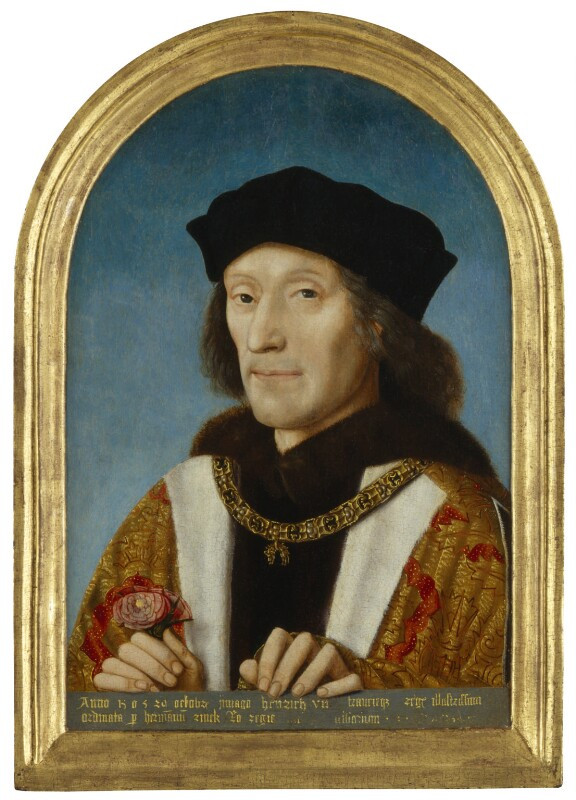
KING HENRY VII. Not someone it was wise to get on the wrong side of. Nevertheless historian T B Pugh was of the opinion that Henry treated Thomas Grey with ‘wisdom and restraint’. Unknown Netherlandish artist c.1505. National Portrait Gallery.
Sources say that after a council meeting at Sheen in February 1487 where the Yorkist rebellion of that year was being discussed things took a serious and dramatic down turn for both Thomas and his mother. In an attempt at appearing loyal to Henry, Thomas attempted to bring his forces to join those of Henry in East Anglia. But Henry had learned a useful lesson at Bosworth when he had such a narrow escape after nervously watching Sir William Stanley sitting upon the fence prevaricating until the very last minute. Henry ordered the Earl of Oxford to arrest Thomas and clap him in the Tower of London until the rebellion was over and it was considered safe for him to be allowed wander around freely. His protestations of innocence were batted aside and he was advised, as Vergil puts it, that if he were a friend (as in truth he was) he would scarcely take amiss this small indignity for the sake of his own safety. Perhaps Henry, a wily man, had not been able to get to the bottom of Thomas’ plotting. However he saw no need to delay punishing Elizabeth Wydeville who was promptly sent to live out the rest of her days in Bermondsey Abbey. after being, as Vergil would put it ‘mulcted of all her possessions.‘ It seems Thomas was never able to gain the trust of Henry again as can be seen by him having to take an oath in 1492 before Henry’s French expedition that he would not commit treason, or conceal acts of treason of which others were guilty. This seems rather odd that as late as 1492 Henry felt it necessary to warn Thomas to behave and not get embroiled in treasonable acts or with anyone else involved with them. Was this because they both knew about the man known as John Evans who was living at one of Thomas’ properties, Coldridge, Devon, and is now being speculated as being the very much still alive adult Edward V living there incognito? Was Edward sent to live at out of the way Coldridge with an agreement reached by Richard III and his mother and had she managed to enlighten Thomas to this fact and that is why he made a brave attempt to return home to England? And did they both wait until the time was ripe to incite a rebellion whereby Henry Tudor would be turfed off the throne and a young Plantagenet put back on it? Of course at Stoke all would go pear shaped and their venture failed. But here’s the thing! Because should these speculations hit the nail on the head, then far from being a dolt, did Thomas manage to pull off one of the biggest hoodwinks in history. The successful secreting away of one of Edward IV’s missing sons enabling him to live out his life in peaceful incognito – a secret that has sustained up until this very day.
Pugh opines that Henry showed wisdom and restraint in his treatment of Thomas and possibly indeed to his half brother Edward V if he did indeed live out his life as John Evans. Did he maybe actually like Thomas who was after all his brother-in-law? Just a teeny bit? He did, after all kindly allow him to take part in the crushing of the Cornish uprising in 1497.
LIKENESSES
Likenesses are few and far between of Thomas. In fact I could find none. However here, and in the interest of having a little fun, are some stills from The Shadow of the Tower broadcast by the BBC in 1973. The late marvellous James Maxwell played Henry Tudor while Leonard Gregory played Thomas. The pained face of Henry, as Thomas declares he is innocent, completely innocent! says it all really. I do like to think that the BBC casting department got it absolutely spot on in this instance:

Henry Tudor – “What does the idiot want? ….”
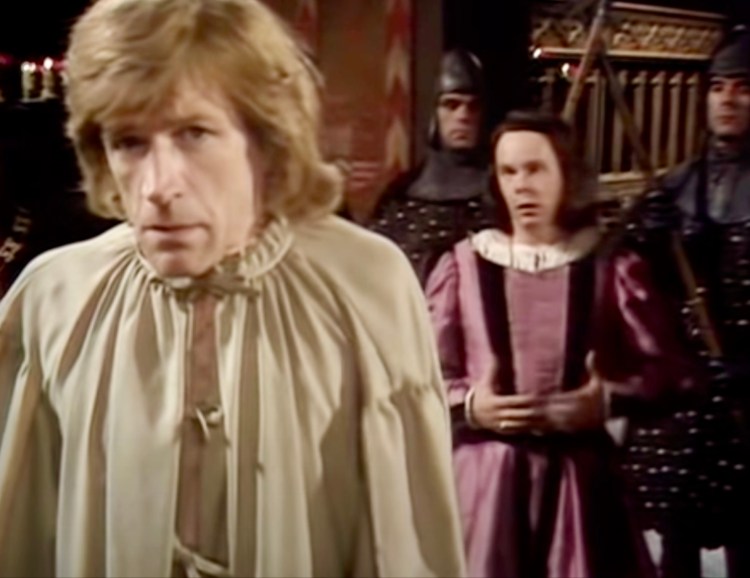
Thomas – “I’m badly used Your Grace and I’m innocent…”

Thomas “I have done nothing – nothing – for what cause have I done to offend the king?”

Thomas “I am Your Grace’s brother…..!”

Henry “Take him to the Tower…you’ll be safer there Thomas and I’ll know where to find you when rumour makes up its mind…’
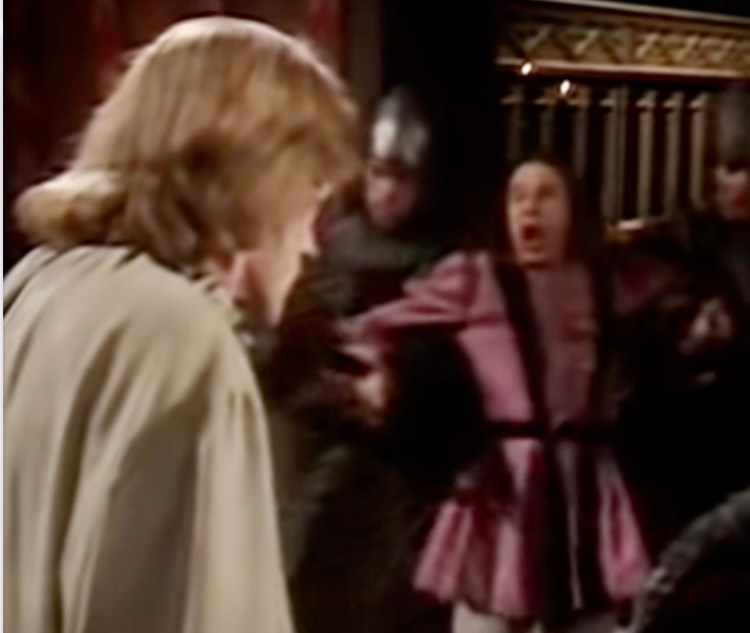
Thomas ” Nooooooooooo! not the tower….urgh! ‘
Priceless. However back to reality….
CONCLUSIONS
Thomas died at his London home on the 30 August 1501. I have been unable to ascertain where this house stood which is strange because it must have been a significant building. Perhaps Cecilia was with him as he breathed his last. He was one of the fortunates of the time who having been deeply involved with the often horrific and bloody occurrences of the Wars of the Roses still managed to die in their beds. His will requested that he be buried in his chapel at Astley Church, Leicestershire. Which was what happened. His grave and monument are lost today although Cecilia’s monument has survived although not in its original position.
‘My body to be buried in my College of Astley, in the County of Warwick, before the image of the blessed Trinity, in the midst of my closet in the said College. I will that my executors shall cause one hundred masses to be said for my soul in every of the four Orders of Friars in London, and that at the time of my burial c marks to be distributed in alms to poor people.’
He also requests prayers for his dead parents, stepfather – to whom he owed so much – and touchingly for his first wife, the young Anne Holland who had died so many years previously at just 18 years old:
‘Also I will that the hospital of Lutterworth, in the county of Leicester, of my patronage, be appropriated to the Dean of my College of Astley, to the intent they, the said Dean and his brethren shall, specially pray for the souls of King Edward the fourth, Queen Elizabeth, his wife, my mother, as likewise for the souls of my father, and of my wife, my own soul, and for all Christian souls‘ (13).
So what should we make of Thomas? A sometime hero? Or vain and untrustworthy? Perhaps none of these or a combination? I will leave that to you Dear Reader to draw your own conclusions…..
-
.Oxford Dictionery of National Biography. Grey, Thomas, first marquess of Dorset T B Pugh.
- Anglica historia. Polydore Vergil
-
What might have been: GeorgeNeville,Duke of Bedford1465-83— his identity and significance. M. A. Hicks.
4. Memorials of the Wars of the Roses p. W E Hampton. See also relevant letters in the Stonor Papers relevant to the stay of Anne at Taunton.
5. Testamenta Vetusta Vol.2. p.p.587.588. Ed.Sir Nicholas Harris Nicolas. See also Memorials of the Wars of the Roses. W E Hampton.
6. I have taken this from the late Arthur Kinkaid’s wonderful edition of The History of King Richard the Third. It is also contained in the Cal.Pat.Rolls 1476-85 p. 371. Foedera Vol.XII,p.204. Richard III p.503. Paul Murry Kendall.
7. .Oxford Dictionery of National Biography. Grey, Thomas, first marquess of Dorset T B Pugh.
8. Mancini. Translation by Annette Carson p.51.
9. The History of King Richard III. Buck. p.247. Arthur Kinkaid edition.
10. Mancini. Translation Annette Carson.
11. Ibid..
12. The Stonor Letters and Papers p.159. Ed.Christine Carpenter. Letter from Simon Stallworth to Sir William Stonor dated 9 June 1483.
13.Testamenta Vetusta Vol.2. p.442.
 A MEDIEVAL POTPOURRI
The actor was Leonard Gregory.
LikeLiked by 1 person
Thank you so much Dan. I will now edit the post,
LikeLike