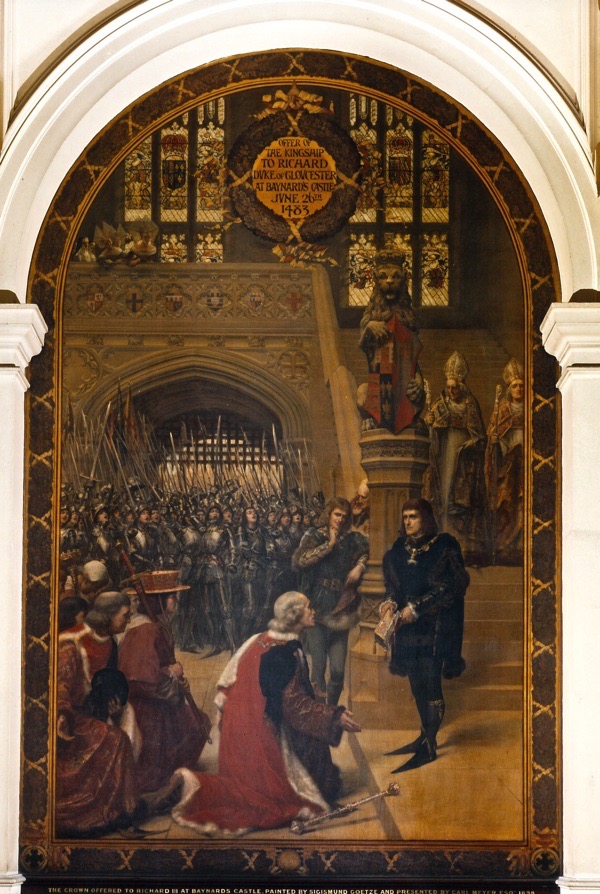
 Artist’s impression of the offer of the Kingship to Richard, Duke of Gloucester, Baynards Castle by the Three Estates of the Realm. Mural in the Royal Exchange. Artist Sigismund Goetz.
I am happy to have a guest post written by Brian Wainwright first published on Murrey&Blue back in 2018. It’s an eloquent, succinct explanation of the tricky situation that evolved in London in June 1483 after the breaking of the staggering news that Edward V, being illegitimate, could not take the throne. It also addresses allegations that the Three Estates and Londoners were in fear of a large army imposed on them by Richard, then Duke of Gloucester, imminently about to become Richard III.
Over to Brian…
It was not the first time that a Convention Parliament* had effectively determined the succession. We might look at, for example, the precedent of 1399, when just such an assembly deposed Richard II and (in effect) elected Henry IV, who was not even Richard II’s right heir. (He was the heir male, but strangely enough did not claim on that basis.) Of course, in 1399 Henry’s very large army was in place in the London area, and it would have been difficult for the Parliament to have rejected him, even had it wished to do so.
Richard, Duke of Gloucester, had no equivalent army in London when the Three Estates met. It is worth remembering that Parliament could reject claims to the throne it did not care to approve. The obvious example is that of Richard’s own father, Richard, Duke of York, who had his very strong claim rejected in 1460. Peers did not show up at Parliament unattended, and if they had strongly objected to Richard’s claim they could easily have mobilised their forces against him, if necessary. The fact is, they chose not to do so.
It seems certain that evidence of Edward IV’s bigamy was presented to the Estates. Sadly, we do not know the details and never will. But it is certain that among the bishops there were no shortage of theologians, any one of whom could have stood up and protested against the accession of Gloucester at very little personal risk to themselves. True, they might conceivably have been imprisoned, but what is that to a senior churchman when the immortal soul is at risk? In 1399, the Bishop of Carlisle objected openly to Richard II’s deposition, and was imprisoned for it, but he survived. There is no evidence of any bishop speaking up for Edward V.
Finally, it is sometimes argued that the legitimacy of Edward V was a matter that ought to have been determined by a Church court. However, the idea that the Parliament of England in the late fifteenth century would allow the succession to be determined by one or more bishops, or even by the Pope, is rather naive. It was, after all, only half a century later that Thomas More and Richard Rich agreed between themselves that Parliament had the power to make Richard Rich king, if it chose to do so.
So there we have it. This may be hard to digest by traditionalists and their followers who have long accused Richard of ‘usurping’ the throne by force and allowed to do so by a cowered Three Estates but there it is. Yet another myth. In summary, Richard’s northern troops did not arrive until after Richard had been offered the crown and accepted it. Thus there was no need for a large armed force to be present in London – nor had they even arrived in London at that point – to enforce Richard’s will upon a tyrannised, browbeaten Three Estates and an equally unwilling population (1).
*A Convention Parliament is one that acts without the usual royal authority….
- Richard III: The Road to Bosworth Field p.p. 114.117. P W Hammond and Anne E Sutton
 A MEDIEVAL POTPOURRI
Excellent😊!
LikeLike