
Elizabeth Wydeville, unknown artist, Royal Collection.
If anyone today wandering around Bermondsey, South London, should find themselves in redeveloped Bermondsey Square they may be surprised to find that they are standing on the spot where once stood the quadrangle of Bermondsey Abbey, the entrance to the square being the site of the Abbey gatehouse.

Very little remains today above ground (after the archaeologists had completed their study of the Abbey remains in 2006 they were once again covered over) other than some remnants of the south western tower which can be seen below the glass floor of a restaurant and nearby houses on Grange Walk, 5, 6 and 7 which incorporate in their structure remains of one wall of the Abbey’s stone eastern gatehouse, particularly No.7, where the chamfered south jamb with two wrought iron gate hooks still project.

5, 6 and 7 Grange Walk, Bermondsey incorporating the remains of the Abbey’s eastern gatehouse seen in 18th century engraving below with remains of hinges. Note the roof line still recognisable today and windows still in original positions.


18th century prints of the Abbey Gatehouse. The gate has already gone but note the surviving hinges.

Drawing by C R B Barrett 1906 where the two Gatehouse hinges can clearly be seen with the remains of a third one still visible.
It is intriguing to remember that in this Abbey, Elizabeth Wydville/Woodville, Edward IV’s widowed queen lived out the last five years of her life, dying in the Clare guest suite on 8 June 1492. She was the second queen to both ‘retire’ and die there, the first being Katherine of Valois, Henry V’s widow. Elizabeth commenced her ‘retirement’ there in February 1487 and debate still rages as to whether she retired there willingly or unwillingly with some good reason to be believe that her withdrawal there was forced upon her by her peeved son-in-law, Henry VII who had reached the end of his rope with her and her penchant for plotting. Her sudden and extreme change in circumstances, as well as Thomas Grey’s incarceration. followed hot on the heels of the news of the outbreak of the Yorkist rebellion – which has became erroneously known as the Lambert Simnel rebellion – and occurred in the immediate aftermath of a council meeting at Sheen so that it might be reasonable to deduce that mother and son were implicated in that plot. MacGibbon, Elizabeth’s biographer, who seems to have been slightly in love with her, wrote ‘Henry is reported to have deprived Elizabeth of all her lands and estates, conferring them on her daughter, his queen, on the Ist May 1487, and finally to have induced her to spend the rest of her days in seclusion in Bermondsey Abbey in very reduced circumstances ‘(1). Vergil, the Tudor historian, was later to say that this was because Elizabeth had reached an understanding with Richard III three years earlier, upon which, she removed herself and her daughters from sanctuary and placed the eldest ones into his care. This is absurd. Vergil wrote his ‘English History’ well into the Tudor regime after being requested to do so by Henry VII. It’s therefore highly likely that Vergil knew full well that Elizabeth’s retirement was not as a result of her earlier rapprochement with Richard and that he knew exactly the precise circumstances but chose not to repeat them, it being unwise to record that Elizabeth and Grey had got themselves involved in the Yorkist rebellion of 1487 because they knew that Edward V and Richard of Shrewsbury were both still alive and well. Certainly it does seem a strange decision on Elizabeth’s part if she herself decided at that point on a move to Bermondsey as she had only in the previous year taken out a 40 year lease on the Abbots House, known as Cheyneygates, in the precincts of Westminster Abbey, conveniently close to the Palace of Westminster (2).
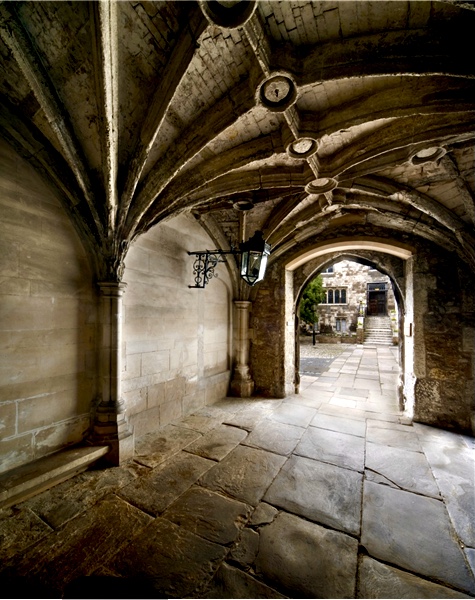
The entrance of Dean’s yard where the abbot’s house, Cheyneygates once stood. Mostly destroyed by a bomb in May 1941.
Ah, man makes plans and the Gods laugh as they say. MacGibbon also opines, that ‘It is possible, if not probable, that Henry disliked his mother-in-law and in this he was no means singular, for there never was a woman who contrived to make more personal enemies’ which seems a rather contradictory statement for someone so besotted with her. However he adds as an afterthought ‘but he ever deprived her of either property or dignity, remains to be proved’. Furthermore, ‘far from being exiled from her daughter’s court, she was in that same year chosen as Prince Arthur’s godmother and attended at the font’ ( 3). Finally, he plucks his ripest plumb from the tree, that on the 28 November 1487 Henry and James III of Scotland agreed that the latter should marry Elizabeth as well as two of her daughters marry James’ sons. However it must be remembered that at the time of James’ death in June 1488 none of these marriages had actually taken place and so it cannot be taken as a given that either King, particularly Henry, ever fully intended these marriages to materialise. Indeed David Baldwin points out that ‘the proposed marriages had been mooted before the ‘Simnel rebellion’, at least as early as the Three Years Truce signed on the 3 July 1486‘ (4).
It has been said that it is unlikely that Elizabeth would have involved herself in the Yorkist rebellion, which would have culminated not only in the eviction of Henry, her son-in-law. from the throne, but also her daughter, as well as robbing her small grandson, Arthur, of his future inheritance. Which is true. However on the other hand if she believed that the true intention of the rebellion was to return Edward V to the throne, then it is highly likely that this is indeed the very course she would have taken. This may also explain any coolness that Elizabeth of York may have felt towards her mother and explain why she appears to have acquiesced in her mother’s removal to Bermondsey. However to be fair we cannot say for certain what Elizabeth of York’s feeling were towards her mother although it’s difficult to believe, under the circumstances, they were warm and fuzzy. Certainly from Henry’s point of view Bermondsey must have seemed the perfect solution. The accommodation itself, the Clare Suite, may have been deemed suitable by some for an ex-queen although to Elizabeth, who had lived a life of luxury in many sumptuous properties, it must have seemed a massive case of downsizing, as we call it today, with a close watch on her movements and an occasional outing to keep any murmuring or speculation down.

Interior of Great Gatehouse as it was in the 17th century.

18th century print of one of the Abbey rooms before demolition
In summary
1485. Elizabeth is treated with deference by Henry and her title of Queen Dowager being restored to her in Henry’s first parliament which met a week after his coronation on 7 November 1485. Acted as godmother to her grandson Arthur.
1486. Titulus Regius declaring the invalidity of Elizabeth’s marriage to Edward IV was repealed in Henry’s first parliament and on the 5 March 1486 she received annuities and a life interest in a raft of properties in southern England in full satisfaction of her dower. All is going swimmingly well for her. What’s not to like? (5)
1486. July 10th. Elizabeth takes out a 40 year old lease on the Abbot’s House, Cheyneygates, at Westminster Abbey and just over the road from Westminster Palace where she can remain in the bosom of her royal family.
1487. February. Immediately following the news of the outbreak of the Yorkist rebellion reaching Henry VII and his council Elizabeth was retired to Bermondsey Abbey and her son Thomas Grey is arrested and put into the Tower of London for the duration of the rebellion. Elizabeth’s biographer David Baldwin wrote Henry ‘deprived Elizabeth of all her properties, and confined her to Bermondsey on the unlikely grounds that she had imperilled his cause by surrendering her daughters, including his bride, to King Richard three years earlier’.
1487 November 28th. An agreement between Henry and James III of Scotland for the latter to marry Elizabeth. However, James died in June 1488 without this proposed marriage taking place.
1489 November. Elizabeth is present when Francois, Monsieur de Luxemboug, head of a visiting French embassy, met Elizabeth of York and her mother-in-law, Margaret Beaufort. Although this might appear prima facie to indicate that all was well within the royal family – as it was surely intended to do – the possibility exists that Francois, her kinsman, had insisted on meeting Elizabeth and to avoid suspicion and gossip the meeting was duly arranged with the presence of Margaret stiffling any chance of a private, and awkward, conversation taking place which might have occurred had he met her in private at Bermondsey.
1492 April 10th. Elizabeth makes her will in Bermondsey Abbey. There can be no dispute, with her will still extant, that her condition was, for a dowager queen, extremely impoverished. I will not go into the entire content of the will which is well known other than to repeat the words ‘I’tm where I have no worldly goods to do the queens grace, my dearest daughter, a pleasure with, neither to reward any of my children, according to my heart and mind, as is to me possible….’
1492 June 8. Elizabeth dies at Bermondsey Abbey.
It could be said that Elizabeth Wydeville and Edward IV’s bigamous and clandestine marriage was the human rock that the House of York foundered and finally crashed upon, taking with it their two young sons, although to be fair it is Edward IV with whom the buck must surely stop. It was certainly upon his early and unexpected death that the situation imploded. Perhaps at the time of his ‘marriage’ to Elizabeth he had been giddy with his triumphs but certainly raging testosterone overcome common sense. Edward seems to have kept his brains in his pants and the ensuing problems and tragedy that this later caused is well documented elsewhere and I need not go into it here. Perhaps it would be mean hearted not to feel some glimmer of compassion when reading the pitiful will made at Bermondsey. Elizabeth asked for a humble funeral and that is exactly what she got – even the herald reporting the funeral was shocked – and so she was laid to rest in a cheap wooden coffin without the usual inner lead one so that when the vault in which she and Edward were interred was opened in 1789 all that remained of Elizabeth was a pile of bones and a skull, the remains of the coffin having rotted away. When the vault was resealed once again there appears to have been nothing left of Elizabeth, her bones having been stolen by Georgian souvenir collectors. Elizabeth remains an important footnote in history, taking any secrets she may have had to her grave , including perhaps the whereabouts/fates of her two young sons. She died knowing that her daughter was queen and that her blood would run through the future Tudor monarchs and perhaps she gained some comfort from that, but I wonder, did she ever muse on what might have been and what had been lost. I leave you dear reader to make your own mind up about that.

Remains of the Abbey revealed in 2006 prior to the Square being redeveloped

Abbey staircase. Photo Museum of London.
1. David MacGibbon, Elizabeth Woodville, a Life p.134
2. J Armitage Robinson The Abbots House at Westminster pp22-23
3. David MacGibbon, Elizabeth Woodville, a Life p 135
4. David Baldwin Elizabeth Woodville Mother of the Princes in the Tower p115
5. Ibid p109
If you have enjoyed this post you might be interested in :
Elizabeth Wydeville – Serial Killer?
MARY PLANTAGENET; DAUGHTER OF EDWARD IV & ELIZABETH WYDEVILLE; A LIFE CUT SHORT
THE MYSTERIOUS DEATH OF EDWARD IV
MARGARET GAYNESFORD: GENTLEWOMAN TO QUEEN ELIZABETH WYDEVILLE
 A MEDIEVAL POTPOURRI
12 thoughts on “BERMONDSEY ABBEY AND ELIZABETH WYDEVILLE’S ‘RETIREMENT’ THERE”