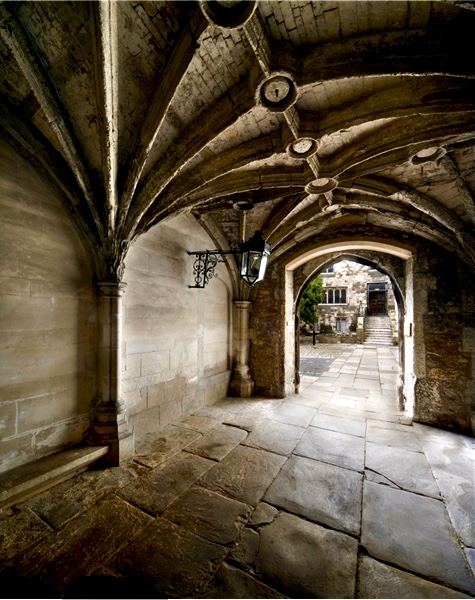
A tantalising glimpse of an ancient passage leading to Abbot’s Court and the steps leading up to Jerico Parlour. The Abbots House, known in the 15th century as Cheyneygates, later known as The Deanery, was situated to the right of the steps. Photo Dr John Crook Country Life Picture Library.
It’s known well how that old fickle wheel of fortune dealt with Elizabeth Woodville/Wydeville, taking her up, taking her down, whirling her around a couple of times and then dumping her, finally, in Bermondsey Abbey, where she died, the impoverished mother in law to the Tudor King, Henry VII.
Her story has been told elsewhere but I would like to focus here on her last stay in Cheneygates, part of the Abbots House complex in Westminster Abbey. It seemed she liked it there, after all it was very convenient being just over the road from Westminster Palace where her daughter Elizabeth of York , now Queen, would often stay, because she took out a 40 years lease which has survived to this very day. However as they say man makes plans and the gods laugh because her son-in-law and his advisers, sagely decided to call time on her sojourn there and with another and final spin of that old wheel of fortune off she went to Bermondsey Abbey which is yet another story.
How did Elizabeth come to rent Cheyneygates? When her husband Edward IV died suddenly in April 1483, Elizabeth – and her family – attempted to take control of her eldest son, the new king, Edward V, in order to maintain their hold on power. This was completely riding roughshod over her very recent deceased husband’s will and with hob nail boots to be precise. The Woodvilles endeavoured, foolishly and unsuccessfully, to outmanoeuvre Richard, Duke of Gloucester, her husband’s only remaining brother, who had been named in Edward’s will as Lord Protector ( 1 ) No doubt it dawning on the Woodvilles they would not fare so well under Richard as they did under his brother, they attempted to override him entirely and there is good reason to believe that there was a plot to assassinate him while on his journey to London possibly near the Woodville stronghold at Grafton Regis. However he confounded them, and on 30 April 1483 he removed Edward from the control of the Woodvilles at Stony Stratford after arresting Elizabeth’s brother, Anthony Woodville, Earl Rivers and her son, Sir Richard Grey. When tidings of this event reach London ‘the following night‘ Elizabeth panicked (2 ). For reasons at the time best known to herself, Elizabeth wasted no time in skedaddling over the road and into sanctuary at Westminster Abbey – the Abbots House known as Cheyneygates to be precise – taking her remaining and no doubt confused children with her. In her scramble to take as much stuff with her as she possibly could, a hole had to be knocked in the wall separating the abbey from Westminster palace to accommodate all the treasure and other loot she’d grabbed. Not very dignified, but then dignity was not uppermost in her mind at that point. According to Thomas More, the Chancellor, Bishop Rotherham also in a rush, took the Great Seal to Elizabeth at Westminster and found ‘much heaviness, rumble, haste and business, carriage and conveyance of her stuff into Sanctuary; chests, coffers, packers, fardels trussed all on mens backs; no man unoccupied, some lading, some going, some discharging, some coming for more, some breaking down the walls to bring in the nearest way, and some yet drew to them that helped to carry a wrong way (3).
And so ensconced there she remained for the foreseeable future. How that panned out is well known now but back to Cheyneygates….. On the 10 July 1486 the following lease was drawn up –
THE LEASE TO THE WIDOWED QUEEN.

This eindenture made bitwene John by the sufferaunce of god Abbot
of the Monastery of seint Peter of Westm' the Priour and covent of the
same of the one partie And the most high and excellent Princesse
Elizabeth by the grace of god Quene of England late wyf to the moost
mighty Prince of famous memore Edward the iiij th late Kyng of Englond
and of Fraunce and lord of Irelond on the other partie Witnesseth
that the forsaid Abbot Priour and Covent consideryng and wele re-
membryng that the forsaid excellent and noble pryncesse in the tyme
of her said late husbond our alder liege lord was unto the said Monastery
verry especiall good lord aswele in protectyng and defendyng the libertes
& ffrauncheses of the same as in bountevous and largely departyng of
her goods to the edifying and reparacions of the ffabrice of the said
monastery by the hole assent concent & will of all the Captre have
graunted dimised and to ferme letyn unto the forsaid Quene a mansion
with in the said Abbey called Cheynegatis Apperteynyng unto the
Abbot of the said place for the tyme beyng with all the Howses
Chambers Aisiaments and other Appertenaunces therunto belongyng
To have and hold the forsaid mansion with Thappertenaunces and
other premisses to the said Quene from the fest of Ester last passed
before the date herof unto thende of the terme of xl yeres then next
folowyng and fully to be complete Yeldyng therfor yerely to the same
Abbot or his successor or theire Assignes x w of lawfull money of Englond
duryng the said terme to be paid atte festis of Mighelmas and Ester by
even porcions And the forsaid Quene at her propre costis and Charge
shall sufficiently repaire uphold and mayntene the said mansion and
voide dense repaire and make the gutter goyng from the kechen of the
same as often as shall be necessary and behovefull And atte ende of
her terme the said mansion with Thappertenaunces sufficiently repaired
mayntened and upholden yeld up unto the forsaid Abbot Priour and
Covent and theire Successours Also it is covenanted and agreed bitwne
the parties abovesaid that the said Quene shall in no wise sell lete
to ferme nor aliene her said yeres nor eny parte therof in the said
mansion with Thappertenaunces to any other person or persones duryng
the said terme And the Abbot Priour and Covent and their successours
forsaid the said mansion with thappertenaunces to the said Quene in
the manner and fourme aboverehersed shall warant ayenst all people by
these presents Provided alwayes that yf it shall happen the same
Quene to dye within the said terme of xl yeres as god defend that then
this present graunt and lees immediately after her decesse be voide and
of no strengthe And over this it is covenanted and agreed that yf it
happen the said Rent to be behynd unpaid after any terme of the termes
abovelymytted in party or in all that is to say the Rent of Mighelmasse
terme at seint Martyns day in wynter then next folowyng and the Rent
of Ester at Whitsontyde then next ensuyng that then it shalbe leefull
to the said Abbot and his Successours in the forsaid mansion with the
Appertenaunces to reentre And the said Quene therfrom to expelle
and put out this lees and dimyssyon notwithstanding In Witnesse &c
Yeven the x day of Juyll the yere of our lord god mcccclxxxvi And the
first yere of the reigne ofkyng Henry the vii (4)
Despite scenes in the tv dramatisation, I use the word loosely, of Philippa Gregory’s ‘White Queen’ which portrayed Elizabeth and her daughters languishing in what appeared to be a dank cellar with damp, dripping walls, Cheyneygates, being part of the Abbots House complex would have actually been extremely luxurious. Tragically Cheyneygates/Abbots House, later known as the Deanery after the Reformation, was destroyed during the Blitz in 1941. I have unfortunately been unable to find any illustrations of Cheyneygates in the 15th century.
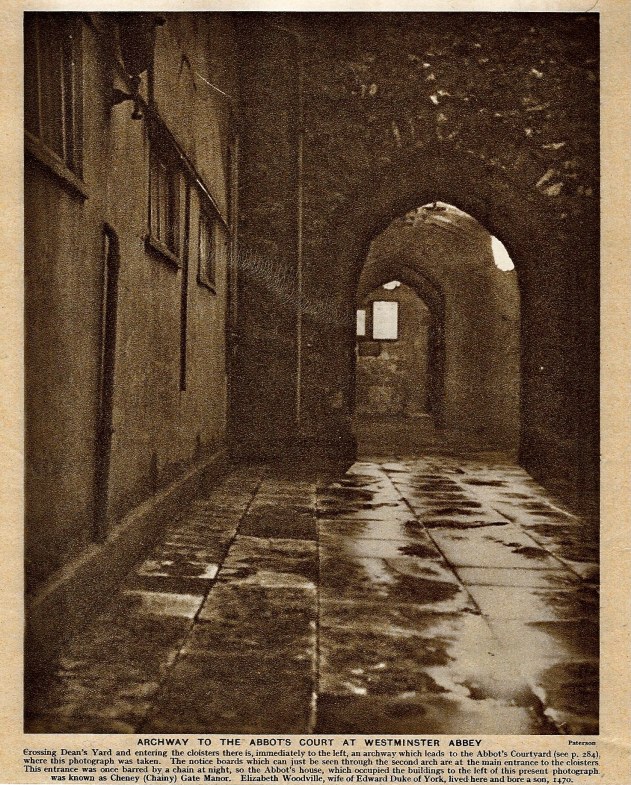
Old, atmospheric photo of the Archway in Abbots’s Court leading out and into the cloisters as well as the exit to the outside world. Elizabeth and her family would have gone through this ancient archway which has remained unchanged throughout the centuries to enter and leave Cheyneygates.
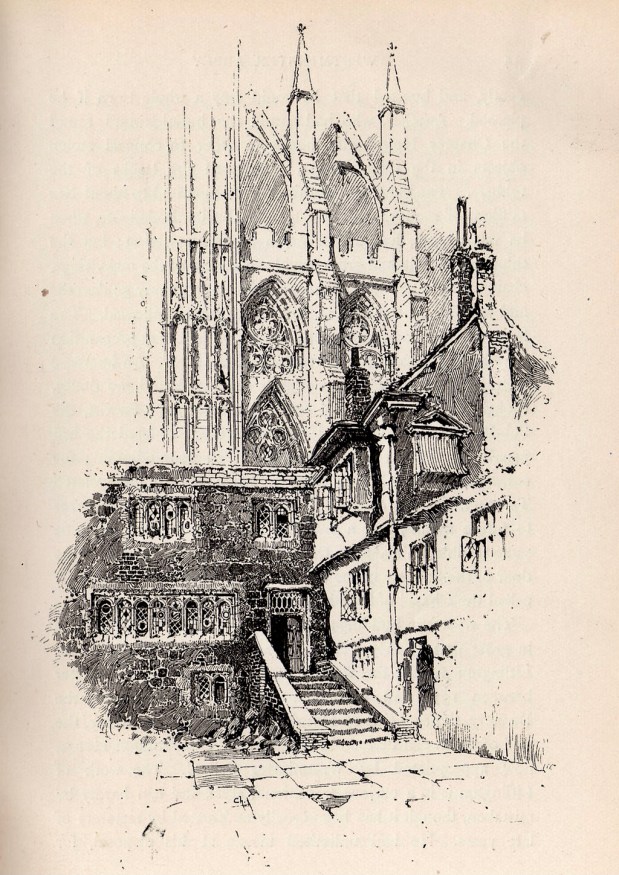
Jerico Parlour and Cheyneygates c1910. Illustration by Herbert Railton. It can be seen that even before the bomb destruction the Abbots House and Cheyneygates exterior facade were much altered since the 15th century. However one of the upstairs rooms was still known as My Lady’s Bedchamber in the 18thc. Could this ‘Lady’ have been Elizabeth Wydeville?
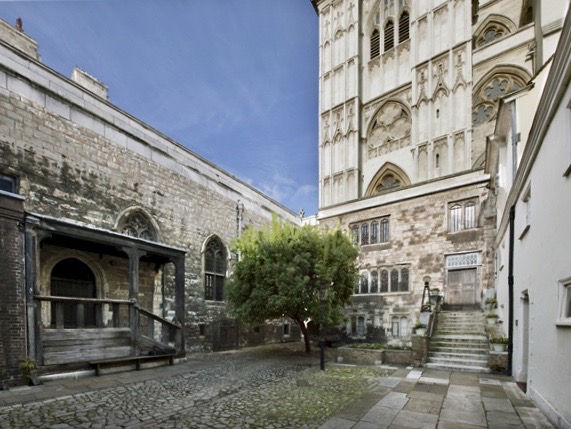
This photo shows the Jerico Parlour as it is today, middle of the picture with steps. Cheyneygates would have stood where the modern white building stands on the right. College Hall to the left. No doubt Elizabeth would be able to recognise the scene today although Cheyneygates is sadly much altered.
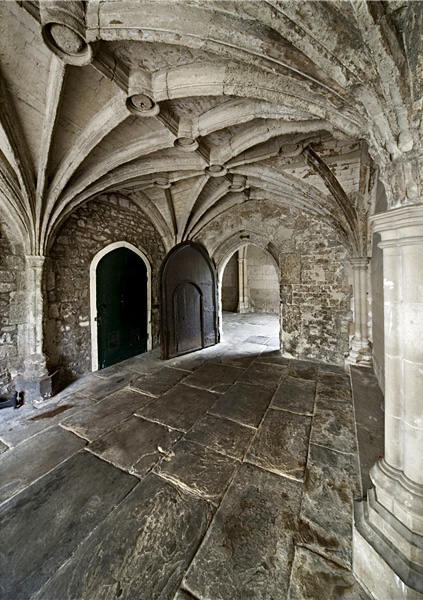
A different view of the ancient passage way leading to Abbot’s Court. Elizabeth and her entourage, daughters, brother Lionel and small son would have approached Cheyneygates via this passageway and trod these very flagstones..
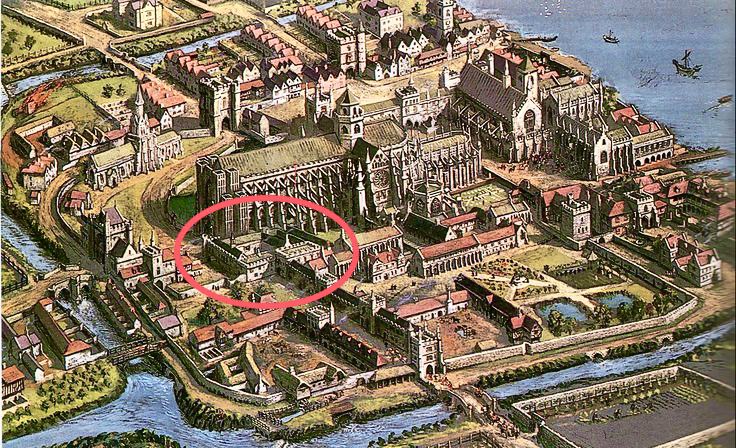
‘The Abbey of St Peter and Palace of Westminster about the year 1532’. Illustration by A E Henderson F.S.A 1938. The Abbot’s House complex circled in red. College Hall stands to the left, Jerico Parlour at the back and Cheyneygates to the right. Cheyneygates overlooked the Great Cloister.

An old plan of Westminster Abbey showing Abbot’s Court. The Abbot’s House/ Cheyneygates , is here called the Deanery which it became known as after the Reformation. Note the site of the Refectory where Margaret’s Beaufort’s body was taken from Cheyneygates to lie in repose before her burial.
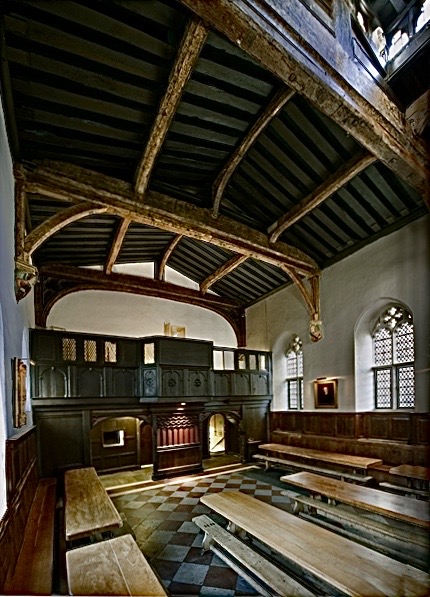
College Hall. Built by by Abbot Litlyngton along with the Jerusalem Chamber c1376. The roof is original. There was a dais at the far end where the Abbot and his guests would be seated. The gallery dates from the 17th century.
It was in College Hall that Dean Stanley writing in the 19th century suggests that Elizabeth and her group would have been met by Abbot Esteney on their hasty retreat from the palace (5). And there she was sat, according to Thomas More, when Bishop Rotherham found her ‘alone, low down on the rushes, all desolate and dismayed‘( 6). And who could blame her to be honest as reality kicked in and she realised the game was well and truly up. Rotherham apparently tried to reassure her that all would be well, in fact he left the Great Seal with her but the very next day realising he had done something really silly he sent someone to get it back.
Pretty soon Richard uncovered the depth of Elizabeth’s plotting. The 10 June found him writing in haste to York for extra troops to ‘eide and assiste us ayanst the Quiene, hir blode adherentts and affinitie, which have entended and daily doith intend, to murder and utterly destroye us and our cousyn, the duc of Bukkyngham and the old royall blode of this realme…’ (7). And so begun Elizabeth’s second stay in the Abbot’s house. Eventually, and pragmatically, she reconciled with Richard and sent her daughters out of Cheyneygates into Richard’s care, whereupon probably the older ones breathed a massive sigh of relief. The rest is history and after Bosworth in 1485, having taken out a 40 year lease on Cheyneygates, she returned to live there, perhaps she had never left. However the lease came to nothing as a short while later she was sent to live out her days at Bermondsey Abbey by her son in law, a canny Henry Tudor, no doubt comfortable but according to her will impoverished – Sic transit gloria mundi. But wait! As it transpired she was not the last lady of the nobility to be a tenant at Cheyneygates – Margaret Beaufort, Henry Tudor’s mother, decided she wanted to live at Cheyneygates too and indeed it was where she died on the 29 June 1509 (8 ). How strange, the richest woman in England with numerous properties had to have the very property where Elizabeth Woodville resided if only for a short while. Was it that Margaret, Elizabeth’s one time fellow conspirator, just had to have something that the ex-queen once had as she also had to have the prayer book of Richard III or indeed his crown for her own son – or – am I being a tad cynical…? Hmmmm!.
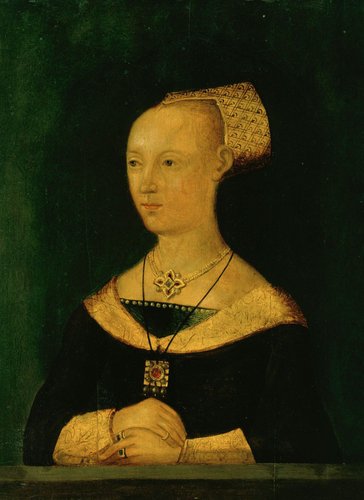
Elizabeth Woodville, in her glory days before it all went pear shaped. This is the earliest known version of the many copies of a now lost original portrait of Elizabeth which was possibly from a likeness of her taken when she was alive. The Royal Collection.
For those who wish to delve deeper into the history of the Abbots House and Cheyneygates a link to an interesting book The Abbots House at Westminster; J Armitage Robinson 1911 can be found here.
(1). This is complex. For the best and fullest explanation of this situation I would recommend Annette Carson’s Richard Duke of Gloucester as Lord Protector and High Constable.
(2) Richard III The Road to Bosworth p.99 P W Hammond and Anne E Sutton
(3) Richard III The Great Debate p.47 Thomas More.
(4) The Abbot’s House at Westminster. 1911 J Armitage Robinson
(5) Westminster Abbey p411 1869 Dean Stanley
(6) History of King Richard III Thomas More
(7) Richard III The Road to Bosworth p.103 P W Hammond and Anne E Sutton
(8) The King’s Mother p.237. Jones and Underwood.
If you enjoyed this post you might also like :
THOSE MYSTERIOUS CHILDRENS COFFINS IN EDWARD IV’S VAULT
ELIZABETH WYDEVILLE, BERMONDSEY ABBEY AND HER RETIREMENT THERE
 A MEDIEVAL POTPOURRI
An intriguing article and some excellent images – but it’s most unfair to label Archbishop Rotherham a fool in his handling of the Great Seal.
Clumsy it may have been, but the events and uncertainty of the times can account for his own lack of surety about the best course of action, not to mention his loyalty to a woman he’d known since her first marriage to Sir John Grey and to whom he may have wished to bring some reassurance.
Rotherham was no fool – he was regarded as one of the greatest equity lawyers of the age and his educational endowments stand testimony to his own learning and love of it for others. Lord Chancellor of England twice, he was no fool in politics either.
In fact, it was only until recently that there was Thomas Rotherham Society named in his honour at Lincoln College, Oxford University, where he is regarded as the second founder.
LikeLiked by 1 person
Thank you for your interest in my post. You have made some excellent comments and given me food for thought. I have probably been too harsh in my judgement of Rotherham and too judgemental. As you say in the turmoil of the time…. It is an old post and has been viewed many, many times. But I will remove the comment about him being a fool. Mea Culpa.
LikeLike
No worries – my apologies if I came across a bit nerdy! I’m researching a quite detailed biography of the Archbishop at the moment so spring to his defence wehenever I can lol!
LikeLiked by 1 person
No you didn’t sound nerdy in the least. And it’s good that we can feel passionate about people that lived so long ago as well as some of the stuff that went on. I still feel upset about the battle of Stoke! Keep up with feeling passion for history and its participants 😊
LikeLike