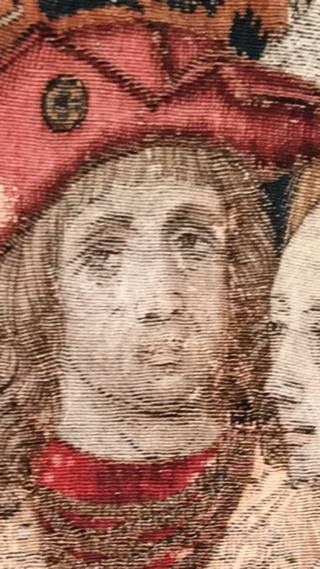
This is thought to be a portrait of Perkin Warbeck/Richard Duke of York from the Tournament Tapestry at Valenciennes
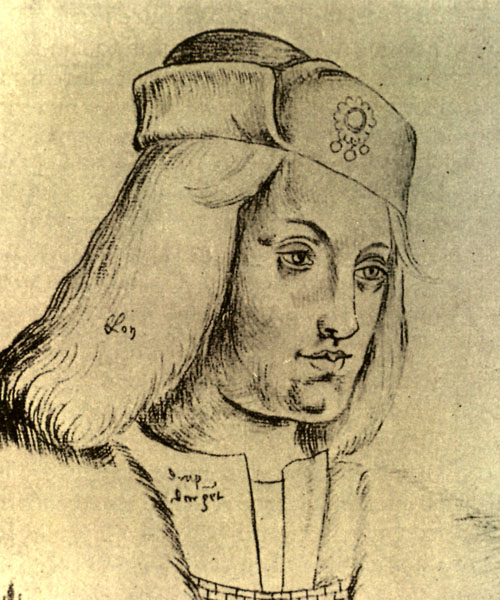
Perkin Warbeck. Pencil sketch c1560. Note the eye blemish in both portraits.
Following on from my earlier post and the theory that John Evans, who lies buried in Coldridge Church Devon, was indeed Edward V, has led me to wonder did he ever meet Perkin Warbeck who claimed to have been his brother, the youngest ‘Prince in the Tower’, Richard of Shrewsbury, Richard Duke of York. Warbeck’s – or should I say Richard Duke of York’s – story is very well covered elsewhere, and I will only be focusing on the events of late 1497, the Second Cornish Rebellion and a window in time where it is possible that Warbeck met John Evans. I shall also for clarity stay with the name Perkin Warbeck although he may well truly have been Richard the Duke of York or Richard of England as he also called himself. The one opportunity for this meeting would have arisen following Warbeck’s arrival at Whitesand Bay near Land’s End, Cornwall on 7 September from Ireland on ‘2 ships and a Breton pinnace.’ Attainders would later say that he came with a ‘a great multitude and number‘ while Raimondo Soncino, Milanese Ambassador to England ‘thought they amounted to 80 savage Irishmen‘ who arrived on ‘fishing boats‘.(1) For some baffling reason, Warbeck chose to bring with him his wife, Lady Katherine Gordon or Kateryn Huntleye as she was called in Henry VIIs Privy Purse Expenses and their almost one year old child, as you do when you embark on a perilous invasion of a country (2). However common sense must have prevailed as both she and the child were sent to safety at St Michaels Mount then, according to Wroe, perhaps to St Buryan, to await the outcome.
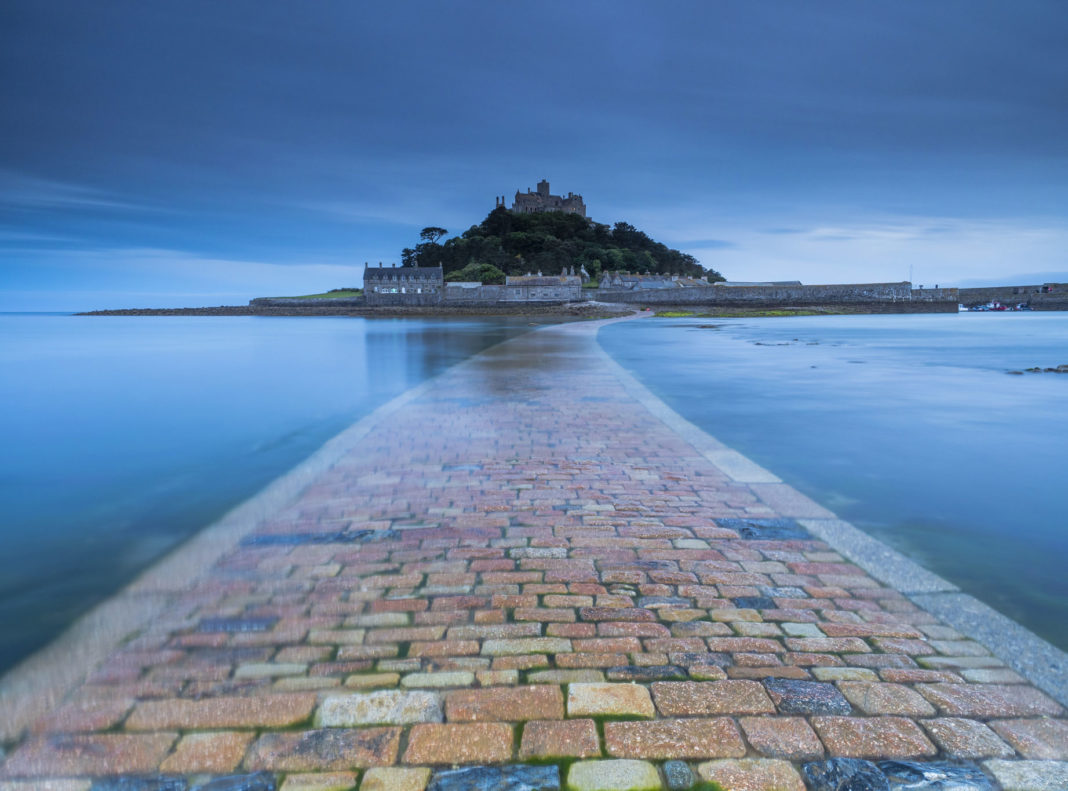
St Michael’s Mount and the Causeway. Photograph © Richard Bowden/Shutterstock
Notwithstanding the defeat of the Cornish rebels at Blackheath on the 17th June – known as the First Cornish Rebellion and sparked off by Henry Tudor’s heavy taxation – Warbeck raised his standard at Penzance and begun his march eastwards gathering followers described as ‘undisciplined’ along the way.
What was his route and did it take him close to Coldridge? Bodmin is mentioned where his following had grown to three thousand. Crossed the River Tamar at Launceston and entered Devon. Crossed Dartmoor and thus to Exeter, the north Gate to be precise, his followers now amounting to nearly eight thousand men arriving on 17 September, St Lambert’s day. It’s interesting to note that Coldridge would have been as the crow flies just a little over 18 miles to Exeter. Surely it’s inconceivable that John Evans/Edward V would not have made the short journey to meet up with this young man who claimed to be his brother and who was now being addressed in some quarters as King Richard IV?
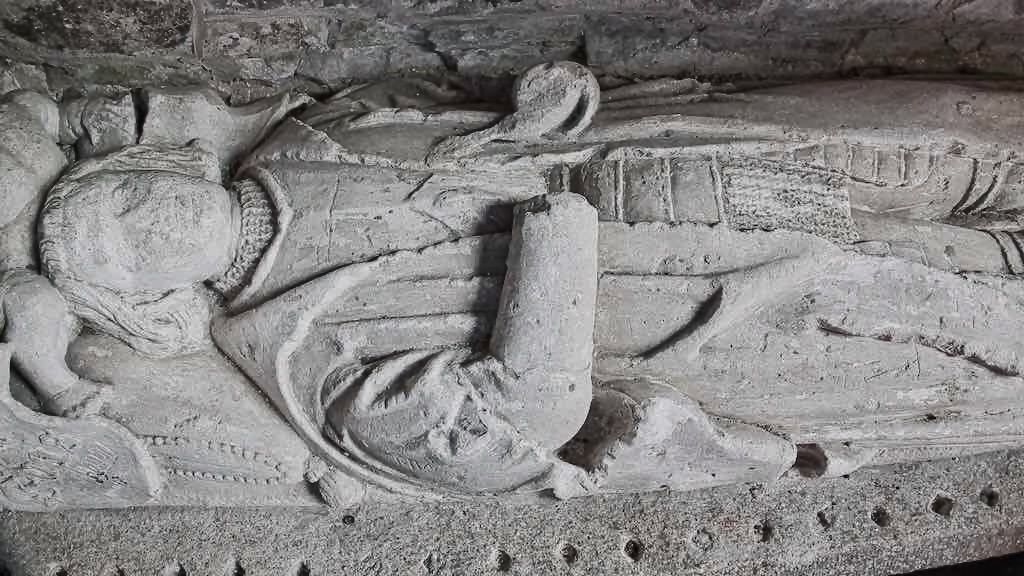
John Evan’s effigy in Coldridge church. Depicted wearing chainmail beneath his robe.
It should be remembered that Edward V and Richard Duke of York, as children, would not have had much chance to bond. Edward had been sent as a toddler to Ludlow, in the Welsh Marches whereas the younger brother, Richard, grew up with his sisters in Westminster and probably Greenwich Palace where their mother Elizabeth Wydeville appears to have had a royal nursery. A few short weeks were spent together in the Tower of London in the summer of 1483 and then no doubt the brothers were speedily separated after a failed rescue attempt forced Richard III’s hand. However casting that aside it’s not hard to envisage that John Evans/Edward V would have been both amenable and perhaps intrigued in having a meeting with his possible brother. This creates a number of interesting scenarios.
Working on the hypothesis that John Evans was Edward V –
- Did John Evans on meeting Warbeck/Richard of York and ascertaining that Warbeck was the genuine article perceive that his younger brother’s intention was to gain the throne from himself and not to put his older brother on the throne? Did a row ensue?
- Did John Evans realise that Warbeck was a fake and thus turn around and leave him to it?
- Or did John Evans on meeting his genuine brother after such a length of time, realise that it was too risky to throw his lot in with him for some reason. Perhaps he was underwhelmed by Warbeck’s followers quickly perceiving that the enterprise was doomed to fail? Henry Tudor made the comment ‘on Monday last, the 18th day of September, there was not one gentleman‘ (3).
- Was John Evans comfortable with his now quiet and peaceful life, living incognito as well as wealthy, and having no wish to risk losing it all plus the danger it would put his wife and children in not to mention Thomas Grey his half brother?
- Did a quarrel erupt? Noblemen of that time, even those living incognito, were well known for their massive egos and were prone to throwing their toys out of their prams at any given time – picture Richard Neville aka Warwick the Kingmaker. Did John Evans and his brother not hit it off for some reason lost to us now resulting in John Evans turning around and riding back to Coldridge in a fit of pique?
- There is no indications that John Evans took part in the attempted storming of Exeter but might he have? Could he possibly have taken part and perceiving it was going disastrously wrong made his escape? Alternatively did they meet betwixt Coldridge and Exeter – a meeting that amounted to nothing?
Please feel free to add any other possible scenarios to the above. I think it was Sir Thomas More who said you might as well shoot too far as to shoot too short – well if he didn’t say it he should have!
Despite ‘King Richard’s‘ promise to the citizens of Exeter that he would make their city like ‘another London‘ the gates were closed to him. The attacks on Exeter’s North and East gates failed despite the valiant attempts by Warbeck and his followers – repelled by the doughty citizens who amongst other thing were eager to prove their loyalty to Henry Tudor after the Cornish rebellion earlier in the year. The attempts to take Exeter and its defence are well told in Perkin a Story of Deception by Ann Wroe. A further good account can be found here ‘Devon Perspectives‘ which covers both Cornish rebellions and Warbeck/Richard’s flight to Beaulieu Abbey, where he took sanctuary. The rest is history.
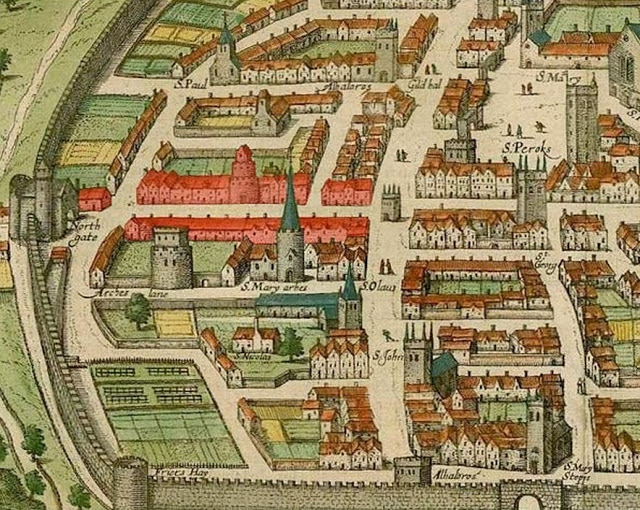
Medieval Exeter. The North Gate can be seen to the left. From a map c1587.
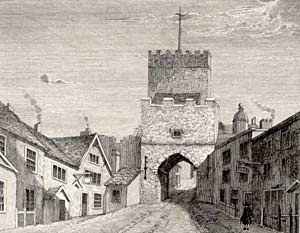
The North Gate from outside the city. Courtesy Devon Library Services
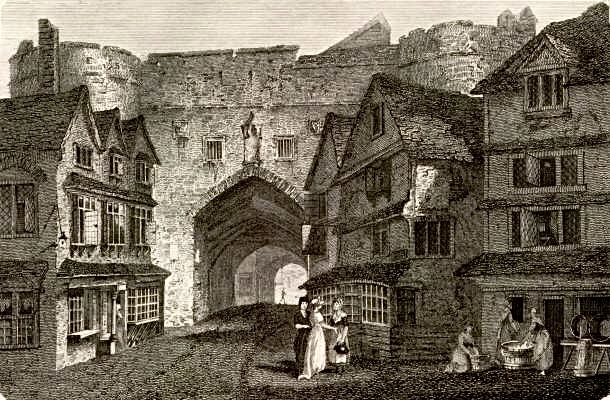
East Gate from the Exterior. Steel line engraving by C J Sprake 1831. The gate was demolished in 1784.
- Perkin, a Story of Deception p.324 Ann Wroe
- Excerpta Historica: or, Illustrations of English History p.115. Samuel Bentley.
- Perkin, a Story of Deception p.337 Ann Wroe
If you liked this story you might be interested in
A Portrait of Edward V and Possible Resting Place
Sir William Stanley – Turncoat of Loyalist?
Dr Argentine – Physician to the Princes in the Tower
 A MEDIEVAL POTPOURRI
10 thoughts on “RICHARD OF SHREWSBURY, DUKE OF YORK ALIAS PERKIN WARBECK AND THE ASSAULTS ON THE GATES OF EXETER”