The two QCs prepare to do battle
Following on from my earlier post. The day had dawned – the trial commenced. Because of the length of the trial I only give snippets here which stand out and which I think are the most pertinent/funny/excruciating.
The judge addressed the jury as to whether Richard III was responsible for the alleged murder of his brother, Edward IV’s sons, Edward and Richard known as the ‘Princes in the Tower’. The judge pointed out that Richard, killed at the battle of Bosworth ‘is beyond the power and jurisdiction of this or indeed any other human court. What you are invited to do today in these proceedings is to pass a historical judgement upon him. He stands in a sense indicted at the bar of history. The charge against him as you’ve just heard is one of the greatest charges in the calendar of crime – murder’. Mr Dillon had, in the absence of the defendant had already entered in a firm voice the plea My Lord, the plea is one of Not Guilty‘.
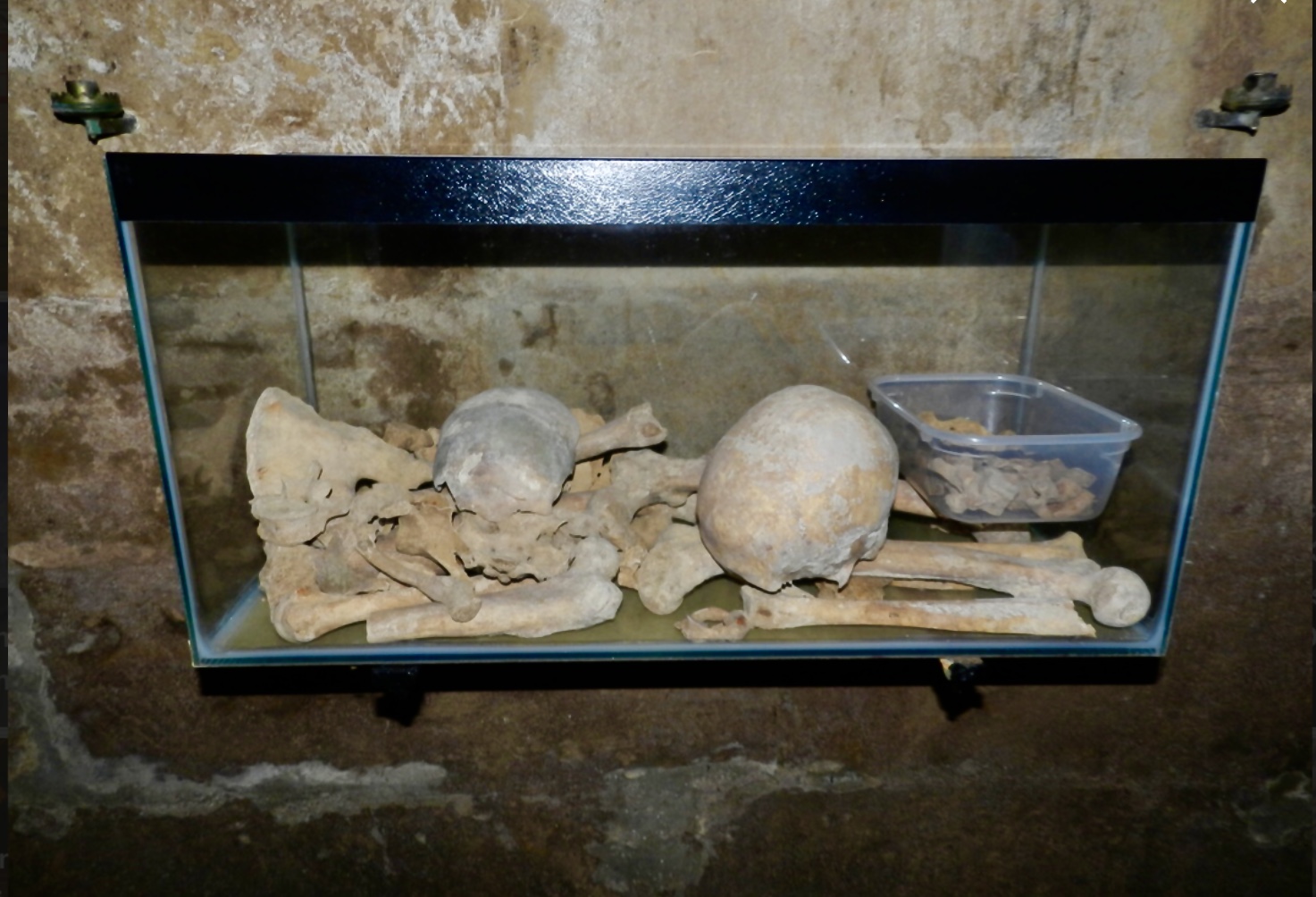
Mr Russell for the prosecution set the historical scene, the ‘unpopular’ Wydeville marriage, the death of King Edward, the taking of his heir into Richard’s care, the Wydvilles ‘disarray’, the eventual disappearance of both Edward’s sons and the discovery of bones at the Tower in the 17th century, which is so well known I need not go into it here.
The first witness for the Prosecution was Jeffrey Richards, lecturer in history at Lancaster. Questioned by Mr Russell, Mr Richards enlarged further on the circumstances of the times i.e the building up of the now all powerful Wydevilles ‘ who were in control of the court, the council, the late kings treasure, the fleet and what is the most important of all the two princes who through they hoped to rule England’ . Mention was made of the famous letter to York in which Richard asked for aid against the queen and her adherents. Mr Richards perception of this was the troops from York were needed to cow and threaten London. The upcoming Coronation was used as a ‘pretext’ to prise Richard of Shrewsbury, the youngest prince, out of Sanctuary. Now Richard could secure his position. Only he didn’t. This was on account the princes represented a focus for rebellion. However moving on – in the interim Margaret Beaufort plotted with the boys mother for a marriage between their offspring which in Mr Richards view Elizabeth would not have done unless she ‘knew her sons were dead’.
Mr Dillon questioned Mr Richards asking him his opinion of More and what would he say to the statement that ‘More is full of probable false facts and is too discredited to build on’
Mr Richards: No I don’t think that is so.
Mr Dillon: You do not accept that statement?
Mr Richards: No not entirely .
Mr Dillon: I take it from the statement served which you have provided for my learned friend for the prosecution. These are your very own words that I have in typing before me.
Mr Richards: Can you repeat them?….(I know… me neither!)
Mr Dillon then went on to repeat them..
Mr Richards: Yes….. well I wrote that in the early stages in my research, since then I have re-read More and I don’t stand in entirely by that…. Ouch!
Asked why he thought Elizabeth would surrender her children to Richard if she believed he had murdered her two sons he responded ‘Because she was a canny political old bird and she knew she needed to survive’.
To be fair Mr Richards has never been A Mother – but would it be so onerous to at least try to imagine?
Next to be called was Dr Jean Ross senior lecturer in anatomy at the Charing Cross hospital medical school. Dr Ross had seen and examined Professor Wright’s 1933 report on the bones. Concluded ages of the bones at the time of death were consistent with 12 and 10 years old and some evidence they were ‘possibly’ blood related. Inconclusive as per usual.
Then came the turn of Dr Tony Pollard
Dr Pollard asserted the precontract was a ‘tissue of lies’ quoting Croyland who described it as ‘the colour for this act of usurpation’. Everyone knew this was the case – ‘except for Stillington!’ interjected the Judge.
Dr Pollard : This bad wicked Bishop as Commynes called him
Mr Dillon – I respectfully suggest that he is not a bad or wicked Bishop at all…
Dr Pollard : You have thrown in so many different things it’s very difficult to know where to start.
Mr Dillon then touched upon the issue of all the chroniclers were southerners or like Mancini reporting southerners perceptions.
Mr Dillon: There is not a single northern chronicler. One of the things that marks the whole of this period is the fear of the south of the barbarians or aliens from the north and the distrust from those of the north for those of the south. One of the things that one finds is a substantial prejudice running through Croyland…..Henry VII was visiting York and there was an uprising there. The Chronicler reported ‘Although by these means peace was graciously restored still the rage of some of the malignants was not averted but immediately after Easter sedition was set on foot by these ingrates in the north whence every evil takes its rise’.
Dr Pollard: Splendid stuff isn’t it..
Mr Dillon: Isn’t it and this is even although the king was staying in those parts I mean the impertinent northerners when the king is there, daring to rise!’
Dr Pollard: That’s very fair.
Then the pièce de résistance of the Prosecution was called – Dr David Robert Starkey – drum roll …
Dr Starkey begun as he meant to go on…
Mr Russell: Did you hear what Dr Pollard said about the precontract?
Dr Starkey: Yes I agree with everything that he said. It is clearly a concatenation of lies, rumour and absurdity. But we can go very much further. It is not merely a concatenation of absurdity it was a red herring and was known to be.
Questioned on Thomas More Dr Starkey will brook no criticism –
Dr Starkey : The criticisms of More on the whole are very small minds attacking a very big one.
He then goes on to relate the ludicrous More story of the page advising Richard while he is sitting on the toilet (really Sir Thomas!) of whom he could rely to do the dirty deed…’out there beyond the lavatory door there is lying on a pallet mattress the man James Tyrell who will do the deed for you’. This is dear reader, despite the fact that Richard had known Tyrell for many years. Tyrell had been in Richard’s service since 1471 after he was knighted by Edward IV after the Battle of Tewkesbury. Dr Starkey attempted to twist the story asserting that either the page or Tyrell was a gentlemen of the stole. However Rosemary Horrox has written Thomas More’s elaborately circumstantial account which is, however, demonstrably inaccurate in detail, notably in the lowly status assigned to Tyrell before the murder I know! You couldnt make it up! however onwards...
Referring to these Tudor stories the defence questioned Dr Starkey who suggested they would now be called Tudor Propaganda
Mr Dillon: I thought I might say Tudor legend
Dr Starkey I’m sure you would sir yes
Mr Dylan does that sound better to you
Dr Starkey: It won’t be the first time you’ve misused a word
Mr Dylan: I dare say
Dr Starkey : Nor the last
Mr Dillon: I see – then if this small lawyer’s mind may ask you some questions about the topics on which you have given evidence
Mr Dillon, brave man, then points out some problems with More’s account…
Dr Starkey : And I think you would be wrong
Mr Dillon: May I finish the question
Dr Starkey: No sir…… The statement has gone on so long I am now entirely unclear as to the question.
The ‘Daggers’ look….takes a lot of practice…yikes!
After returning to his seat Dr Starkey gets an attack of thirst. “Water, water gasped Dr Starkey..this Death Stare look is hard work..”
Next to be called was Lady Wedgwood – and for the defence. Medieval Art historian and a Fellow of the Society of Antiquaries. Responsible for mounting the exhibition on Richard III at the National Portrait Gallery in 1973 and for gathering together almost all known portraits of Richard, mounting to nearly 30, most of them duplicates and not originals.
Mr Dillon questioned Lady Wedgwood on the Thomas More description of Richard quoting ‘ill featured limbs, crook backed, his left shoulder much higher than his right…also a withered limb’.
Lady Wedgwood: That is I claim was an exaggeration. The first record of that is a written one where it is accepted that there was some disparity in the shoulders.
Lady Wedgwood held up a portrait from the Royal Collection at Windsor which under X ray can be seen the shoulder line has been tampered with including the links in the collar –
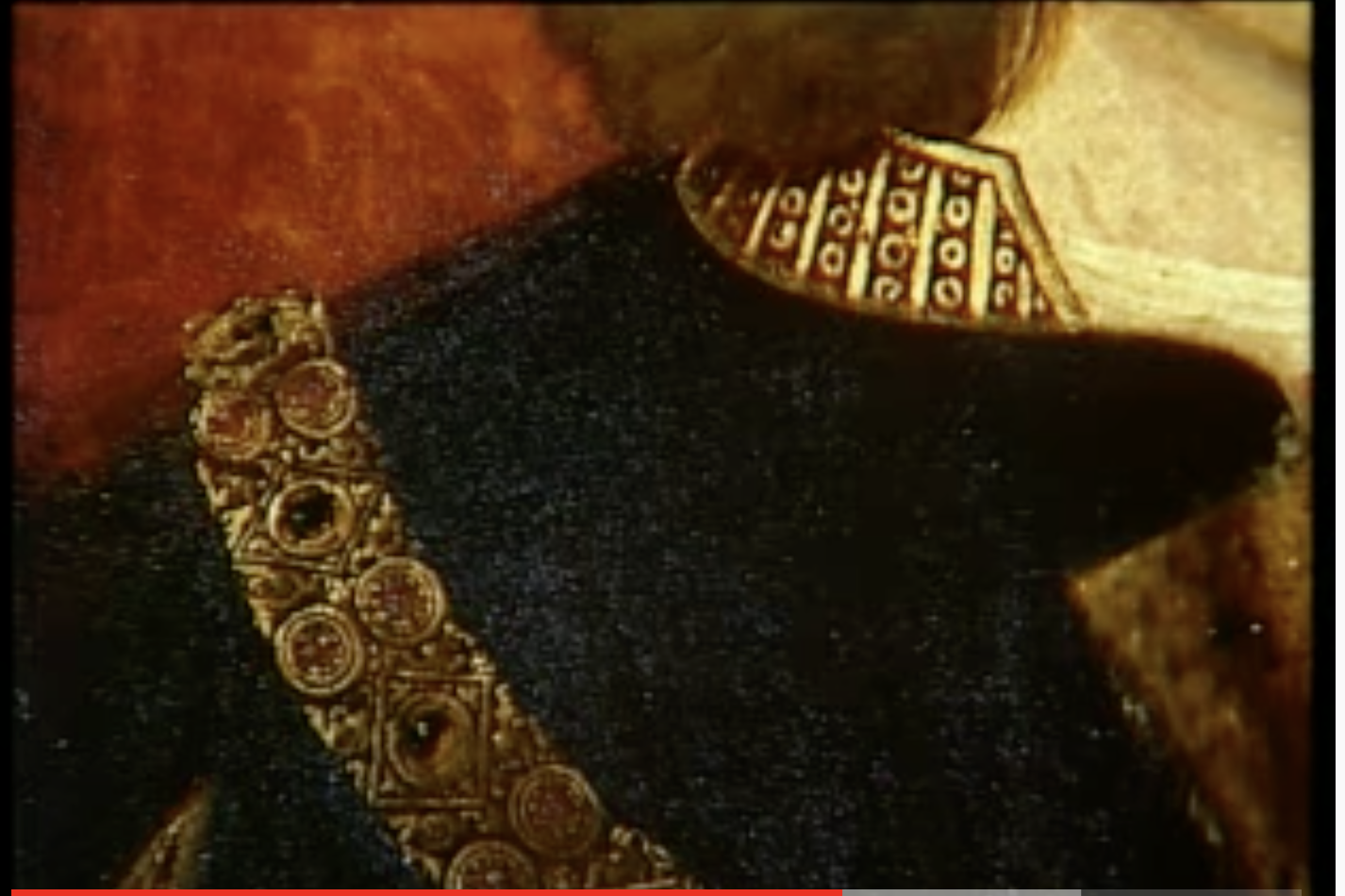
The mouth has also been altered as well as the face more lined and narrowed eyes c.1530
Numerous portraits were also discussed including an infra red photograph of the ‘Broken Sword’ portrait with alterations including a ‘hump’ back as well as a withered hand.
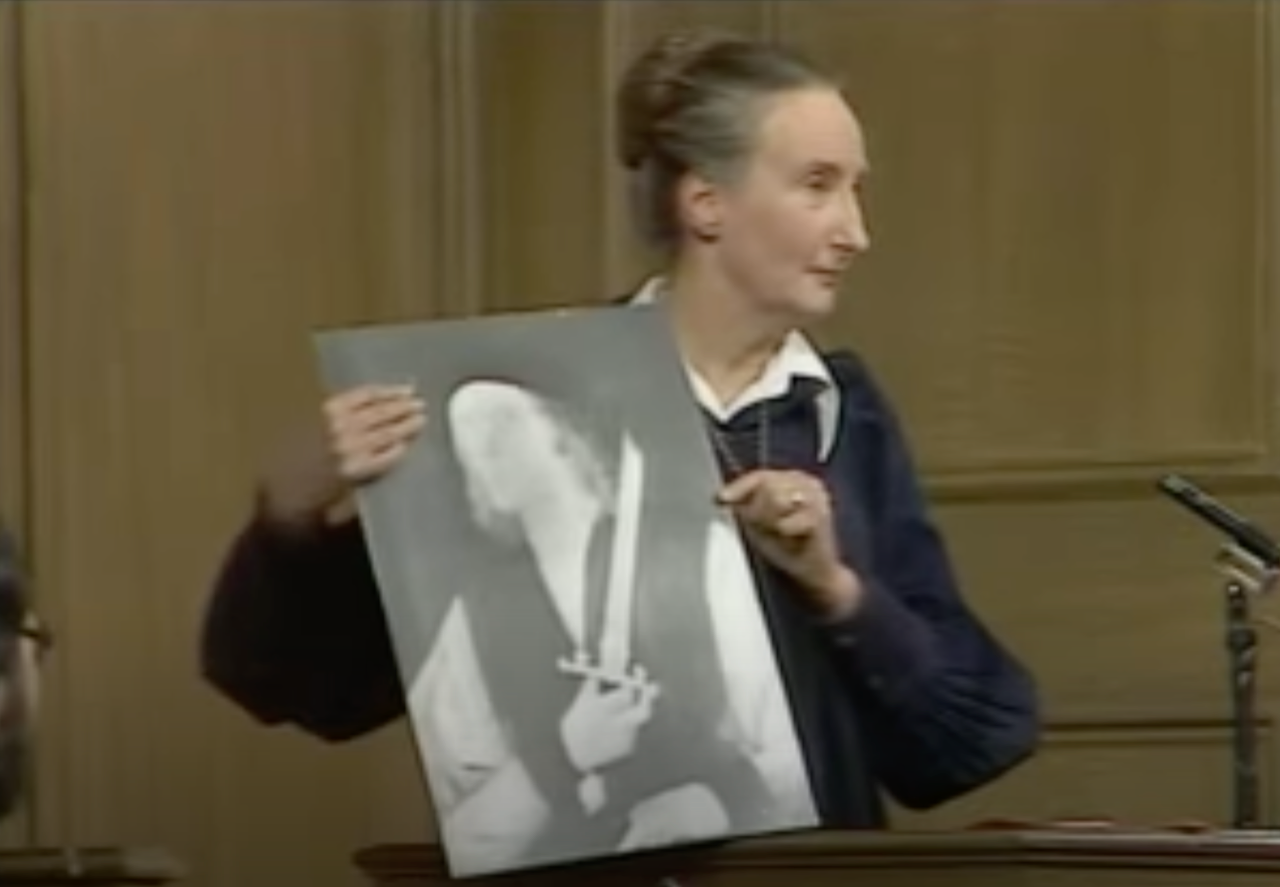
Lady Wedgwood and the Broken Sword Portrait from the Society of Antiquaries
Next to be called was Anne Sutton, archivist, fellow of Society of Antiquities, editor of the Ricardian and co-editor of the Coronation Records of Richard III. Called for, among other things, her knowledge and understanding of the pre-contract.
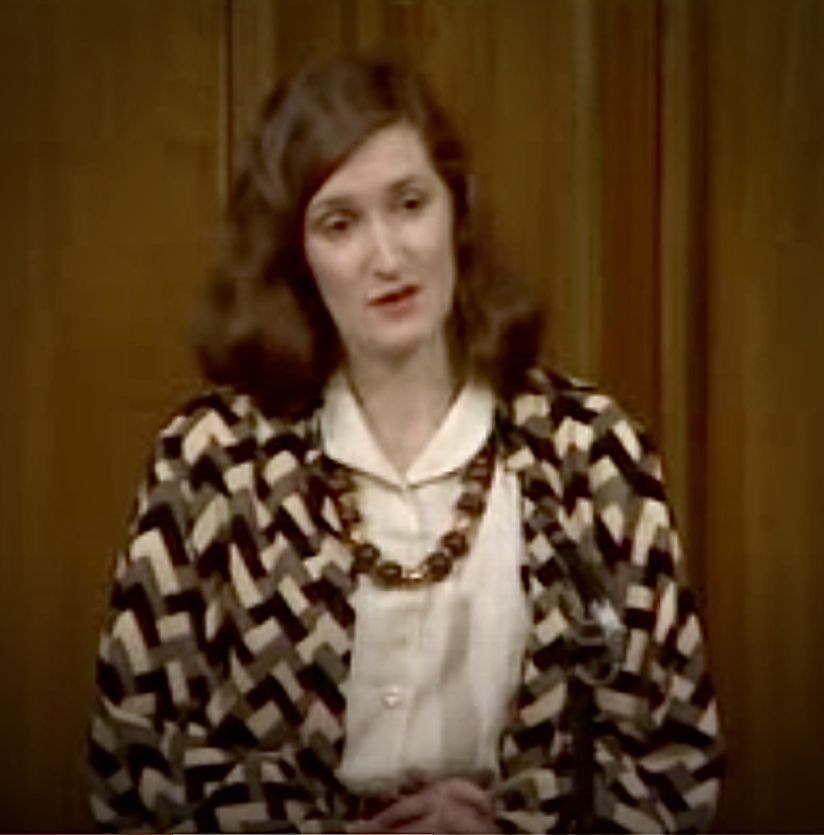
Anne Sutton.
Mr Dillon: it’s been described – this question of the pre-contract – as being simply a pretext used by Richard to seize the throne for himself. Do you agree with that assessment?
Miss Sutton: No.
Mr Dillon: It has been described by one of the witnesses and I hope I have the language right as a red herring, do you agree with that assessment?
Miss Sutton: No. It’s the crux of the matter .
Mr Dillon : Referring to the pre-contract as reported in Croyland…. could this private, clandestine marriage, not celebrated in church, with no publication of banns have been a valid ground for objecting to the validity of the marriage between Edward and Elizabeth subsequently and leading to the bastardisation of their children?
Miss Sutton: yes the two things together
Mr Dillon: Was adultery taken very seriously in fact in mediaeval times.
Miss Sutton: Oh yes it was a heinous crime
Mr Dillon when there was a question of succession raised
Miss Sutton: yes undoubtedly .
Following further discussion on the legalities of the pre-contract Mr Dillon played a blinder.
Mr Dillon: It is said by Dr Starkey that once proclamation had been made of Edward as King Edward V then all questions of illegitimacy would have been wiped out. Do you agree with that?
Miss Sutton I think it’s true of Dr Starkey’s period but he is forgetting the reign of Henry VIII and the great increase of the theory of the absolute king so the situation was entirely different in 1483…
Cue soundtrack from Jaws….
Miss Sutton pointed out only the act of the annointing and the coronation could have wiped out the illegitimacy. Then followed some robust questioning by Mr Russell which led to Autumn Rebellion
Mr Russell : A lot of the south of England and Wales supported that rebellion to free the princes whether or not they were bastards
Miss Sutton: There were a lot of people involved in that rebellion who had their own personal axes to grind … touché!
The last witness to be called, Mr Jeremy Potter, Chairman of the Richard III Society and as seen earlier to be among those who first suggested the Trial of Richard III. Mr Potter made many a good point:
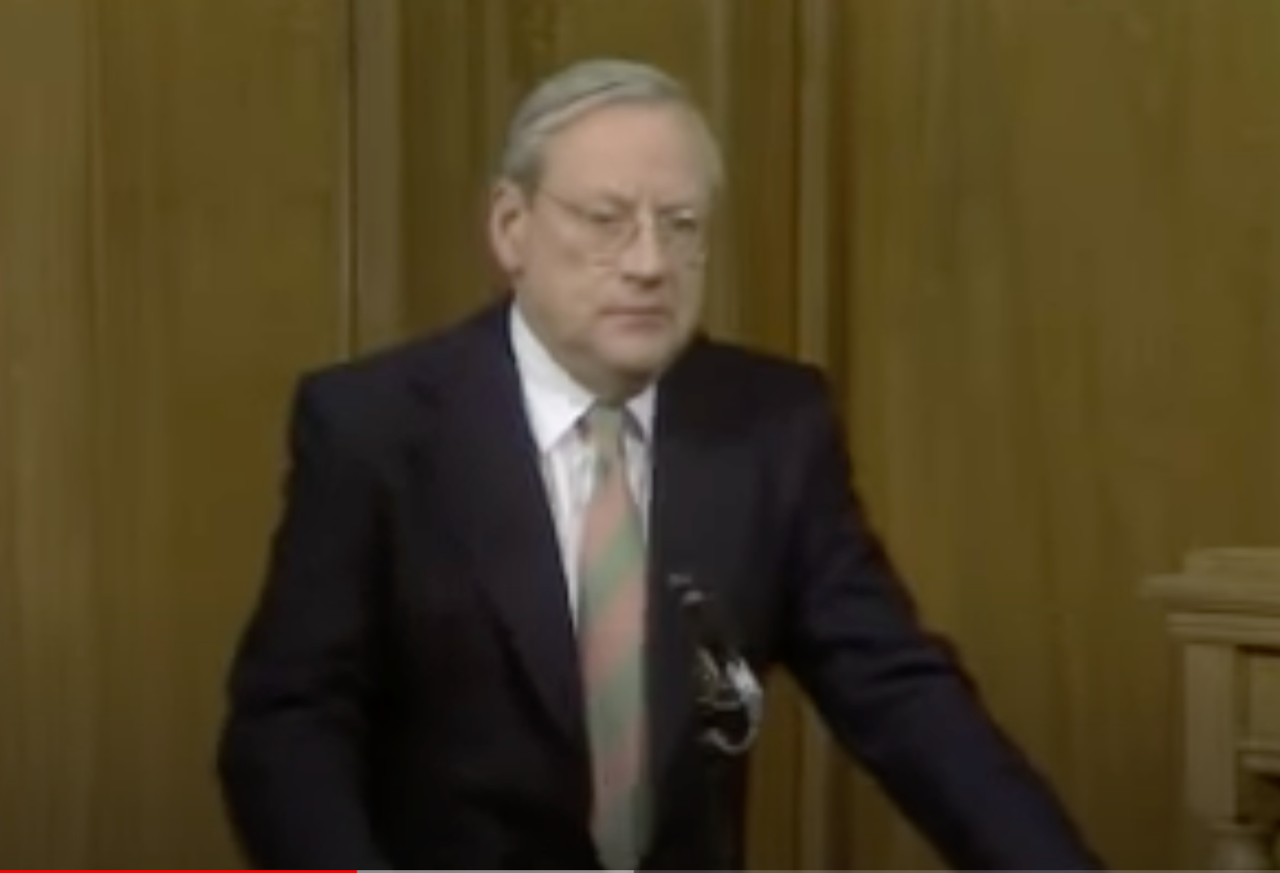
Mr Potter: Richard behaved impeccably. The reason why he has a bad reputation is that the Tudors had to say that he was being hypocritical and deceitful. If he behaved badly they would have said look how badly he behaved. Since he behaved very well they said he must be a hypocrite…. The real peculiarity of Richard is that he is the only king of England who has came from the north with northern support, his northern affinity to claim the throne. This naturally upset southerners, men of Edwards household who lost their jobs to these intruding northerners, savages from places like Yorkshire….when the Woodvilles made a pre-emptive strike for power this naturally put Richard on his mettle. It become clear that the sensible thing was that Richard should become king. A boy king would have been a disaster. Nobody wanted a boy king. It would’ve started the Civil War over again. If Richard had been made Protector he was open in two or three years time to the vengeance of the Woodvilles and not only Richard himself but everyone who has supported him.
Mr Potter touching on the pre-contract pointed out that:
Stillington was probably right. Stillington was a man of considerable importance, had been Chancellor of England for seven years under Edward IV which was the number one job equivalent to the Prime Minister today and so Stillington was very far from being a nobody. He had fallen out with Edward IV and been imprisoned at the time of Clarence’s disgrace. Some historians assume the reason for this was that Stillington told Clarence some years earlier of this pre-contract which would’ve made Clarence heir to the throne and not the boys and was the reason for Clarence’s execution.
Mr Potter also pointed out that Clarence’s heir, Edward of Warwick, was alive at the time and as attainders could be reversed was in much the same position as the ‘princes’.
Mr Potter: And what happened to Edward of Warwick? We know he was well treated by Richard , kept in Yorkshire in a royal nursery with Edward IVs daughters ,even made Richard’s heir at one time. He survived Richard’s reign quite happily but immediately after Bosworth put in the Tower of London by Henry Tudor and judicially murdered some years later. So we do know what happened to one nephew who had a very good claim to the throne, as good as the two princes once they’ve been declared illegitimate.
Further debate followed with Mr Russell questioning Mr Potter on the Hastings execution possibly without a trial.
Mr Russell: … but very much a barrack room trial over a very short space of time if it took place at all yes?
Judge: Killing without trial was not an unusual event in these days I gather
Mr Potter: No it become commoner when the Tudors were on the throne
Judge : That’s a good tu quoque if I may say so!
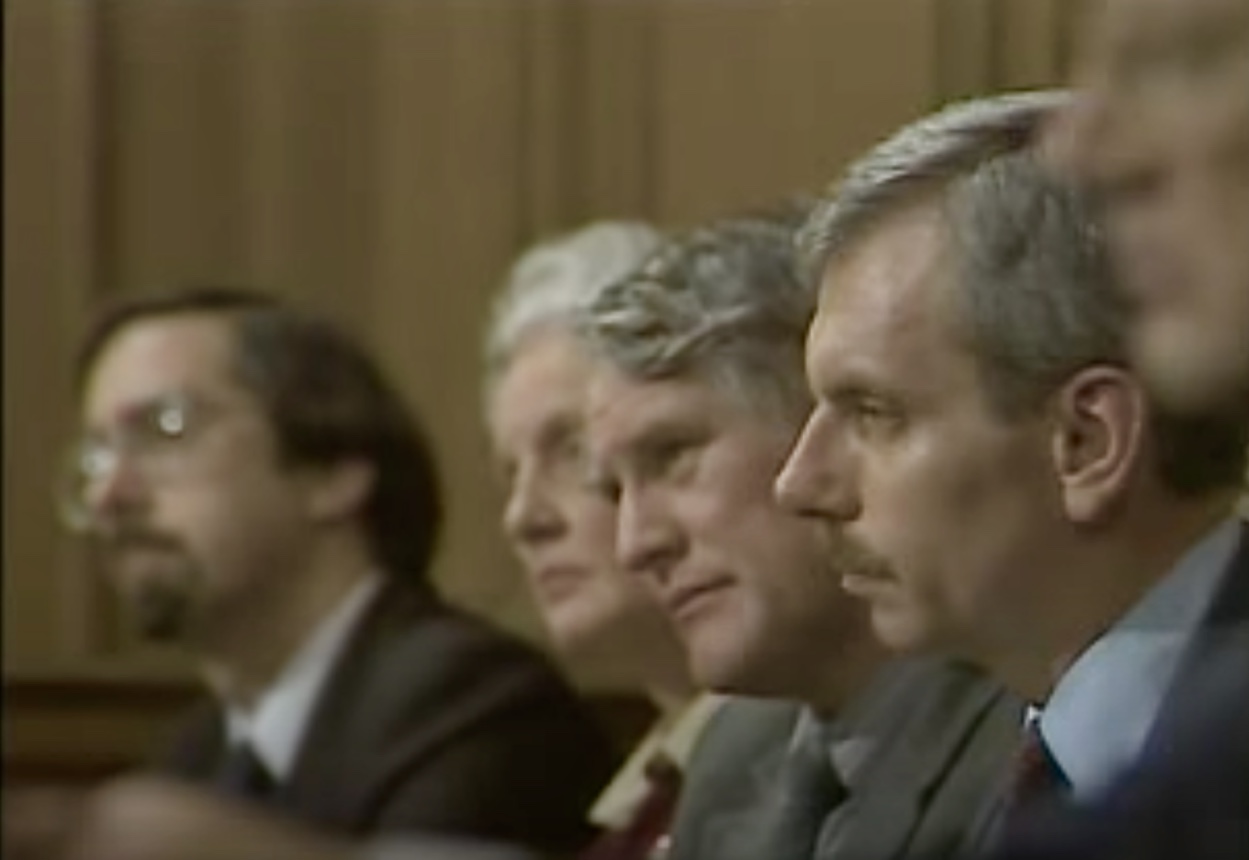
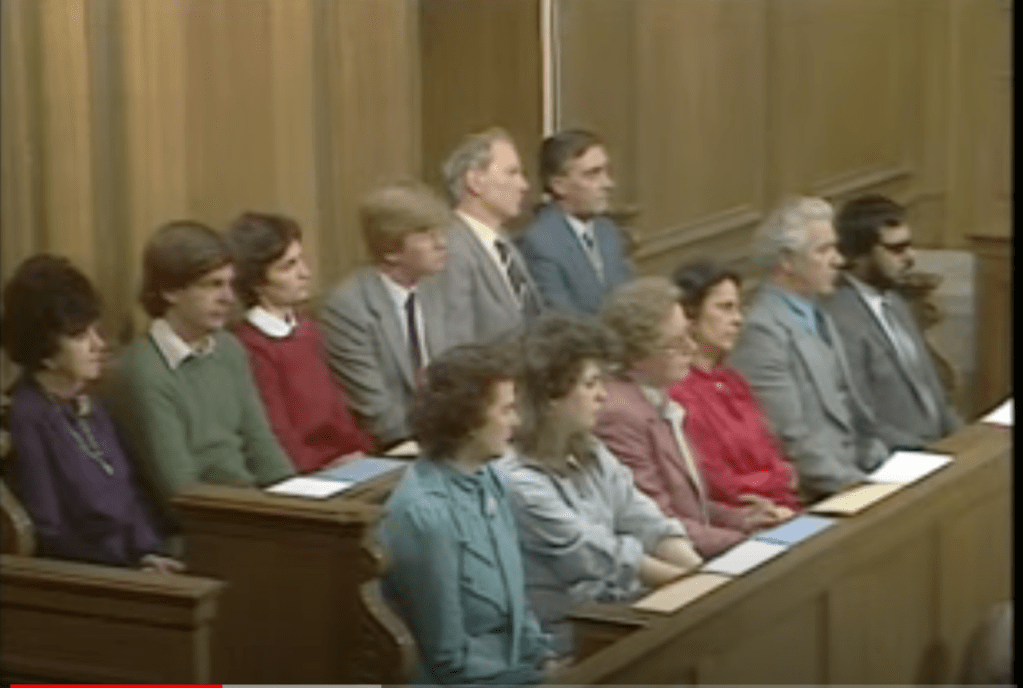
There then followed summaries by both QCs and also the Judge. The Jury were then invited to retire to consider their verdicts. Which they did. Of course they reached the right and fair verdict which was Not Guilty. Brief notes were given as to how they reached the not guilty vote including –
MR RICHARDS Traditional historical statement of events but without strong expression of belief in Richard guilt.
DR POLLARD noted Mancini could not make categorical statement re Richard’s guilt. Mancini an Italian without much knowledge of English was considered unreliable. Pre N|contract seen as decisive area debate. Little doubt cast upon marriage of Edward IV and Eleanor
DR STARKEY encouraged to shoot from the hip by defence barrister. Dynamics of confrontation overshadowed his evidence.
MISS SUTTON undermined contention that Richard III had motive for killing princes. Satisfied jury on marriage of Eleanor Butler and Edward IV. Richard’s consequent legal and moral justification in taking throne and his lack of motive for murder on grounds that the princes were bastards.
MR POTTER Established favourable impression of Richards character. General conduct appeared reasonably decent and honest. Impressive loyalty to brother, quality of rule. Elizabeth Woodville’s apparent reconciliation with Richard suggested she believed him innocent.
LADY WEDGEWOOD Compelling evidence that Richard’s portraits have been purposefully tampered with and altered over the ages to show him in a malignant light.
Factors in favour of the prosecution. Throne gave Richard strong motive to dispose of Princes. Execution of Hastings showed preparedness to be ruthless. Impossible for anyone who was not a close associate of Richard to have killed the princes while they were kept in the tower.
Factors in favour of the defence Princes might easily have been killed without Richard’s knowledge or approval. Lack of direct accusation. Richard’s general conduct. Edwards pre-contract of marriage to Eleanor Butler. General feeling that information about Richard was distorted or biased.
So there we have it. The common sense of a mixed jury from all walks of life came through and thank goodness for that.
I have to give immense thanks to Richard Drewett and Mark Redhead for their book The Trial of Richard III from which I have drawn heavily for my two posts.
Loyaulté me Lie
For those who would like to view the trial for themselves it is available on Utube
For those who have enjoyed these posts you might be interested in my post on William Lord Hastings














 A MEDIEVAL POTPOURRI